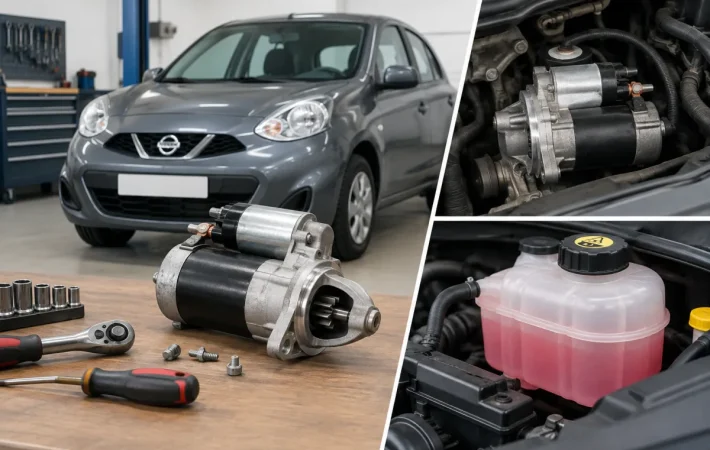
How to Repair a Starter in a Nissan Micra and Check Coolant Capacity

How to Repair a Starter in a Nissan Micra and Check Coolant Capacity

Repairing a starter on a Nissan Micra depends on the generation, engine and transmission. The available service information is most specific to the Nissan Micra K12, also known as Micra 3, produced approximately from 2002 to 2010. In many cases, replacing the complete starter is more practical than rebuilding it, because an internal repair requires the correct starter manufacturer, part number and replacement components.

Check the starting system before removing the starter

A no-crank condition does not automatically mean that the starter motor has failed. Before removing it, check the battery condition, battery terminals, engine ground connection and starter wiring. Corroded or loose connections can prevent the starter from receiving enough current.

Inspect the starter’s electrical terminals as well as the battery cables. If the battery is discharged, charge or test it before condemning the starter. Nissan also warns not to keep the starter engaged for more than 10 seconds during one starting attempt. Wait at least 10 seconds before trying again.

How to remove the starter on a Nissan Micra K12

  1. Park the vehicle securely, switch off the ignition and allow the engine to cool.
  2. Disconnect the negative battery cable. This is essential because the starter has a direct high-current connection to the battery.
  3. Locate the starter and identify the electrical connections. Depending on the engine, access may be from underneath the vehicle.
  4. Remove the starter’s S and B electrical terminals, keeping the cables marked so they can be reinstalled correctly.
  5. Support the starter and remove the upper and lower mounting bolts.
  6. Remove the starter from the vehicle. Some Micra engines require removal of additional components to create enough clearance.

Installation is carried out in the reverse order. Refit the mounting bolts securely, reconnect both electrical terminals, reconnect the negative battery cable and test the starting system.

Why the Micra engine matters

The K12 service procedures are separated by engine type, including CR, HR and K9K engines. The access route and preliminary component removal are therefore not identical on every Nissan Micra. A procedure for one engine should not be treated as a universal method for all K12 vehicles.

Confirm the model year, engine code and transmission before following a detailed removal guide. If the starter has been removed for internal repair, also confirm its manufacturer and part number. The research available supports starter removal, inspection and replacement, but not one universal internal rebuilding procedure.

Nissan Urvan Escapade radiator capacity

The phrase “Nissan Urban Escapade” may refer to the Nissan Urvan Escapade. A dependable factory figure for the radiator or total cooling-system capacity was not confirmed for this version.

Do not fill the system using a guessed capacity. The correct quantity can vary according to the model year, engine, transmission, market and whether the figure refers only to the radiator or to the complete cooling system, including the engine, hoses, heater circuit and expansion tank.

To identify the correct coolant quantity, confirm the exact Urvan Escapade year and engine, then use the vehicle-specific factory manual. When refilling, use the specified coolant, bleed trapped air according to the vehicle procedure and check the level again after the engine has cooled. A capacity figure should only be recorded once it has been verified for the exact vehicle specification.
Does the Nissan Altima Have Apple CarPlay?

Does the Nissan Altima Have Apple CarPlay?

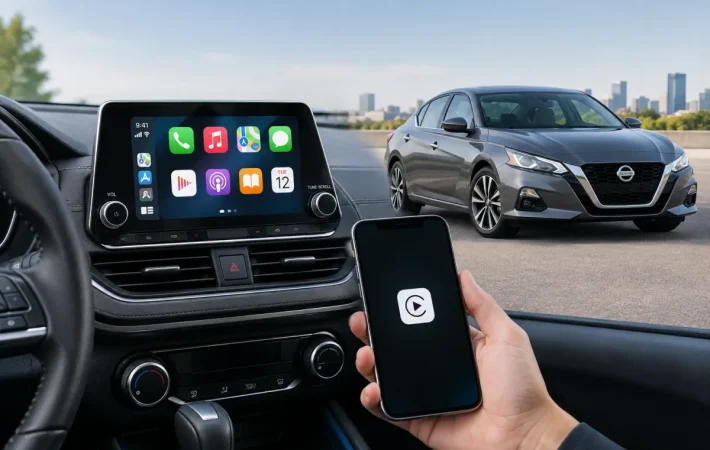
Yes, the Nissan Altima has Apple CarPlay. Availability and the connection method depend on the model year, trim level and infotainment system.

Which Nissan Altima models have Apple CarPlay?

The 2019 Nissan Altima offered standard Apple CarPlay and Android Auto integration. Apple CarPlay is also listed for the 2022 and 2023 Altima, including wireless functionality on equipped versions.

Newer Altima models continue to offer Apple CarPlay integration. For the 2026 Nissan Altima, wireless Apple CarPlay is available on selected trims or with specific equipment, while availability can vary across the lineup.

Is Apple CarPlay wired or wireless in the Altima?

Some Nissan Altima versions use a wired Apple CarPlay connection through a USB cable. NissanConnect instructions for the 2024 model describe connecting a compatible iPhone to the vehicle with a USB cable.

Wireless Apple CarPlay is available on certain Altima trims or equipped versions, particularly on newer models. The exact connection type depends on the vehicle’s model year, trim and infotainment equipment.

What does Apple CarPlay do in the Nissan Altima?

On compatible Altima systems, Apple CarPlay displays selected iPhone functions on the vehicle’s infotainment screen. These can include:

  • Navigation and maps
  • Phone calls and contacts
  • Messages
  • Music and other supported audio apps

How to check whether a specific Altima has CarPlay

  1. Identify the Altima’s model year and trim.
  2. Check whether the infotainment screen shows an Apple CarPlay option.
  3. For wired systems, connect a compatible iPhone to the vehicle’s USB port with a USB cable.
  4. For wireless-equipped systems, check the phone and Bluetooth or smartphone-connection settings in the infotainment system.

Because equipment can vary by year, trim, market and infotainment system, the vehicle’s exact specifications are needed to confirm whether Apple CarPlay is wired or wireless.

Are Nissan Xterras Reliable? Common Problems and Lifespan

Are Nissan Xterras Reliable? Common Problems and Lifespan

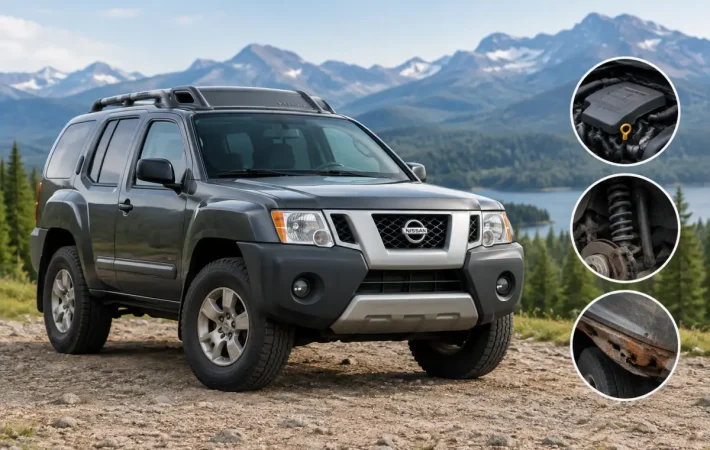
Are Nissan Xterras reliable? They can be, especially when properly maintained, but reliability varies significantly by generation, service history, corrosion exposure, drivetrain condition, and recall status. The available evidence does not establish a guaranteed lifespan or a universal mileage limit for every Xterra.

The first-generation Xterra covers model years 2000–2004, while the second generation covers 2005–2015. Before buying or keeping one, the vehicle identification number, maintenance records, rust condition, cooling system, transmission, and fuel system should be checked carefully.

Nissan Xterra reliability by generation

First-generation Xterra: 2000–2004

Early Xterras can be durable, but certain 2000–2003 vehicles were affected by a fuel-sending-unit recall. Corrosion at the fuel-sending-unit terminal could stop the fuel pump from operating, prevent the engine from starting, or cause the engine to stop while driving.

For a first-generation Xterra, inspect the fuel system and confirm that the relevant recall work was completed. Rust, cooling-system condition, drivetrain wear, and documented maintenance are also important factors because these vehicles are now older and their condition can vary widely.

Second-generation Xterra: 2005–2015

The second-generation Xterra is generally newer and offers a more modern platform, but it is not free of potential problems. Certain 2005–2014 Xterras were included in Nissan campaign P7318. The affected vehicles were identified by production date and vehicle identification number, so checking the VIN is more reliable than judging campaign status by model year alone.

NHTSA records associated with this generation include complaints involving shuddering, loss of motive power, stalling, overheating, no cabin heat, no reverse, and check-engine warnings. These records do not mean that every Xterra will develop these problems, but they show why a thorough inspection and service-history review matter.

Common Nissan Xterra problems to check

  • Fuel-system corrosion: Certain 2000–2003 Xterras had a recall related to corrosion at the fuel-sending-unit terminal.
  • Shuddering and loss of power: NHTSA investigation records included complaints of vehicle shudder, inability to maintain speed, loss of motive power, and engine stalling.
  • Overheating: Overheating and lack of cabin heat appeared among reported concerns and should be investigated before purchase.
  • Transmission and drivetrain condition: Check for warning lights, delayed engagement, unusual noises, difficulty selecting gears, and evidence of neglected fluid service.
  • Rust and corrosion: Corrosion can affect the fuel system, frame-related areas, brake components, and other structural or mechanical parts, particularly in regions where road salt is used.
  • Uncompleted recalls or campaigns: A vehicle’s exact VIN should be checked rather than relying only on its model year.

How long can a Nissan Xterra last?

Official sources do not provide a statistically valid average lifespan or a guaranteed maximum mileage for all Xterras. Longevity depends on regular maintenance, driving conditions, corrosion, drivetrain condition, accident history, and the quality of previous repairs.

NHTSA records for the investigated issue set reported an average mileage of approximately 106,482 miles when complaints were filed. This is not a lifespan estimate and should not be treated as a mileage limit. It only indicates the mileage recorded in those complaints.

A well-maintained Xterra with minimal corrosion and complete service records may remain useful for many years, while a lower-mileage vehicle with neglected fluids, overheating, rust, or unresolved recall work may require expensive repairs sooner.

What to check before buying a used Xterra

  1. Obtain the vehicle identification number and search for open recalls and campaigns.
  2. Review maintenance records for oil, cooling-system, brake, transmission, transfer-case, and differential service.
  3. Inspect the underbody, fuel-system areas, frame-related components, brake lines, and suspension for corrosion.
  4. Test-drive the vehicle for shuddering, loss of power, overheating, warning lights, transmission issues, and abnormal drivetrain noises.
  5. Check for a functioning heater and confirm that the engine reaches and maintains normal operating temperature.
  6. Have an independent mechanic inspect the vehicle before purchase, especially when service records are incomplete.

How to verify recalls and maintenance requirements

The NHTSA recalls database can be searched by VIN, license plate, or vehicle year, make, and model. A VIN search is necessary to determine whether a specific Xterra has an unrepaired recall. NHTSA lists its vehicle-safety resource at 1200 New Jersey Avenue SE, Washington, DC 20590, with the phone number 1-888-327-4236.

Nissan’s official maintenance resources provide schedules based on the vehicle configuration, mileage, driving conditions, and VIN. Nissan’s maintenance assistance phone number is 1-800-647-7261. The owner’s manual and vehicle-specific service schedule should be used to confirm the required fluid, transmission, cooling, brake, and drivetrain maintenance.

Are Nissan Xterras reliable overall?

Nissan Xterras can be reliable used SUVs when they have a strong maintenance history, limited corrosion, a healthy cooling system, and verified recall status. Reliability is less predictable when the vehicle has overheating symptoms, drivetrain complaints, missing service records, serious rust, or unresolved campaigns.

The safest assessment is therefore vehicle-specific rather than based only on the Xterra nameplate or model year. A well-inspected example may be a sound choice, while an otherwise attractive Xterra with neglected maintenance or major corrosion can become costly to own.

What Does SV Stand for on a Nissan? Understanding SV and SR Trims

What Does SV Stand for on a Nissan? Understanding SV and SR Trims

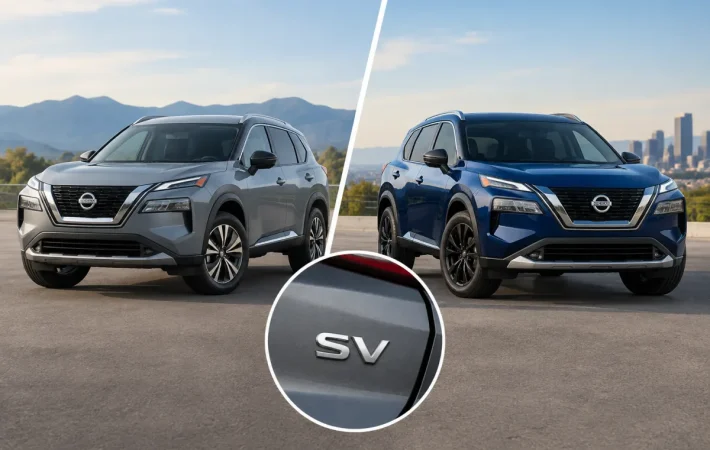
Nissan uses SV and SR as trim-level designations. They identify different equipment packages, but Nissan does not consistently define either abbreviation as one universal phrase across every model and model year.

What does SV stand for on a Nissan?

In practice, SV usually marks a Nissan trim positioned above the entry-level S model. It generally adds more convenience, technology, and comfort features than the base version.

Depending on the Nissan model and year, an SV trim may include upgraded interior equipment, additional driver-assistance technology, improved connectivity, or convenience features. The exact package varies, so the vehicle’s original specifications should be checked before comparing two Nissan models.

Although SV is sometimes given an unofficial expansion such as “Special Value,” Nissan’s reviewed official materials do not confirm one fixed meaning for the abbreviation across all vehicles.

What does SR stand for on a Nissan?

SR generally identifies a sport-oriented Nissan trim. It commonly emphasizes sportier styling or equipment rather than simply adding comfort and convenience features.

Depending on the model and model year, an SR version may feature items such as sport-tuned suspension, a spoiler, sport seats, special wheels, or dark exterior accents. Not every SR trim includes the same equipment, and the designation does not have one confirmed universal expansion in Nissan’s official materials.

SV vs. SR: what is the difference?

  • SV: Usually a better-equipped everyday trim with added comfort, convenience, and technology features.
  • SR: Usually a sportier-looking or sport-focused trim with styling or driving-oriented equipment.
  • S: Often the entry-level trim, although the lineup differs by Nissan model and year.

An SV is often the practical choice for shoppers prioritizing features and daily comfort. An SR may appeal more to buyers who prefer sportier styling or equipment. Neither badge has exactly the same specifications on every Nissan vehicle.

How to identify the exact Nissan trim

To determine what an SV or SR includes, check the specific Nissan model, model year, and market. Compare the vehicle’s original window sticker, brochure, owner documentation, or official specifications rather than relying only on the badge.

The most accurate interpretation is that SV usually means a more feature-rich trim, while SR usually means a sport-oriented trim. The equipment list for that particular vehicle determines the real difference.

What Is Nissan Customer Cash? Incentives and Discounts Explained

What Is Nissan Customer Cash? Incentives and Discounts Explained

Nissan customer cash is a manufacturer or program incentive that can reduce the amount paid for an eligible Nissan vehicle or qualifying Nissan products and services. In Nissan’s official offer system, cash is listed separately from APR financing, lease offers, and MSRP information.

There is no single nationwide customer-cash amount. The available incentive depends on the Nissan model, model year, ZIP code, local participating dealer, offer period, and the conditions stated in the offer disclosure.

How Nissan customer cash works

A vehicle customer-cash offer generally works as a discount applied to an eligible purchase. The incentive may reduce the vehicle’s negotiated price or the amount used to calculate the final transaction, subject to the offer’s terms.

Nissan’s official shopping tools use information such as the vehicle, model year, ZIP code, and local Nissan retailer to display available offers. Incentives can vary by model, location, sales event, and dealer.

How it differs from financing and lease offers

  • Customer cash: A purchase incentive that may reduce the cost of an eligible vehicle.
  • APR offer: Special financing terms, which may require approval through Nissan Motor Acceptance Company and may not be combined with a cash incentive.
  • Lease offer: Terms for leasing a qualifying vehicle rather than purchasing it.

Because Nissan lists cash, APR, and lease offers as separate categories, a buyer should not assume that every incentive can be combined with every financing or leasing option. The specific offer disclosure determines whether stacking is permitted.

What determines eligibility?

Eligibility and the incentive amount may depend on:

  • the Nissan model and model year;
  • the buyer’s ZIP code and location;
  • the participating Nissan dealer;
  • the offer’s start and expiration dates;
  • vehicle availability;
  • required financing or other purchase conditions; and
  • whether the offer may be combined with other Nissan or dealer incentives.

Nissan’s sales-event offers may include incentives, special financing, or lease terms on select vehicles. Availability varies by model, location, and event, so the current offer disclosure is more reliable than a general advertised amount.

How to verify a Nissan customer-cash offer

  1. Select the Nissan model and model year you are considering.
  2. Enter the ZIP code for the area where you plan to buy.
  3. Review the offers shown for the local Nissan retailer.
  4. Read the disclosure for the exact incentive amount, eligibility rules, expiration date, and combination restrictions.
  5. Ask the participating dealer to confirm that the offer applies to the specific vehicle identification number and transaction.

Nissan USA is the official source for the manufacturer’s vehicle offers. The final price should also reflect the dealer’s pricing, taxes, fees, registration costs, and any separately negotiated discount.

MyNISSAN Rewards customer cash

Nissan also uses the phrase “customer cash” in its MyNISSAN Rewards program. In that context, eligible reward points can be redeemed for Genuine Nissan Service, Parts and Accessories, or the purchase of a new Nissan vehicle at participating dealerships.

Nissan states that one eligible MyNISSAN Rewards point equals one dollar in customer cash for qualifying redemptions. These points are not general cash and can be used only for the purposes allowed by the program. Dealer participation varies, and Sales Dollars are not offered by all dealerships or valid in every state.

Questions about MyNISSAN Rewards can be directed to Nissan at 1-800-326-9108. Before relying on a points balance, confirm that the dealer participates and that the intended purchase or service qualifies.

What to check before accepting the discount

  • Confirm that the cash offer applies to the exact model and vehicle you want.
  • Check whether the offer requires Nissan financing or excludes certain financing methods.
  • Verify the expiration date and any residency or regional restrictions.
  • Ask whether the incentive can be combined with loyalty, conquest, dealer, or other promotional discounts.
  • Compare the total purchase cost, not just the advertised cash amount.

The exact meaning of Nissan customer cash depends on the context: it may be a vehicle purchase incentive shown in Nissan’s offer system or the dollar value of eligible MyNISSAN Rewards points. In both cases, the applicable disclosure and participating dealer determine the final eligibility and value.

Where Is Nissan Stadium? Location, Capacity, and Roof Guide

Where Is Nissan Stadium? Location, Capacity, and Roof Guide

Nissan Stadium is located at One Titans Way, Nashville, Tennessee 37213. It is the Nashville home venue associated with the Tennessee Titans.

Nissan Stadium address and contact

  • Address: One Titans Way, Nashville, TN 37213
  • Phone: 615-565-4300
  • City: Nashville, Tennessee

Is Nissan Stadium covered?

The answer depends on which stadium is being discussed. The new Nissan Stadium planned to open in 2027 is designed with a circular, translucent ETFE roof. The roof will cover the field and provide protection from rain.

Available official information does not verify that the existing Nissan Stadium has a retractable or permanent roof. The current venue and the planned 2027 stadium should therefore be treated as separate facilities when discussing roof coverage.

How many people does Nissan Stadium hold?

The new Nissan Stadium planned for 2027 is expected to have an overall capacity of approximately 60,000 people. Official event information also states that the new stadium can accommodate up to 50,000 guests for major events.

The exact seating capacity of the existing Nissan Stadium was not verified in the available official information, so the planned 60,000-person capacity should not be presented as the capacity of the current facility.

Current and planned Nissan Stadium

Nissan Stadium is in Nashville, while the new Nissan Stadium is a planned replacement venue scheduled to open in 2027. Capacity and roof details associated with the new building do not necessarily describe the existing stadium at One Titans Way.

What Is the Fastest Nissan? Performance Models Compared

What Is the Fastest Nissan? Performance Models Compared

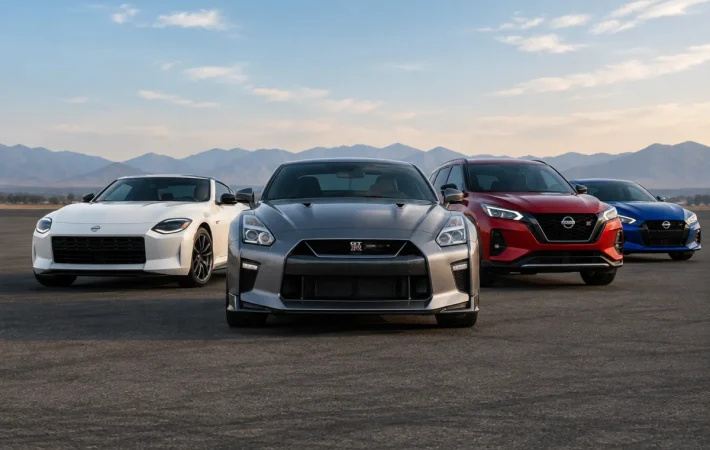
The 2024 Nissan GT-R NISMO is the best-supported answer to “what is the fastest Nissan?” when comparing factory Nissan road cars by power and performance position. Its twin-turbocharged engine produces 600 horsepower, placing it above the standard Nissan GT-R and the 2025 Nissan Z NISMO in Nissan’s performance range.

2024 Nissan GT-R NISMO

The 2024 Nissan GT-R NISMO is Nissan’s highest-performance version of the GT-R. Nissan describes it as a track-born, road-ready performance coupe, and its 600-horsepower engine makes it the most powerful model in this comparison.

  • Power: 600 horsepower
  • Position: Highest-performance expression of the GT-R range
  • Type: Performance coupe
  • Performance focus: Track-inspired aerodynamics, suspension tuning and engineering

How the Nissan performance models compare

Nissan GT-R

The standard Nissan GT-R uses a twin-turbocharged 3.8-liter V6 engine and serves as one of Nissan’s flagship sports cars. It has less power than the 600-horsepower GT-R NISMO, so the NISMO version remains the stronger factory performance choice.

2025 Nissan Z NISMO

The 2025 Nissan Z NISMO is a rear-wheel-drive sports coupe with a NISMO-tuned 3.0-liter twin-turbocharged V6. Nissan rates it at 420 horsepower and 384 lb-ft of torque. The NISMO version uses a 9-speed automatic transmission as standard.

  • Power: 420 horsepower
  • Torque: 384 lb-ft
  • Engine: NISMO-tuned 3.0-liter twin-turbocharged V6
  • Drivetrain: Rear-wheel drive
  • Transmission: 9-speed automatic

Nissan Z Performance

The Nissan Z Performance is a lower-output alternative within the Z lineup. It remains a rear-wheel-drive sports car, but it is not the fastest Nissan performance model based on the official horsepower figures available for comparison.

Is the GT-R NISMO the fastest Nissan by top speed?

The available official Nissan information confirms that the 2024 GT-R NISMO is the most powerful model in this comparison, but it does not provide a complete, directly comparable top-speed table for the GT-R NISMO, standard GT-R and Z NISMO. Therefore, the clearest supported answer is that the GT-R NISMO is the fastest Nissan when “fastest” refers to factory horsepower and performance ranking, rather than a verified top-speed record.

Fastest Nissan models at a glance

  • 2024 Nissan GT-R NISMO: 600 horsepower and the top performance position
  • 2025 Nissan Z NISMO: 420 horsepower and 384 lb-ft of torque
  • Nissan GT-R: Standard GT-R model with less power than the GT-R NISMO
  • Nissan Z Performance: Lower-output rear-wheel-drive Z model
How to Set Cruise Control on a Nissan Rogue

How to Set Cruise Control on a Nissan Rogue

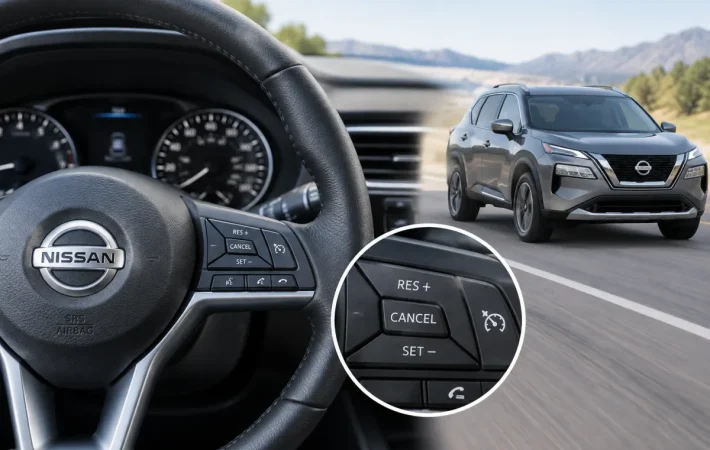
The steps for setting cruise control on a Nissan Rogue vary slightly by model year and equipment. Conventional systems use buttons labeled CRUISE ON/OFF, SET/−, RES/+, and CANCEL. Some newer Rogue vehicles may also have Intelligent Cruise Control or ProPILOT Assist.

How to set conventional cruise control

  1. Press the CRUISE ON/OFF button on the steering wheel. The cruise-control indicator should appear on the instrument panel.
  2. Accelerate to the speed you want to maintain.
  3. Press and release SET/−.
  4. Take your foot off the accelerator. The Rogue should maintain the selected speed.

On some Rogue models, the cruise indicator is gray when the system is switched on and turns green after a cruising speed has been set.

How to adjust the set speed

  • Press SET/− briefly to decrease the set speed in small increments.
  • Press RES/+ briefly to increase the set speed in small increments.
  • Hold SET/− or RES/+ to change the speed continuously, then release the button at the desired speed.

How to cancel cruise control

Press the CANCEL button or lightly press the brake pedal. This cancels the active cruising speed without necessarily switching the entire cruise-control system off.

To turn the system off completely, press CRUISE ON/OFF.

How to resume the previous speed

After canceling cruise control, press RES/+ when the vehicle is traveling at a suitable operating speed. The Rogue can then return to the previously selected speed. The exact minimum operating speed depends on the model year and system.

Intelligent Cruise Control and ProPILOT Assist

Some Nissan Rogue trims have Intelligent Cruise Control, and some may include ProPILOT Assist. These systems can use radar and other driver-assistance functions to help maintain following distance and, depending on the vehicle, manage stop-and-go traffic.

The controls and activation sequence may differ from conventional fixed-speed cruise control. Check the owner’s manual for the specific Rogue model year before using these features.

When not to use cruise control

Nissan advises against using cruise control in heavy traffic, on winding or hilly roads, or on slippery road surfaces. The driver must continue to monitor traffic, road conditions, and vehicle speed at all times.

Find the correct Nissan Rogue manual

Nissan provides vehicle-specific manuals through its official Manuals & Guides resource. The 2017 and 2019 Rogue owner’s manuals describe the conventional controls and procedures, but the manual for the exact model year and trim should take priority because equipment and button labels can differ.

For Nissan owner support, Nissan lists Consumer Affairs at 1-800-647-7261.

Is the Nissan Versa a Good Car? Versa vs. Murano Buying Guide

Is the Nissan Versa a Good Car? Versa vs. Murano Buying Guide

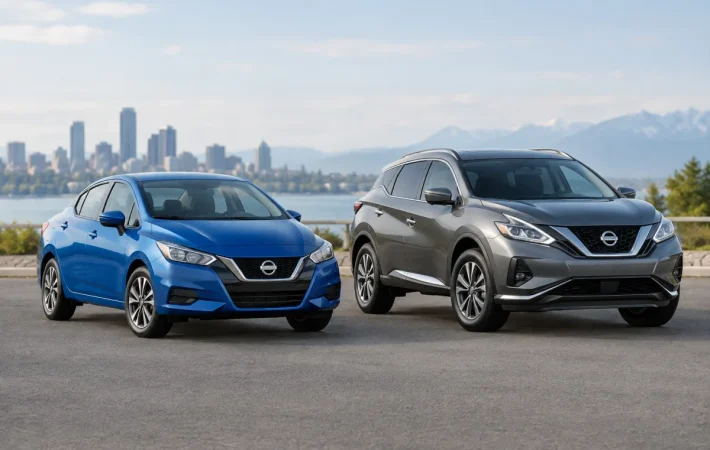
The Nissan Versa is a good choice for buyers who want a low-cost compact sedan, practical transportation, and a strong quality-and-reliability rating for its class. The Nissan Murano is a very different vehicle: it offers more space, power, comfort, and features, but costs substantially more and has weaker early reliability feedback.

Is the Nissan Versa a good car?

For budget-conscious drivers, the 2025 Nissan Versa is a reasonable new-car choice. Consumer Reports expects its reliability to be about average compared with other new cars, while J.D. Power gave the Versa an 87 out of 100 quality-and-reliability score. J.D. Power also ranked it first among small cars in its 2025 ratings.

The Versa is best suited to commuting, city driving, and buyers who value a low purchase price. It is a compact sedan rather than a spacious family SUV, so passenger and cargo capacity are more limited than in the Murano.

How much is a Nissan Versa?

The current Nissan U.S. vehicle listing shows the Versa starting at $17,390. Consumer Reports lists a 2025 Nissan Versa base MSRP range of $17,390 to $21,390, before the $1,195 destination charge.

The final amount can vary by trim, equipment, dealer pricing, incentives, taxes, registration, and financing. Actual transaction prices and current dealer offers were not verified in the available research.

Are Nissan Versa good cars for reliability?

The available ratings point to a generally competitive reliability outlook rather than exceptional, proven long-term durability. Consumer Reports places expected reliability around the class average, while J.D. Power’s 87/100 score is a strong result for quality and reliability.

  • Good fit: buyers seeking inexpensive basic transportation.
  • Reliability picture: average predicted reliability from Consumer Reports and a strong J.D. Power rating.
  • Ownership decision: compare the specific trim, warranty, service history, and total purchase cost before buying.

Used Versa reliability can differ significantly by model year, mileage, maintenance history, and powertrain. The available information does not provide a complete year-by-year guide.

Is the Nissan Murano a good car?

The Nissan Murano can be a good choice for shoppers who prioritize a comfortable midsize two-row SUV with more power and space than the Versa. However, its reliability outlook is less reassuring, especially because the current generation is relatively new.

The 2025 Murano was a major redesign year. Nissan replaced the previous generation’s V6 engine and continuously variable transmission with a turbocharged four-cylinder engine and a nine-speed automatic transmission. J.D. Power gave the 2025 Murano a 77/100 quality-and-reliability score, described as average, but its driving-experience score was a much stronger 92/100.

Consumer Reports describes the redesigned 2025 Murano as having below-average predicted reliability and reports concerns involving powertrain behavior and in-car electronics. Long-term reliability data for the redesigned 2025 and 2026 models remains limited.

How much is the 2026 Nissan Murano?

The 2026 Nissan Murano is offered in three trims, with official starting MSRPs before destination charges:

  • Murano SV: $41,670
  • Murano SL: $46,760
  • Murano Platinum: $49,800

The 2026 Murano uses a 241-horsepower turbocharged engine and is rated at up to 21 mpg in the city and 27 mpg on the highway. It is aimed at buyers who want a more refined, better-equipped SUV rather than the lowest possible purchase price.

Nissan Versa vs. Nissan Murano

Category Nissan Versa Nissan Murano
Vehicle type Compact sedan Midsize two-row SUV
Starting price information $17,390 listed for the current Nissan U.S. vehicle lineup $41,670 for the 2026 SV before destination charges
Reliability information Average predicted reliability; 87/100 J.D. Power quality-and-reliability score for 2025 Below-average predicted reliability reported for 2025 by Consumer Reports; 77/100 J.D. Power quality-and-reliability score
Strength Low cost and practical transportation Comfort, power, space, and driving experience
Best for Commuters and budget-focused buyers Buyers seeking a larger, more feature-focused SUV

Which Nissan should you buy?

Choose the Nissan Versa if keeping the purchase price low is the priority and a compact sedan meets your space needs. Its 2025 reliability results are competitive, particularly the 87/100 J.D. Power quality-and-reliability score.

Choose the Nissan Murano if you need a midsize SUV and place greater importance on comfort, power, and features than on the lowest price or strongest available reliability outlook. The Murano’s 92/100 driving-experience score is a positive, but its average J.D. Power reliability rating and below-average Consumer Reports prediction warrant careful consideration.

For either model, compare the exact trim and equipment, verify the vehicle’s maintenance history when buying used, and account for taxes, insurance, fuel, financing, and destination charges. The available research does not verify current dealer incentives, transaction prices, insurance costs, or maintenance estimates.

Are Nissan Titans Reliable? Reliability, Towing, and the Model’s Future

Are Nissan Titans Reliable? Reliability, Towing, and the Model’s Future

Are Nissan Titans reliable? The answer is generally positive for the final model years, but reliability depends heavily on the specific truck’s maintenance history, mileage, recalls, and drivetrain condition. The 2024 Nissan Titan earned a strong reliability score from J.D. Power, although Consumer Reports does not provide a current overall reliability prediction for that model.

The Nissan Titan is also no longer produced. Nissan ended Titan production after the 2024 model year, so buyers are now choosing from used inventory rather than waiting for a confirmed new-generation replacement.

How reliable is the 2024 Nissan Titan?

J.D. Power gave the 2024 Nissan Titan a Quality & Reliability score of 81 out of 100, classified as “Great.” Its overall Consumer Rating was 82 out of 100. The reliability score is based on owner opinions about defects, malfunctions, and design flaws.

Consumer Reports lists the 2024 Titan’s reliability rating as unavailable. Its reliability data normally comes from subscriber surveys covering systems such as the engine, transmission, brakes, electrical equipment, and vehicle equipment. This means the available sources do not provide a complete consensus, but there is no research-based reason to label every Titan unreliable.

Are Nissan Titans good trucks?

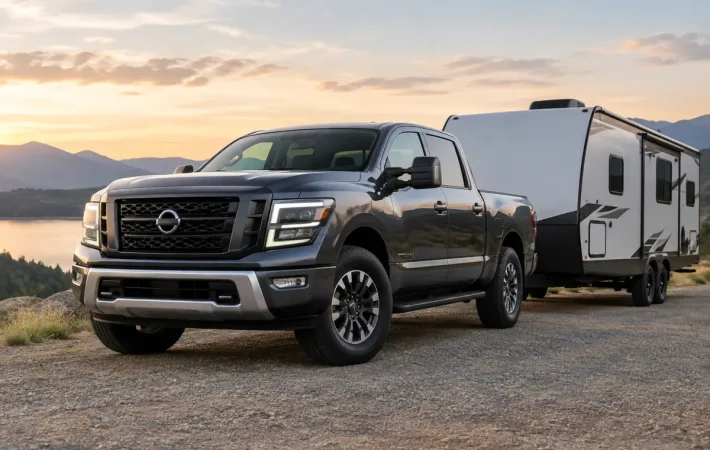
Yes, the Nissan Titan is a capable full-size truck, particularly for buyers who want strong V8 power and substantial towing ability. The final Titan used a 5.6-liter V8 producing 400 horsepower and 413 lb-ft of torque.

  • The Titan was rated to tow up to 9,290 pounds.
  • The Titan XD was rated to tow up to 11,050 pounds.
  • The V8 provided the power expected from a full-size pickup.
  • The truck’s final model years received competitive owner-reported quality ratings.

Towing capacity varies by configuration, equipment, cab style, drivetrain, and trailer setup. Buyers should verify the specific truck’s factory rating rather than applying the maximum figure to every Titan.

What should used Nissan Titan buyers check?

Because the Titan has been discontinued, condition and documentation are especially important when shopping for one. A used Titan with complete service records may be a sensible purchase, while an inexpensive truck with neglected maintenance can carry substantially more risk.

  1. Check the vehicle identification number. Confirm open and completed recalls through an official Nissan dealer or the National Highway Traffic Safety Administration.
  2. Review maintenance records. Look for evidence of regular servicing and repairs, especially on higher-mileage trucks.
  3. Inspect the engine and transmission. A pre-purchase inspection should look for leaks, warning lights, unusual noises, shifting problems, and signs of neglected drivetrain maintenance.
  4. Evaluate the towing equipment. Confirm the tow package, hitch, brake controller, cooling equipment, and the truck’s exact rating if towing is a priority.
  5. Check parts and service access. Discontinuation does not automatically make a Titan unreliable, but local dealer and independent-shop support should be considered before purchase.

2024 Nissan Titan recall information

Certain 2024 Nissan Titan vehicles were included in NHTSA recall 24V-154. The recall involved the driver’s airbag inflator, which could deploy improperly and reduce occupant protection in a crash. The recall report listed 351 potentially affected vehicles across the included Nissan and Infiniti models.

Recall status is tied to the vehicle identification number. A buyer should confirm that any applicable repair has been completed before purchasing or driving the truck.

Does the Nissan warranty help with used Titan ownership?

The 2024 Nissan new-vehicle warranty included basic coverage for 36 months or 36,000 miles and powertrain coverage for 60 months or 60,000 miles, whichever came first. An eligible late-model used Titan may still have remaining coverage, but this depends on the vehicle’s in-service date, mileage, warranty terms, and exclusions.

Warranty status should be verified using the vehicle identification number and the original in-service date. Buyers should not assume that every used 2024 Titan still has active coverage.

Is the Nissan Titan being replaced?

Nissan identified 2024 as the Titan’s final production year. The available official information does not confirm a replacement or successor. The end of production is a model-line decision and does not, by itself, prove that the Titan had poor reliability.

For buyers, the main practical effect is that the Titan is now a used-truck purchase. Availability of parts, qualified service, recall support, and the condition of individual vehicles matter more than simply choosing the newest model year.

Are Nissan Titans reliable enough to buy?

A well-maintained Nissan Titan can be a reasonable used full-size pickup, especially for buyers who value its V8 performance and towing capability. The 2024 model has a J.D. Power Quality & Reliability score of 81 out of 100, but Consumer Reports does not provide a current overall prediction, so buyers should avoid treating one rating as a guarantee.

The safest choice is a Titan with documented maintenance, a clean inspection, verified recall completion, and a configuration that matches the intended towing or hauling job. The truck’s discontinued status should prompt careful due diligence, not an automatic assumption that it is unreliable.

What Are They Building Next to Nissan Stadium?

What Are They Building Next to Nissan Stadium?

The major project being built next to the current Nissan Stadium in Nashville is a new enclosed stadium for the Tennessee Titans. It is rising directly east of the existing stadium on the East Bank of the Cumberland River.

New Nissan Stadium

The new Nissan Stadium will become the Titans’ home venue. Construction is expected to be completed in February 2027. The project is being built beside the current stadium rather than at a separate location.

After the new stadium is completed, Nashville plans to demolish the existing Nissan Stadium. The current site is expected to become part of the next phase of the East Bank redevelopment.

What else is planned for the East Bank?

The stadium is part of a much larger waterfront redevelopment called the East Bank Development. The broader plan covers Metro-owned land and the Central Waterfront area around the stadium.

  • Public parks and greenways
  • A future waterfront park on the current Nissan Stadium site
  • Affordable housing and other neighborhood development
  • New businesses and mixed-use areas
  • Transportation improvements

Future East Bank Waterfront Park

A new waterfront park is planned for the site of the current Nissan Stadium after the existing venue is demolished. The park is part of the city’s long-term plan to create more public space along the Cumberland River.

Who is coordinating the wider redevelopment?

The East Bank Development Authority coordinates and supports planning for the broader redevelopment. The authority’s projects are anchored by the new Nissan Stadium, Oracle’s campus, Eastpoint and planned civic and neighborhood improvements.

Location

The new stadium and surrounding redevelopment are located on Nashville’s East Bank of the Cumberland River, directly east of the current Nissan Stadium. The final list of private buildings, restaurants, retail spaces and residential projects around the stadium has not been fully published.

What Is NissanConnect? Nissan Hybrids and CVT History Explained

What Is NissanConnect? Nissan Hybrids and CVT History Explained

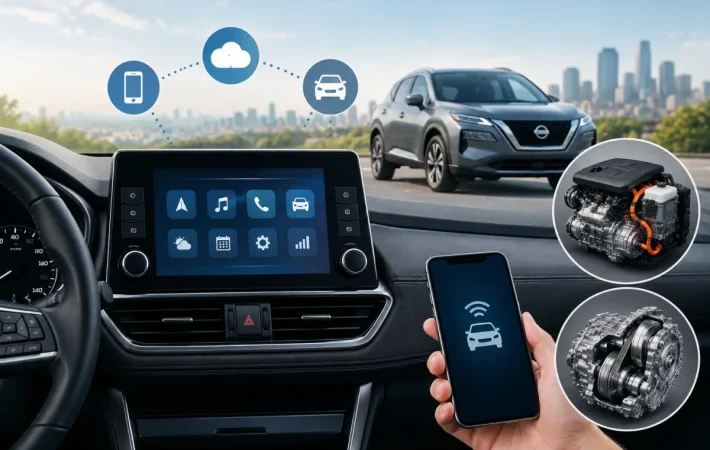
NissanConnect is Nissan’s connected-vehicle technology suite. Depending on the Nissan model, trim, and model year, it can link the vehicle with a smartphone and provide remote functions, maintenance alerts, navigation, safety services, and vehicle-status information.

What is NissanConnect?

NissanConnect combines in-car technology with connected services and smartphone features. Available functions vary, but may include:

  • Apple CarPlay and Android Auto
  • Google built-in on supported vehicles
  • Remote engine start
  • Remote locking and unlocking
  • Vehicle location information
  • Maintenance and vehicle-status alerts
  • Navigation and convenience features
  • Roadside assistance and emergency services

Some features require enrollment in NissanConnect Services. Nissan may provide a trial period, followed by a paid subscription. Trial length, pricing, compatibility, and available functions depend on the vehicle, trim, model year, and market. NissanConnect Services support is available at 1-855-426-6628.

Does Nissan make a hybrid?

Yes. Nissan makes hybrid and plug-in hybrid vehicles. In the U.S. lineup, Nissan lists the 2026 Nissan Rogue Plug-in Hybrid and has announced the 2027 Nissan Rogue Hybrid with e-POWER.

2026 Nissan Rogue Plug-in Hybrid

The 2026 Rogue Plug-in Hybrid is an electrified SUV listed by Nissan USA. As a plug-in hybrid, it differs from a conventional hybrid because its battery can be charged from an external power source.

2027 Nissan Rogue Hybrid e-POWER

Nissan describes the 2027 Rogue Hybrid as an upcoming U.S. model using the company’s e-POWER technology. Nissan identifies it as its first hybrid of this kind in the U.S. Because it is an announced future model, final specifications, pricing, release timing, and availability should be checked against Nissan’s latest information.

Does Nissan have a hybrid SUV?

Yes. The 2026 Nissan Rogue Plug-in Hybrid is listed as a hybrid SUV, and the announced 2027 Nissan Rogue Hybrid will also be an electrified SUV. These vehicles should not be treated as identical: the 2026 model is a plug-in hybrid, while the 2027 model is announced with Nissan e-POWER technology.

When did Nissan start using CVT?

Nissan began using continuously variable transmission technology in 1992. Nissan’s heritage materials state that the company adopted the N-CVT as standard on the March, also known as the Micra, in January 1992.

A CVT changes gear ratios continuously rather than shifting through a fixed set of conventional gears. Nissan later expanded its CVT technology, including the introduction of a CVT for front-wheel-drive vehicles with engines in the 2.0-liter class in 1997.

The 1992 adoption does not mean that every Nissan model introduced afterward used a CVT. Transmission type depends on the specific vehicle, engine, drivetrain, model year, and market.

How NissanConnect, hybrids, and CVTs differ

  • NissanConnect: connected vehicle technology and services.
  • Hybrid: a vehicle powertrain that combines an internal-combustion engine with electric drive technology.
  • Plug-in hybrid: a hybrid with a battery that can be charged from an external power source.
  • CVT: a transmission that provides continuously variable gear ratios.
Does the Nissan Pathfinder Have a Third Row?

Does the Nissan Pathfinder Have a Third Row?

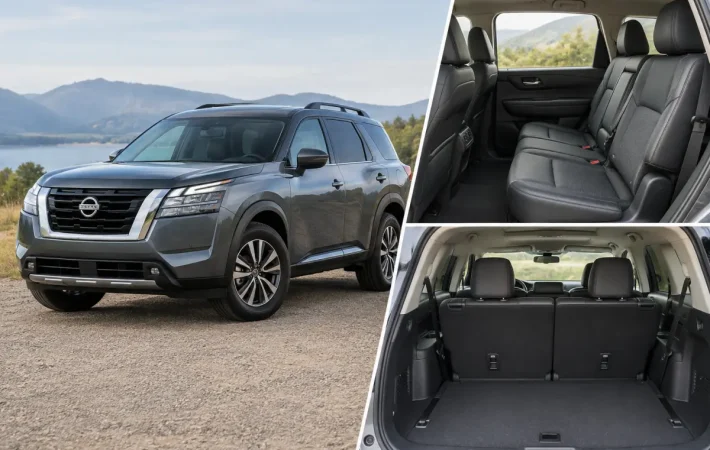
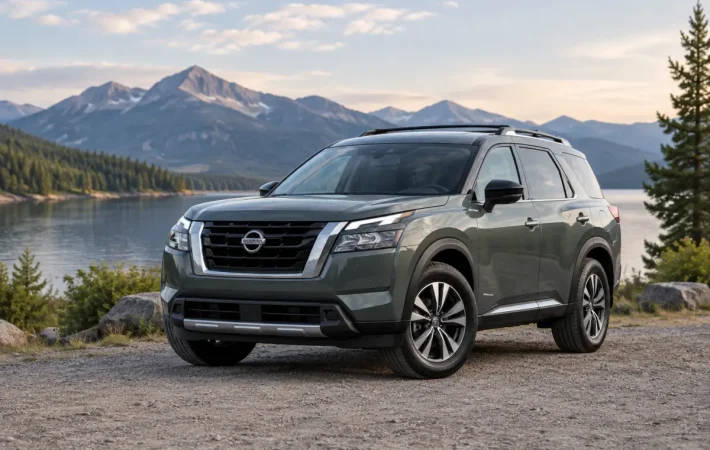
Yes. The Nissan Pathfinder is a three-row SUV with seating for passengers in the front, second and third rows.

How many people can the Nissan Pathfinder seat?

The 2026 Nissan Pathfinder seats up to eight people with its standard second-row bench seat. Models equipped with available second-row captain’s chairs seat up to seven.

  • Eight passengers: front-row seats, a second-row bench and a third-row bench.
  • Seven passengers: front-row seats, second-row captain’s chairs and a third-row bench.

What is the Pathfinder’s third row like?

The 2026 Pathfinder has a reclining and folding 60/40-split third-row bench seat. It provides 28 inches of third-row legroom and can be folded to create additional cargo space when the full passenger capacity is not needed.

Does every Nissan Pathfinder have a third row?

The current 2026 Nissan Pathfinder lineup has three rows of seating. Seating equipment and passenger capacity can vary by model year and trim, particularly when comparing a second-row bench with captain’s chairs. For an older Pathfinder, check the specifications for that specific model year.

Does the Nissan Rogue Have a Third Row?

Does the Nissan Rogue Have a Third Row?

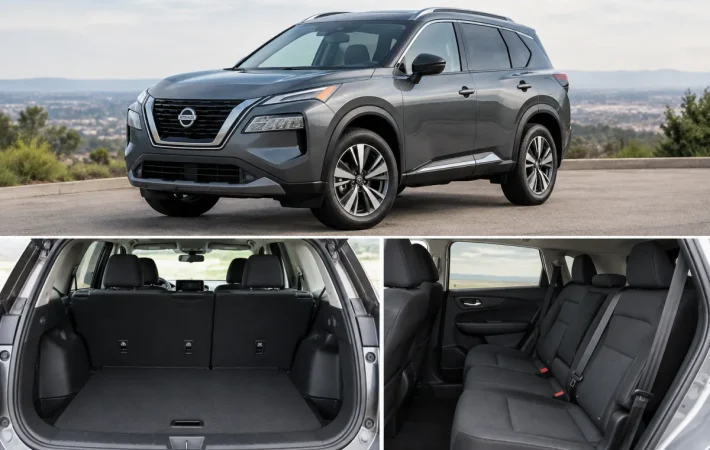
The standard Nissan Rogue does not have a third row. It is a two-row compact SUV with seating for five passengers.

How many people fit in a Nissan Rogue?

The standard Nissan Rogue seats five people across two rows. The second row is a reclining, folding 60/40 split bench seat, so it can be adjusted for passengers or folded to expand cargo space.

Does every Rogue have two rows?

The standard Nissan Rogue is configured with two rows and does not offer a third-row seat. This applies across its available trims according to Nissan’s current specifications.

What about the Nissan Rogue Plug-in Hybrid?

Nissan also markets a separate 2026 Nissan Rogue Plug-in Hybrid. Unlike the standard Rogue, this model is described as having three rows and seating for up to seven passengers.

When checking a vehicle listing, confirm whether it is the standard Nissan Rogue or the 2026 Nissan Rogue Plug-in Hybrid. The two models have different seating configurations.

Bottom line on Rogue seating

  • Standard Nissan Rogue: two rows and seating for five.
  • 2026 Nissan Rogue Plug-in Hybrid: three rows and seating for up to seven.
How to Open a Nissan Key Fob, Replace the Battery, and Handle a Lockout

How to Open a Nissan Key Fob, Replace the Battery, and Handle a Lockout

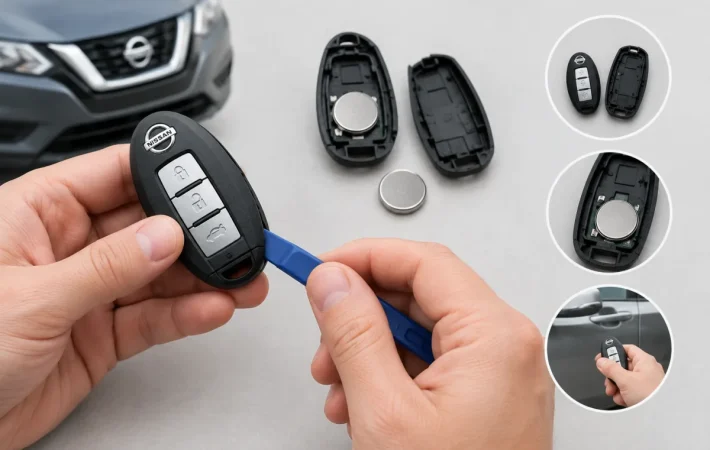
Nissan key fobs differ by model and year, but many Nissan Intelligent Keys use a similar design. You can usually open the fob by removing the hidden mechanical key and carefully separating the case at its seam. The exact battery type, polarity, and emergency-start procedure must be confirmed in the owner’s manual for your Nissan.

How to open a Nissan key fob

  1. Find the mechanical-key release switch on the back or end of the Intelligent Key.
  2. Slide or press the release and pull out the hidden mechanical key.
  3. Locate the seam where the two halves of the fob case meet.
  4. Insert a small flathead screwdriver into the seam.
  5. Gently twist the screwdriver to separate the upper and lower sections of the case.

Use light pressure so you do not crack the plastic, damage the circuit board, or mark the casing. Wrapping the screwdriver tip in a clean cloth can help protect the fob.

How to change the battery in a Nissan key fob

After opening the case, note how the old battery is positioned. Remove it carefully and install a new battery of the same type or an approved equivalent. Keep the battery orientation the same as the original unless your vehicle manual specifies otherwise.

Nissan battery requirements are not universal. For example, the 2022 Nissan Kicks uses a CR2032 or equivalent battery, with the positive side toward the bottom of the lower fob section. The 2019 Nissan NV uses a CR2025 or equivalent battery, with the positive side facing down. Check the Nissan owner’s manual for your exact model and year before purchasing a battery.

  1. Separate the fob case carefully.
  2. Remove the old coin-cell battery.
  3. Install the correct replacement with the specified polarity.
  4. Press the case halves together until they close securely.
  5. Insert the mechanical key again and test the lock, unlock, and other buttons.

Keep coin-cell batteries away from children and pets. Swallowing one can cause serious injury.

How to unlock a Nissan when the keys are inside

If the keys are locked inside the vehicle, avoid forcing the door or inserting improvised tools. These methods can damage the weather seals, paint, wiring, airbags, or locking mechanism.

  • Use the mechanical key if it is available and the vehicle has a key cylinder.
  • Use an eligible Nissan connected-service function for remote unlocking, if your vehicle, subscription, equipment, and mobile connection support it.
  • Contact Nissan Roadside Assistance for vehicle lockout service.

Nissan Roadside Assistance

Nissan Roadside Assistance provides vehicle lockout assistance. The official telephone number is 1-800-225-2476. Nissan states that the service is available 24 hours a day, 365 days a year, subject to applicable coverage terms. Eligibility, fees, and coverage limits can vary by vehicle, warranty, mileage, and service plan.

Eligible vehicles and subscriptions may also request roadside help through the MyNISSAN App. Remote unlocking and remote-start functions depend on the Nissan model, equipment, subscription, and connectivity.

What to do when the Nissan key fob battery is dead

A discharged fob battery may still allow entry with the mechanical key hidden inside the fob. Starting the vehicle can require a model-specific emergency procedure, such as placing the Intelligent Key in a designated location or using it in a specified way near the start switch. Follow the instructions in the owner’s manual for your Nissan rather than relying on a universal method.

Nissan Owner’s Manuals provide the model-specific instructions for opening the Intelligent Key, replacing its battery, and starting the vehicle when the fob battery is discharged. The correct manual is especially important because fob construction, battery type, polarity, and emergency-start steps vary between Nissan models and years.

How Much Is a Nissan GT-R? Prices for the GT-R, Skyline R34, and 350Z

How Much Is a Nissan GT-R? Prices for the GT-R, Skyline R34, and 350Z

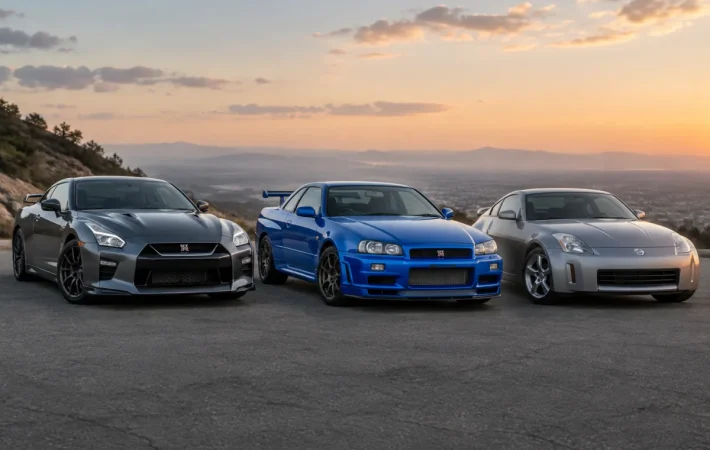
The price of a Nissan GT-R depends on its model year, mileage, condition, originality, modifications and market location. Recent documented sales show that a used 2015 Nissan GT-R Premium sold for $75,970, while a 1999 Nissan Skyline GT-R R34 V-Spec sold for $107,000.

How much does a Nissan GT-R cost?

A reliable current new-car MSRP for the Nissan GT-R was not confirmed from the available Nissan USA information. Nissan identifies the GT-R and GT-R NISMO as performance models, but current pricing is more practical to assess through used examples and collector-market sales.

  • 2015 Nissan GT-R Premium: $75,970 for an 18,000-mile example sold on December 18, 2024.
  • Used Nissan GT-R: Prices vary according to generation, mileage, service history, modifications and condition.
  • GT-R NISMO: Typically commands a premium over standard GT-R versions, although a current official price was not confirmed in the researched information.

These figures are individual transaction prices rather than guaranteed values for every GT-R. Cars with low mileage, strong documentation, desirable specifications or limited modifications can command significantly different prices.

How much is a Nissan Skyline R34 GT-R?

The Nissan Skyline R34 GT-R is a collector car from the 1999–2002 market segment. Its price is strongly influenced by specification, originality, mileage, color, documentation and import condition.

A 1999 Nissan Skyline GT-R R34 V-Spec sold for $107,000 on January 7, 2025. This result illustrates why an R34 GT-R can cost substantially more than an ordinary used Skyline or an older Nissan performance car.

How much is a Nissan Skyline?

“Nissan Skyline” covers several generations and trims, so there is no single Skyline price. The R34 range includes GT-R, 25GT, 25GT-T and other versions with very different specifications and market values.

  • R34 Skyline GT-R-related market benchmark: $28,958.
  • R34 25GT benchmark: $26,304.
  • R34 25GT-T benchmark: $40,645.

These are market benchmarks, not guaranteed selling prices. A Skyline’s actual value can change considerably based on engine and drivetrain specification, transmission, rust, restoration quality, legal import status and supporting records.

How much is a Nissan 350Z?

The Nissan 350Z is generally far less expensive than an R34 GT-R or a modern GT-R, although exceptional low-mileage examples can bring strong prices. Recent documented sales include:

  • 2005 Nissan 350Z Enthusiast: $16,250 for a 10,000-mile coupe with a six-speed manual transmission, sold on July 30, 2026.
  • 2006 Nissan 350Z: $24,750 for a 25,000-mile example, sold on April 9, 2026.

For a 350Z, buyers should compare mileage, clutch and transmission condition, accident history, rust, modifications and maintenance records. A lower-priced car may need substantial work, while an original, well-preserved example can sell near or above the documented figures.

How does the current Nissan Z compare?

The current Nissan Z provides a useful new-car comparison for shoppers considering a 350Z or another Nissan sports car. Nissan lists the 2027 Nissan Z at the following starting prices:

  • Nissan Z Sport: $44,480.
  • Nissan Z Performance: $54,480.
  • Nissan Z NISMO: $67,260.

The Nissan Z is the modern successor to the Z-car line that includes the 350Z. Its new-car warranty coverage, equipment and condition differ from those of a used 350Z, so the lower purchase price of an older car should be weighed against maintenance and refurbishment costs.

What affects Nissan GT-R, Skyline and 350Z prices?

  • Model and trim: GT-R, GT-R NISMO, R34 V-Spec, 25GT-T and 350Z Enthusiast models occupy different parts of the market.
  • Mileage: Low-mileage examples usually attract more collector interest.
  • Originality: Factory specification, correct parts and limited modifications can matter greatly to collectors.
  • Condition: Rust, accident damage, engine work and interior wear can materially reduce value.
  • Documentation: Service records, ownership history and import paperwork support a stronger valuation.
  • Location and import costs: Taxes, shipping, registration and compliance expenses can significantly increase the final cost of an imported Skyline or GT-R.
  • Auction demand: Rare colors, desirable specifications and strong presentation can produce results above broader market benchmarks.

Typical price perspective

Based on the researched sales and market benchmarks, a 350Z can be found in the mid-five-figure range, while a used modern GT-R can approach or exceed $75,000. An R34 GT-R is usually treated as a collector vehicle, with the documented V-Spec sale reaching $107,000. Standard Skyline variants can be much less expensive than the GT-R, but their prices still depend on trim, condition and import status.

Are Nissan Pathfinders Reliable? Reviews, Pricing, and 2026 Release Details

Are Nissan Pathfinders Reliable? Reviews, Pricing, and 2026 Release Details

Recent Nissan Pathfinders are generally regarded as reliable three-row midsize SUVs, particularly the redesigned models from 2022 onward. The 2025 Pathfinder received an 84/100 Quality & Reliability score from J.D. Power and an overall consumer rating of 83/100. Consumer Reports also describes the 2025 model as more reliable than other vehicles from the same model year based on its available data.

Reliability still depends on the model year, mileage, maintenance history, drivetrain, and whether recalls have been completed. Buyers should check the vehicle identification number for open recalls before purchasing a used Pathfinder.

Is the Nissan Pathfinder a good car?

The Nissan Pathfinder is a practical choice for drivers who need three rows, family-friendly seating, and available four-wheel drive. The current generation was redesigned for the 2022 model year. Recent models use a 3.5-liter V6 and a nine-speed automatic transmission, rather than a continuously variable transmission.

For 2025, Nissan lists 284 horsepower for most trims and 295 horsepower for the Rock Creek version. Front-wheel drive and four-wheel drive are available, depending on the configuration.

The 2025 Pathfinder also received a Top Safety Pick+ designation from the Insurance Institute for Highway Safety. Its listed standard safety equipment includes blind-spot detection, lane-departure warning, and rear automatic braking. The safety ratings apply to 2024–2026 models built after November 2023.

Are Nissan Pathfinders good cars for families?

They can be. The Pathfinder is an eight-seat midsize SUV, and its three-row layout makes it suitable for larger families. Its main strengths are seating capacity, available four-wheel drive, a conventional nine-speed automatic transmission, and strong recent safety results.

The Rock Creek trim is aimed at buyers who want additional capability. It includes four-wheel drive and the 295-horsepower version of the 3.5-liter V6. Higher trims add more comfort and technology, while the SV includes a 12.3-inch NissanConnect touchscreen with wireless Apple CarPlay and Android Auto.

2025 Nissan Pathfinder reliability and recalls

The 2025 Pathfinder has positive reliability indicators, but it is not free from potential issues. Consumer Reports lists one NHTSA recall involving certain front brake caliper assemblies that could break and reduce front-brake function.

This does not mean every 2025 Pathfinder has the problem. A prospective buyer should confirm whether the vehicle is affected and whether the recall repair has been completed. On any used Pathfinder, service records and recall status are as important as the model’s general reliability ratings.

How much is a Nissan Pathfinder?

Nissan lists the following starting MSRPs for the 2026 Pathfinder:

  • 2026 Pathfinder SV 4WD: $41,990
  • 2026 Pathfinder Rock Creek 4WD: $45,090
  • 2026 Pathfinder SL 4WD: $44,590
  • 2026 Pathfinder Platinum 4WD: $51,790

These are starting MSRPs, not guaranteed purchase prices. Destination charges, taxes, registration, dealer fees, options, incentives, and financing can change the final amount. Exact transaction prices and lease offers were not established in the available information.

When will the 2026 Nissan Pathfinder be released?

The 2026 Nissan Pathfinder is already listed on Nissan’s U.S. website, so it is not an unreleased model. Nissan’s inventory information shows 2026 Pathfinder vehicles and an arrival date of September 17, 2026. However, a single formal nationwide release date was not identified, and availability can vary by dealership and region.

Because the 2026 model is newer, long-term reliability data is limited. Buyers who want the most established reliability information may prefer a recent model year with a documented maintenance history, while buyers choosing a 2026 Pathfinder should confirm local inventory, pricing, and recall information with the selling dealer.

Which Nissan Pathfinder trim is worth considering?

  • SV 4WD: A lower-priced 2026 option with a 12.3-inch touchscreen and wireless smartphone integration.
  • Rock Creek 4WD: A better fit for buyers who want the 295-horsepower engine and standard four-wheel drive.
  • SL 4WD: A midrange option for shoppers seeking more equipment than the SV.
  • Platinum 4WD: The highest-priced listed trim, intended for buyers who prioritize additional luxury and technology features.

Overall, recent Nissan Pathfinders are good cars for buyers who value three-row practicality, available four-wheel drive, a V6 engine, and strong safety performance. Their reliability reputation is favorable, but checking the specific model year, recall completion, maintenance records, and final purchase price remains essential.

Are Nissan Frontiers Reliable? Towing, Capability, and Buying Guide

Are Nissan Frontiers Reliable? Towing, Capability, and Buying Guide

The Nissan Frontier is generally a reliable midsize pickup, particularly in recent model years. The 2025 Frontier received an 87/100 Quality & Reliability score from J.D. Power, rated in the “Great” category. Consumer Reports also says the 2025 model is more reliable than other vehicles from the same model year.

Reliability is only one part of the decision. The Frontier is also a conventional truck with a naturally aspirated V6, body-on-frame construction, rear-wheel drive or four-wheel drive, and useful towing and payload ratings. Its main limitation is that capability varies significantly between cab styles, bed lengths, drivetrains, and trims.

Are Nissan Frontiers reliable?

For the current generation, available independent data is favorable. The 2025 Nissan Frontier has a J.D. Power Quality & Reliability score of 87 out of 100. Consumer Reports likewise reports above-average reliability compared with other 2025 vehicles.

That does not mean every Frontier will be trouble-free. Consumer Reports lists three NHTSA recalls for the 2025 model. Anyone buying a new or used Frontier should check the vehicle identification number and confirm that applicable recall repairs have been completed.

Long-term reliability information for the current generation is still limited compared with older Frontier generations. Reliability can also vary by model year, so a general reputation should not replace a vehicle-specific inspection and maintenance review.

Are Nissan Frontiers good trucks?

The Frontier is a strong choice for buyers who want a traditional midsize pickup rather than a car-based utility vehicle. Its body-on-frame design, V6 engine, available four-wheel drive, and truck-oriented suspension make it suitable for hauling, towing, outdoor use, and off-road driving.

The 3.8-liter V6 produces 310 horsepower and 281 lb-ft of torque. A nine-speed automatic transmission is standard, and buyers can choose rear-wheel drive or four-wheel drive depending on the configuration.

Strengths of the Nissan Frontier

  • Strong naturally aspirated V6 with 310 horsepower.
  • Traditional body-on-frame pickup construction.
  • Available four-wheel drive for demanding roads and trails.
  • Competitive towing capacity for a midsize truck.
  • Conventional truck design suited to hauling and outdoor activities.

Potential drawbacks

  • Towing capacity changes considerably between configurations.
  • Off-road trims generally sacrifice some maximum towing capacity.
  • Recent reliability ratings are encouraging, but long-term data for the current generation remains limited.
  • Recall history should be checked by vehicle identification number before purchase.

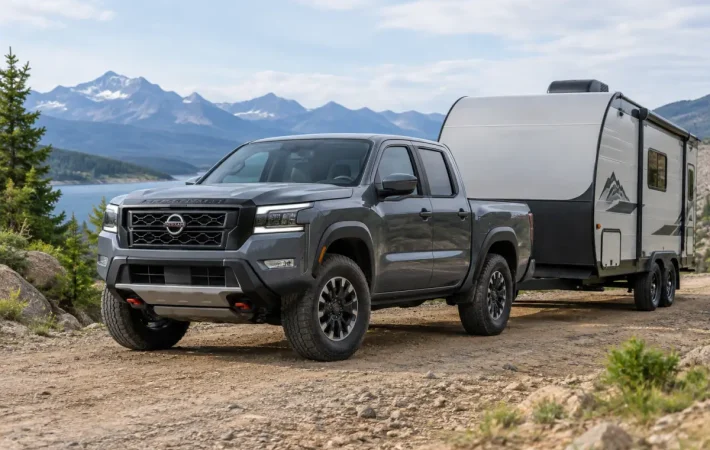
How much can a Nissan Frontier tow?

The 2026 Nissan Frontier can tow between 6,270 and 7,150 pounds, depending on the cab, drivetrain, bed length, trim, and equipment. The highest rating belongs to the King Cab S with rear-wheel drive, while four-wheel-drive, Crew Cab, off-road, and long-bed versions generally have lower ratings.

Configuration Maximum towing capacity
2026 Frontier S King Cab 4×2 7,150 pounds
2026 Frontier S King Cab 4×4 7,000 pounds
Crew Cab 4×2 configurations Up to 7,070 pounds
Frontier PRO-4X Crew Cab 4×4 6,680 pounds
Frontier PRO-4X Crew Cab Long Bed 4×4 6,270 pounds

Nissan’s published specifications can show slightly different maximum figures depending on the page and presentation. The detailed towing information for the exact model, trim, drivetrain, bed, and equipment should be used before matching the truck with a trailer.

Is the Nissan Frontier a good truck for towing?

Yes, the Frontier can be a good midsize towing truck when its configuration matches the trailer. A maximum rating of 7,150 pounds is competitive, and the V6 provides substantial power for a vehicle in this class.

Buyers focused mainly on towing should look closely at the 2026 Frontier S King Cab 4×2, which has the highest published rating. The PRO-4X is better suited to off-road driving than to maximum trailer capacity: its Crew Cab 4×4 rating is 6,680 pounds, and the Long Bed version is rated at 6,270 pounds.

Payload is also important. The 2026 Frontier S King Cab 4×2 is listed with a maximum payload of 1,590 pounds. Passengers, cargo, accessories, and trailer tongue weight all count against the truck’s available payload, so towing capacity alone does not determine whether a particular setup is suitable.

Which Nissan Frontier configuration makes sense?

For maximum towing

The 2026 Frontier S King Cab 4×2 offers the highest listed towing capacity at 7,150 pounds. It is the clearest choice when trailer capacity matters more than four-wheel-drive traction or additional rear-seat space.

For passengers and everyday use

A Crew Cab provides a more practical passenger area, but its towing rating depends on the trim and drivetrain. Crew Cab 4×2 versions can tow up to 7,070 pounds, while other Crew Cab configurations have lower ratings.

For off-road driving

The 2026 Frontier PRO-4X is designed for off-road use and comes with four-wheel drive. Its towing rating is lower than the maximum available from the King Cab S, but that trade-off may be worthwhile for buyers who prioritize trail capability.

Are Nissan Frontiers good used trucks?

A used Frontier can be a sensible purchase, but the model year and vehicle condition matter. Check the service history, accident history, recall completion, drivetrain operation, frame condition, and signs of neglected towing or off-road use.

For a newer 2025 Frontier, the available reliability ratings are positive, but the listed recalls should be verified. For older Frontiers, reliability cannot be judged solely from the current model’s scores because design, age, maintenance, and previous use differ between generations.

Is the Nissan Frontier a good truck to buy?

The Nissan Frontier is a good truck for buyers who want a midsize pickup with a powerful V6, traditional construction, available four-wheel drive, and strong towing capability. Recent reliability information is encouraging, with J.D. Power rating the 2025 model’s Quality & Reliability at 87/100 and Consumer Reports placing it ahead of other 2025 vehicles for predicted reliability.

It is less suitable for buyers who need the absolute highest payload or towing capacity in every configuration, because the figures drop for Crew Cab, four-wheel-drive, long-bed, and off-road versions. The best choice depends on whether the priority is maximum towing, passenger space, off-road equipment, or everyday versatility.

Is the Nissan Kicks a Good Car? Reliability, Price, and AWD Guide

Is the Nissan Kicks a Good Car? Reliability, Price, and AWD Guide

The Nissan Kicks is a good car for drivers who want a small SUV with a compact footprint, available all-wheel drive, standard driver-assistance features, and efficient everyday performance. The redesigned 2025 model introduced a larger 2.0-liter engine and moved the Kicks further into the small-SUV class. The 2026 Nissan Kicks continues with S, SV, and SR trims.

It is less appealing for shoppers who prioritize quick acceleration, maximum cargo capacity, or a fully proven long-term reliability record. The latest generation is still relatively new, so reliability expectations are encouraging but not conclusive.

Is the Nissan Kicks a good car?

For urban driving, commuting, and light family use, the Nissan Kicks offers a practical balance of size, features, and versatility. The 2026 model uses a 2.0-liter direct-injection four-cylinder engine producing 141 horsepower and 140 lb-ft of torque. Power is sent through an Xtronic continuously variable transmission.

  • Good fit: city drivers, commuters, and buyers seeking a small SUV with available AWD.
  • Main strengths: compact dimensions, useful standard safety technology, available AWD, and efficient operation.
  • Main compromises: modest acceleration, reduced efficiency with AWD, and limited long-term data for the redesigned generation.

Are Nissan Kicks good cars for reliability?

Early reliability information is positive, but it should be interpreted carefully. J.D. Power lists the 2025 Nissan Kicks with an overall consumer rating of 84 out of 100 and a Quality & Reliability score of 82 out of 100. However, J.D. Power notes that its rating uses previous model-year data because the vehicle was newly redesigned for 2025.

That means the available rating is a useful early indicator rather than definitive proof of how the redesigned Kicks will perform over many years. Long-term reliability data for 2025-and-newer models remains limited.

How safe is the Nissan Kicks?

The 2025 Nissan Kicks earned an IIHS Top Safety Pick designation for vehicles built after July 2024. It received Good ratings in the small-overlap front and updated side crash tests.

There are also important qualifications. The updated moderate-overlap front crash test received a Poor overall rating, while the vehicle-to-vehicle front crash-prevention system received a Marginal rating. Buyers comparing small SUVs should review the complete safety evaluation rather than relying only on the Top Safety Pick designation.

Is the Nissan Kicks AWD?

Yes. The Nissan Kicks is available with Intelligent AWD. Front-wheel drive remains an option, and the choice affects both practicality and efficiency.

  • AWD can provide additional traction in rain, snow, and on loose surfaces.
  • AWD reduces fuel economy compared with front-wheel drive.
  • AWD also reduces cargo capacity compared with the front-wheel-drive version.
  • AWD does not turn the Kicks into an off-road vehicle; it is primarily a traction feature for everyday driving.

The 2026 Kicks with AWD is rated at 30 mpg combined. The front-wheel-drive version offers up to 60.0 cubic feet of cargo space with the rear seats folded.

How much is a Nissan Kicks?

A verified current U.S. MSRP for the 2026 Nissan Kicks was not available in the researched information. The model is offered in S, SV, and SR trims, but the exact price depends on the model year, drivetrain, equipment, destination charges, dealer pricing, financing, and regional incentives.

For an accurate purchase price, shoppers should check the current Nissan configurator or obtain a written quote from a local Nissan dealer. A general price estimate would not be reliable without current regional information.

Which Nissan Kicks buyers should consider it?

The Kicks makes the most sense for buyers who want a manageable small SUV rather than a powerful crossover. Its 141-horsepower engine is suitable for routine commuting and city driving, but drivers who frequently carry heavy loads, travel through steep terrain, or want fast highway acceleration may prefer a stronger vehicle.

Choose front-wheel drive when lower fuel consumption and maximum cargo space matter most. Choose AWD when additional traction is more important and the trade-offs in efficiency and cargo room are acceptable.

What to check before buying

  • Confirm the current MSRP and destination charge for the selected trim.
  • Compare front-wheel-drive and AWD fuel-economy figures.
  • Check cargo requirements if the vehicle will regularly carry large items.
  • Review the complete IIHS crash-test results, including the Poor moderate-overlap rating.
  • Arrange a test drive to evaluate acceleration, CVT behavior, seating comfort, and road noise.
  • Compare dealer inventory and current incentives because transaction prices can vary by location.

The Nissan Kicks is a sensible small SUV when efficiency, compact dimensions, safety equipment, and available AWD are higher priorities than performance. It appears promising for reliability, but the redesigned generation needs more time to establish a long-term track record.

Is Nissan Reliable? Best Models, Risks, and Buying Advice

Is Nissan Reliable? Best Models, Risks, and Buying Advice

Nissan can be a reliable car brand, but dependability varies considerably by model and model year. Current reliability evidence places Nissan near the stronger end of the mainstream market overall, while individual vehicles range from notably dependable to below average.

Consumer Reports ranks Nissan sixth among new-car brands for reliability, eighth for used-car reliability, and sixth for maintenance and repair costs in its current brand comparison. However, the organization also notes that Nissan quality is inconsistent across the lineup.

Which Nissan models are the most reliable?

Nissan Kicks

The Nissan Kicks is one of the strongest Nissan choices for buyers focused on reliability, efficiency, and relatively simple ownership. J.D. Power named the 2022 Kicks the highest-ranked model in its 2025 Small SUV dependability segment. Consumer Reports also describes the 2025 Kicks as much more reliable than other cars from the same model year.

Nissan Murano

The Nissan Murano has particularly strong evidence for dependability among midsize SUVs. J.D. Power ranked the 2022 Murano highest in its 2025 Midsize SUV dependability segment. The 2025 Murano also received an IIHS Top Safety Pick+ designation, making it a strong candidate for buyers who want a midsize SUV with favorable reliability and safety results.

Nissan Pathfinder

The Nissan Pathfinder is worth considering for families that need a three-row SUV. The 2025 and 2026 Pathfinder received an IIHS Top Safety Pick+ designation. Its safety performance is a positive factor, although reliability still needs to be checked by model year because Nissan results are not uniform across every vehicle.

Nissan Sentra

The Nissan Sentra presents a more average reliability picture. J.D. Power listed the 2025 Sentra as a segment award winner for initial quality among compact cars, while Consumer Reports rates its 2025 reliability at about average compared with other cars from the same model year. Buyers should still check recalls, maintenance records, and the vehicle history before purchasing.

Which Nissan models require more caution?

Nissan Rogue

The Nissan Rogue deserves a more careful evaluation than the Kicks or Murano. Consumer Reports describes the 2025 Rogue as less reliable than other cars from the same model year. Reported issues include infotainment, navigation, phone pairing, and display problems.

The Rogue should be assessed by exact model year, trim, recall status, and service history rather than chosen solely because it is a Nissan. Safety results can also differ by year; the Rogue received an IIHS 2026 Top Safety Pick designation, but safety performance does not by itself guarantee mechanical reliability.

How reliable is Nissan compared with other brands?

Nissan’s overall position is relatively favorable, particularly among new vehicles. Consumer Reports places the brand sixth for new-car reliability and sixth for maintenance and repair costs in its current comparison. That suggests Nissan can be a sensible ownership choice, but the brand-level ranking should not replace research into the specific vehicle.

J.D. Power’s 2025 Vehicle Dependability Study is based on responses from more than 80,000 verified owners of three-year-old vehicles. It measures problems experienced during the previous 12 months, so its results are useful for comparing dependability but do not provide a complete prediction of every long-term repair cost.

What to check before buying a Nissan

  1. Confirm the exact model year. Reliability can change substantially between generations, powertrains, transmissions, and trims.
  2. Check the VIN for open recalls. Nissan provides an official VIN-based recall lookup for this purpose.
  3. Review maintenance records. Look for evidence that scheduled servicing was completed on time, especially for used vehicles.
  4. Inspect the transmission and electronics. During a test drive, check shifting behavior, warning lights, infotainment, navigation, displays, and phone connectivity.
  5. Obtain a vehicle history report and independent inspection. These steps can reveal accident damage, neglected maintenance, or recurring faults that a short test drive may miss.
  6. Compare the exact Nissan with alternatives. Brand reputation is less useful than model-specific reliability data and the condition of the particular vehicle.

Is Nissan a good car brand?

Nissan is a reasonable choice when the buyer selects a well-reviewed model and verifies its history. The Kicks and Murano have especially positive dependability evidence, the Sentra is approximately average in the cited 2025 data, and the Rogue requires more careful scrutiny. Nissan also offers several SUVs with strong recent IIHS safety results, including the Murano and Pathfinder.

The most accurate answer to “is Nissan reliable?” is therefore model-specific: Nissan makes some dependable cars and SUVs, but reliability should be judged by the exact model year, powertrain, recall record, maintenance history, and inspection results.

Are Nissan Sentras Good Cars? Reliability, Price, Reviews, and Lifespan

Are Nissan Sentras Good Cars? Reliability, Price, Reviews, and Lifespan

Yes, Nissan Sentras can be good cars for drivers who want an affordable compact sedan with good fuel economy, simple front-wheel-drive practicality, and a comfortable everyday driving experience. Recent ratings are generally positive, but reliability varies by model year, maintenance history, mileage, and the condition of the continuously variable transmission (CVT).

Are Nissan Sentras reliable?

Recent evidence suggests that newer Nissan Sentras offer generally solid reliability. The 2025 Sentra received an 88 out of 100 quality-and-reliability score from J.D. Power, rated “Great,” and earned an 85 out of 100 overall consumer rating. J.D. Power also placed it among the leading compact cars for the 2025 model year.

Consumer Reports described the 2024 Nissan Sentra as more reliable than other cars from the same model year. However, its owner data also includes transmission-related complaints, including leaks, rough shifting, slipping, and transmission-system faults. Consumer Reports lists three recalls for the 2024 model.

These results show why the specific model year and vehicle history matter. A well-maintained Sentra can be a sensible used-car choice, while a neglected example with CVT problems may become expensive to own.

Is a Nissan Sentra a good car for daily driving?

The Sentra is designed as an economical compact sedan rather than a performance car. The 2026 Nissan Sentra uses a 2.0-liter four-cylinder engine producing 149 horsepower, a CVT, and front-wheel drive. The official 2026 lineup includes the S, SV, SR, and SL trims.

Fuel economy is one of its main strengths. The S and SV trims are listed at 33 mpg combined, while the SR and SL trims are listed at 32 mpg combined. This makes the Sentra well suited to commuting, city driving, and routine family transportation.

  • Advantages: affordable pricing, good fuel economy, compact dimensions, and practical sedan design.
  • Potential concerns: modest acceleration, CVT-related complaints on some vehicles, and reliability differences between model years.

How much is a Nissan Sentra?

For the 2026 model year, Consumer Reports lists a base MSRP range of $22,600 to $27,990. The exact price depends on the trim and equipment. Taxes, registration, dealer fees, financing costs, incentives, and regional pricing are not included in that range.

For shoppers considering a newer used Sentra, Consumer Reports lists average retail prices of $17,925 to $20,850 for the 2025 model and $16,925 to $19,100 for the 2024 model. Actual prices depend on mileage, condition, accident history, location, equipment, and maintenance records.

How long do Nissan Sentras last?

iSeeCars estimates that Nissan Sentras have an average usable lifespan of approximately 142,522 miles or 12.4 years. Its data also gives the model a 13% chance of reaching at least 200,000 miles. The model receives a 7.3 out of 10 reliability rating and ranks 11th among 31 small cars analyzed.

Those figures are statistical estimates, not a guarantee for every vehicle. Longevity depends on regular maintenance, driving conditions, accident history, mileage, and how the CVT has been serviced. A Sentra with complete service records and careful ownership may last considerably longer than one that has been driven hard or had maintenance neglected.

Which Nissan Sentra years deserve the most attention?

2025 Nissan Sentra

The 2025 model has strong J.D. Power quality-and-reliability results and is a reasonable option for buyers seeking a newer compact sedan. Its price will usually be higher than an older used Sentra, but it may offer lower mileage and less wear.

2024 Nissan Sentra

The 2024 model received a positive reliability assessment from Consumer Reports, but buyers should take its transmission-related owner reports seriously. Before purchasing, check the vehicle history, confirm recall status, and look for evidence of proper CVT maintenance.

Older used Sentras

Older examples require a more detailed inspection because condition and maintenance can matter more than the model’s average reliability rating. Pay particular attention to CVT operation, service records, warning lights, leaks, rough shifting, slipping, and unusual drivetrain noises.

Should you buy a Nissan Sentra?

A Nissan Sentra is a good choice when affordability, fuel economy, and straightforward daily transportation are the priorities. The newest ratings are encouraging, and the estimated average lifespan is competitive for a small car.

It is a less attractive purchase when the vehicle has an unclear history, inconsistent maintenance, or signs of CVT trouble. For any used Sentra, verify the vehicle identification number for open recalls, review maintenance documentation, and arrange a professional inspection before buying.

Is Nissan Going Out of Business? Financial Health, Discontinued Models, and Future Plans

Is Nissan Going Out of Business? Financial Health, Discontinued Models, and Future Plans

Nissan is not officially going out of business or bankrupt. However, Nissan Motor Co., Ltd. is under significant financial and operational pressure and is carrying out a recovery program called Re:Nissan.

The company reported a fiscal-year 2025 net loss attributable to its owners of ¥533.1 billion and negative automotive free cash flow of ¥480.8 billion. At the same time, Nissan reported automotive net cash of ¥1,170.4 billion at the end of the fiscal year. Its filings describe a plan targeting ¥500 billion in total cost savings compared with fiscal year 2024.

Is Nissan going bankrupt?

The available company filings do not show that Nissan has filed for bankruptcy or formally announced that it is shutting down. The automaker is restructuring its operations, reducing costs, and adjusting its vehicle lineup in response to financial challenges.

That situation is serious, but it is different from bankruptcy or going out of business. Nissan’s Re:Nissan plan is intended to improve profitability and cash flow. Its long-term outcome is not guaranteed, but the current evidence supports describing Nissan as a company undergoing recovery rather than one that has ceased operating.

Is Nissan discontinuing the Altima?

No, the Nissan Altima has not been discontinued for the 2026 model year. Nissan’s U.S. materials continue to list the 2026 Altima, including SR and SV trims.

Some model-year and catalog pages can remain online during product changes, so buyers should confirm current availability with Nissan dealers. Based on the available official information, the claim that Nissan discontinued the Altima is not supported for 2026.

Did Nissan discontinue the Maxima?

Yes. The Nissan Maxima was discontinued after the 2023 model year. Nissan identifies 2023 as the final year of Maxima production and lists the model as no longer in production.

Nissan has not provided a definitive official date for a replacement that would directly revive the Maxima name. The end of Maxima production does not mean Nissan has stopped making passenger vehicles; the company continues to sell other models, including the Altima.

Does Nissan still make the Titan?

No. Nissan ended production of the Titan and Titan XD after the 2024 model year. Nissan’s U.S. information lists both full-size pickup trucks as no longer in production.

This means the Titan is not a current production model in the same way as Nissan’s active lineup. Remaining new inventory may still appear at dealerships, depending on location and stock, but the truck itself is no longer being produced for a new model year.

Is Nissan bringing back the Titan?

Nissan has not officially confirmed a Titan return. Its future-vehicle materials mention planned products such as the Xterra and Rogue Hybrid, but they do not announce a new Titan or a Titan replacement.

Until Nissan publishes a specific product announcement, claims that the Titan is definitely coming back should be treated as speculation.

Did Honda buy Nissan?

No. Honda did not buy Nissan. Nissan and Honda discussed a possible business integration, but the companies ended their memorandum of understanding in February 2025. The proposed integration was not completed.

The companies stated that they would continue strategic cooperation in areas related to intelligent and electrified vehicles. That cooperation is not the same as an acquisition, merger, or Honda takeover of Nissan.

What Nissan plans are confirmed?

Nissan’s official future-vehicle information identifies several planned products, including:

  • All-new Rogue Hybrid: targeted for late 2026.
  • Xterra return: targeted for late 2028.

These plans show that Nissan continues to develop future vehicles despite its restructuring. They do not, however, confirm a return of the Titan or a new Maxima.

What is Nissan’s current position?

Nissan is a continuing automaker facing substantial losses, cost pressures, and lineup changes. The Maxima and Titan have ended production, while the Altima remains listed as a 2026 model in the United States. Nissan and Honda did not complete their proposed integration, and Honda did not acquire Nissan.

The most accurate description is that Nissan is restructuring and trying to recover—not that it has gone bankrupt or officially announced that it is going out of business.

Is Infiniti Nissan? Understanding the Brand Relationship

Is Infiniti Nissan? Understanding the Brand Relationship

Yes. Infiniti is Nissan’s premium and luxury automotive brand. Nissan Motor Corporation owns and operates Infiniti, but Infiniti vehicles are designed, marketed, and sold under their own brand name rather than the Nissan badge.

Does Nissan own Infiniti?

Yes, Nissan owns Infiniti. Infiniti is not a completely independent automaker; it was created as Nissan’s performance-luxury division. Nissan provides corporate ownership, engineering resources, technology, and manufacturing connections, while Infiniti focuses on premium vehicles and a separate luxury-car identity.

What is Nissan’s luxury brand?

Infiniti is Nissan’s luxury brand. The brand launched in the United States in 1989 with the Infiniti Q45 sedan and M30 coupe. Since then, Infiniti has developed its own model names, design language, dealerships, and luxury-focused customer experience.

Is Infiniti made by Nissan?

Yes. Nissan develops Infiniti products and supports their production, but the vehicles are marketed as Infiniti models. This arrangement is similar to other automotive groups that operate a mainstream brand alongside a premium division.

Infiniti vehicles are built in more than one country. Depending on the model and model year, production may take place in Japan, Mexico, or the United States. For example, the Nissan North America, Inc. Smyrna Plant at 983 Nissan Drive, Smyrna, Tennessee 37167, assembles the Infiniti QX60 as well as selected Nissan vehicles.

How are Nissan and Infiniti different?

  • Nissan: The parent automaker and mainstream vehicle brand.
  • Infiniti: Nissan’s premium brand, focused on luxury vehicles, distinctive styling, and a more upscale customer experience.
  • Shared resources: The brands can share engineering expertise, technologies, manufacturing facilities, and other corporate resources.
  • Separate identity: Infiniti uses its own badges, model names, design approach, and brand positioning.

Does Nissan make every Infiniti in Japan?

No. Infiniti vehicles are not all manufactured in Japan. Official brand information identifies production in Japan, Mexico, and the United States, depending on the vehicle. Manufacturing locations may change by model year, so the production location for a specific Infiniti should be checked for that model and year.

How to contact Infiniti

For questions about Infiniti vehicles and customer support in the United States, Infiniti can be reached at 1-800-647-7261.

In practical terms, the answer to “is Infiniti Nissan?” is yes: Infiniti is Nissan’s luxury and premium division, with its own brand identity and vehicles supported by Nissan’s corporate, engineering, and manufacturing network.

Are Nissan Altimas Good Cars? Reliability, Price, Lifespan, and More

Are Nissan Altimas Good Cars? Reliability, Price, Lifespan, and More

Yes, Nissan Altimas can be good cars, particularly for buyers seeking a comfortable midsize sedan with available all-wheel drive, a quiet cabin, straightforward controls, and reasonable fuel economy. Reliability ratings are generally favorable, although the ownership experience depends heavily on the model year, maintenance history, and condition of the continuously variable transmission (CVT).

Are Nissan Altimas reliable?

Available reliability assessments are positive, but each organization uses its own methodology. J.D. Power gives the 2025 Nissan Altima an overall score of 84 out of 100 and an 89 out of 100 score for quality and reliability. The model ranks first among the midsize cars shown in its comparison.

RepairPal rates the Nissan Altima 4.0 out of 5.0 for reliability and places it 11th among 24 midsize cars. RepairPal also reports average annual repair costs of $483.

Consumer Reports describes the 2025 Altima as much more reliable than other cars from the same model year. Its reviewed data also lists two recalls for the 2025 model, so buyers should verify the vehicle identification number for unrepaired recall work before purchasing.

How long do Nissan Altimas last?

There is no authoritative mileage guarantee that applies to every Nissan Altima. Longevity varies with the model year, maintenance schedule, driving conditions, accident or corrosion history, and the condition of major components.

The CVT deserves particular attention when evaluating an Altima, especially a used vehicle. A complete service history, smooth acceleration, and the absence of unusual whining, shuddering, slipping, or delayed engagement are important signs during an inspection and test drive. A claim that every Altima will reach a specific mileage is not supported by the available data; some well-maintained examples may last a long time, while neglected vehicles can require major repairs much earlier.

Is the Nissan Altima being discontinued?

No. Nissan lists the Altima as an active model for the 2026 model year. Official model information includes current trims, pricing, specifications, and inventory details, so the available information does not support the claim that the sedan has been discontinued.

How much is a new Nissan Altima?

Nissan lists the following starting prices for the 2026 Altima before the $1,245 destination charge:

  • Altima S: $27,000
  • Altima SV: $27,430
  • Altima SR: $28,830

Actual transaction prices can vary with options, drivetrain, dealer charges, taxes, registration, and availability. Used Altima prices also vary substantially by model year, mileage, condition, location, title history, and trim, so there is no single price that accurately represents every used example.

What are the Nissan Altima’s main specifications?

The 2026 Altima is listed with a 2.5-liter gasoline engine, a continuously variable transmission, front-wheel drive, and available Intelligent All-Wheel Drive. Select trims can produce up to 188 horsepower when using premium fuel.

Fuel economy is listed at up to 27 mpg city, 39 mpg highway, and 32 mpg combined, depending on the trim and configuration.

How much does a Nissan Altima weigh?

The Altima’s curb weight depends on the model year, trim, engine, equipment, and whether it has front-wheel drive or all-wheel drive. The available official specifications reviewed do not provide a complete weight table for every 2026 trim, so a single weight would be misleading. For an accurate figure, the exact model year, drivetrain, and trim must be identified.

How to remote start a Nissan Altima

Compatible Altimas can be started using the vehicle’s Remote Engine Start System. Some vehicles and services also support remote starting through the MyNISSAN app.

Availability depends on the vehicle’s equipment, model year, and connected-services compatibility. The vehicle should be locked and used according to the instructions for its specific key fob or app. Remote starting should never be used in an enclosed space such as a garage.

Is a Nissan Altima a good used car?

A used Altima can be a sensible choice when its maintenance records and mechanical condition are strong. The model offers comfortable seating, a large trunk, easy-to-use controls, and available all-wheel drive. Consumer Reports also highlights the quiet cabin and comfortable rear seat of the 2025 model.

Before buying a used Altima, check:

  • CVT operation during cold and warm driving;
  • service records, including transmission maintenance where applicable;
  • open recalls using the vehicle identification number;
  • accident, flood, and corrosion history;
  • warning lights, fluid leaks, unusual noises, and uneven acceleration;
  • an independent pre-purchase inspection.

Overall, the Nissan Altima is a generally well-rated midsize sedan rather than a model with a guaranteed trouble-free lifespan. A newer, properly maintained example with a clean history is more likely to provide dependable ownership than an older vehicle with missing records or signs of CVT problems.

Is the Nissan Rogue a Good Car? Reliability, Price, Size, AWD, and More

Is the Nissan Rogue a Good Car? Reliability, Price, Size, AWD, and More

The Nissan Rogue can be a good compact SUV for drivers who want available all-wheel drive, a practical cabin, remote start, and moderate towing capacity. However, its reliability depends heavily on the model year, engine, maintenance history, and recall status. A vehicle-specific inspection and VIN recall check are important before buying a used Rogue.

Is the Nissan Rogue a good car?

For many buyers, the Nissan Rogue is a practical everyday vehicle. The current lineup offers front-wheel drive and all-wheel drive, useful cargo space, available remote start, and up to 1,500 pounds of towing capacity on the compared 2026.5 trims.

The main reason to be cautious is that certain Rogue model years and engine configurations have been affected by safety recalls. That does not mean every Rogue is unreliable, but buyers should verify the exact vehicle rather than judging the entire model range as one group.

Are Nissan Rogues reliable?

Nissan Rogues do not have one universal reliability record across all years. Reliability can vary according to the engine, transmission, maintenance, mileage, driving conditions, and repair history. Official recall records show issues affecting some vehicles, including certain 2021–2024 Rogues with specified turbocharged engines.

NHTSA recall 25V437 covered certain 2021–2024 Nissan Rogue vehicles equipped with specified 1.5-liter three-cylinder or 2.0-liter four-cylinder variable-compression turbo engines. The reported engine-bearing defect could lead to engine failure.

Some 2024–2025 Rogue SL and Platinum vehicles were also included in NHTSA recall 24V748 because a specified infotainment system could cause the display to go blank when the vehicle was shifted into reverse. Another recall record involved an infotainment software update campaign for certain 2021–2023 Rogues identified by plant and production dates.

Before purchasing, check the vehicle identification number through the National Highway Traffic Safety Administration. NHTSA is located at 1200 New Jersey Avenue SE, Washington, DC 20590. Its vehicle-safety information line is available through the agency, while Nissan USA can be contacted at 800-647-7261.

What year Nissan Rogue should you avoid?

A definitive best-and-worst model-year ranking is not established by the available verified information, so it would be misleading to name one year as the model everyone should avoid. Instead, investigate the specific Rogue’s VIN, engine, recall completion status, service records, accident history, and pre-purchase inspection results.

Pay particular attention to certain 2021–2024 vehicles covered by the engine-bearing recall and to infotainment-related campaigns affecting selected 2021–2025 vehicles. A completed recall repair does not replace a mechanical inspection, especially when buying a used vehicle.

How much is a Nissan Rogue?

Nissan’s listed 2026.5 starting prices include:

  • SV FWD: $30,490
  • Dark Armor FWD: $33,340
  • Rock Creek AWD: $34,390
  • Platinum AWD: $39,390

Nissan also lists an S trim with a starting MSRP of $29,490 on its overview information. The listed destination charge for the compared 2026.5 trims is $1,545. Dealer pricing, taxes, registration, options, and financing can change the final amount.

Is the Nissan Rogue AWD or four-wheel drive?

The Nissan Rogue is available with front-wheel drive or all-wheel drive. Not every Rogue is AWD, and it is not a traditional four-wheel-drive SUV. Buyers who need AWD should confirm the drivetrain on the window sticker, vehicle history, or VIN-specific equipment record.

How to remote start a Nissan Rogue

Keyfob remote start is listed as standard on the compared 2026.5 Nissan Rogue trims. The exact button sequence and connected-service requirements can vary by model year, trim, key fob, and equipment package.

For a particular Rogue, use the instructions in that vehicle’s owner’s manual and verify whether NissanConnect or another subscription feature is required. Do not assume that the procedure for a current Rogue applies to every earlier generation.

How big and how long is a Nissan Rogue?

Nissan lists the 2026.5 Rogue at:

  • 183 inches long
  • 72.4 inches wide
  • 66.5 inches high
  • Up to 36.5 cubic feet of interior cargo volume

These dimensions make the Rogue a compact crossover SUV suited to daily driving, family use, and routine cargo needs. Exact interior measurements and cargo capacity can vary by configuration and the way the seats are positioned.

How long do Nissan Rogues last?

A single authoritative mileage figure cannot be confirmed for every Nissan Rogue. Service life depends on the model year, engine, maintenance schedule, driving conditions, accident history, and the quality of previous repairs.

For a used Rogue, maintenance records are more useful than a mileage estimate alone. Review oil-change documentation, transmission service, warning lights, recall repairs, tire wear, brake condition, and signs of engine or electrical problems. An independent inspection is especially valuable before purchase.

Where can I rent a Nissan Rogue SL in Maine?

A specific Maine rental company offering a Nissan Rogue SL was not verified in the available information. Rental companies commonly advertise an SUV class rather than guaranteeing a particular make, model, or trim. Anyone seeking a Rogue SL should confirm the exact vehicle and trim directly with the rental location before booking.

Warranty and ownership considerations

Nissan lists a 36-month/36,000-mile basic warranty and a 60-month/60,000-mile powertrain warranty for the compared 2026.5 Rogue trims. Used buyers should determine whether any original warranty remains and whether recall repairs have been completed.

Nissan USA provides official Rogue information and can be reached at 800-647-7261. The most important checks before buying are the VIN recall record, complete service history, drivetrain configuration, engine type, and results of an independent inspection.

Who Owns Nissan? Ownership, Origins, Manufacturing, and Brand History

Who Owns Nissan? Ownership, Origins, Manufacturing, and Brand History

Nissan is a Japanese automaker. Nissan Motor Co., Ltd. is headquartered in Yokohama, Japan, and its corporate history is rooted in Japanese automobile manufacturing. Nissan is not an American car company, although some Nissan vehicles and powertrains are manufactured in the United States.

Who owns Nissan?

Nissan Motor Co., Ltd. is a publicly traded Japanese company. It is separate from Renault, although Nissan and the French automaker have maintained a strategic alliance since March 1999. The alliance has included corporate cooperation and historical cross-shareholding, but the exact current ownership percentages should be checked in Nissan’s latest investor-relations filings.

Renault does not simply own Nissan as a wholly controlled subsidiary. Nissan and Renault retain separate corporate structures, brands, and operations.

Is Nissan a Japanese company?

Yes. Nissan is a Japanese company and a Japanese car brand. Its headquarters are at Nissan Motor Co., Ltd., 1-1, Takashima 1-chome, Nishi-ku, Yokohama, Kanagawa 220-8686, Japan.

The company was established in Yokohama in December 1933 and adopted the name Nissan Motor Co., Ltd. in 1934. This Japanese corporate origin is why Nissan is generally classified as a Japanese automaker, even when a particular vehicle is built in another country.

Where is Nissan from?

Nissan is from Japan. The company’s early automotive history can be traced to Kwaishinsha Motor Car Works, which completed a DAT vehicle in 1914. Nissan Motor Co., Ltd. was later established in Yokohama, where the company developed its manufacturing operations.

When did Datsun become Nissan?

The Nissan name was adopted in 1934. Before that, the company and its vehicles were closely associated with the DAT and Datsun names.

The name DAT came from the initials of three early investors: Kenjiro Den, Rokuro Aoyama, and Meitaro Takeuchi. The name Datsun developed from “Datson,” meaning “son of DAT.” The spelling changed to “Datsun” because the pronunciation of “son” was associated with loss in Japanese.

Datsun became an important vehicle brand within Nissan’s history. Nissan later consolidated its automotive branding under the Nissan name in many markets.

Who makes Nissan cars?

Nissan Motor Co., Ltd. designs, engineers, manufactures, and sells Nissan vehicles through its worldwide operations. Manufacturing is carried out at Nissan facilities and through its international production network.

Nissan has production, research, engineering, testing, and sales operations in several countries. The country where a Nissan is made depends on the model, factory, and destination market.

Where are Nissan cars made?

Nissan vehicles are made in multiple countries, including Japan, the United States, and Mexico. A specific model may be assembled in different locations for different markets, so the vehicle identification label and manufacturer information provide the most precise answer for an individual car.

Nissan production in Japan

The Yokohama Plant in Japan is associated with Nissan’s early mass-production history. The first Datsun 14 sedan made at the Yokohama Plant came off the production line in April 1935. The facility is also associated with Nissan engine production and heritage activities.

Nissan production in the United States

Nissan North America, Inc. manages Nissan’s Americas operations from One Nissan Way, Franklin, TN 37067, U.S.A. Nissan has vehicle and powertrain production facilities in the United States, including:

  • Smyrna, Tennessee: production has included the Nissan LEAF, Pathfinder, Rogue, Murano, and INFINITI QX60.
  • Canton, Mississippi: production has included the Altima, TITAN, and Frontier.
  • Decherd, Tennessee: manufactures engines and transmissions.

A Nissan assembled in the United States can be considered American-made in terms of assembly location, but the brand itself remains Japanese.

Nissan production in Mexico

Nissan also operates manufacturing facilities in Mexico. Mexican production forms part of the company’s international manufacturing network and supplies vehicles for selected markets. The exact production location varies by model and destination.

Is Nissan an American car?

Nissan is not an American automaker. It is a Japanese automobile manufacturer. However, Nissan vehicles sold in the United States may be assembled at American plants, including facilities in Tennessee and Mississippi.

This distinction separates the brand’s corporate nationality from the manufacturing location of an individual vehicle:

  • Brand and company: Japanese.
  • Headquarters: Yokohama, Japan.
  • Possible assembly locations: Japan, the United States, Mexico, and other countries.
  • Exact origin of a vehicle: depends on its model, factory, and destination market.

What does Nissan mean?

“Nissan” is the corporate name adopted by the company in 1934. The company’s earlier history is connected with the DAT vehicle brand, whose name came from the initials of three early investors. Nissan’s modern identity developed as the company expanded from its Japanese origins into a global automobile manufacturer.

Nissan and Renault: what is the relationship?

Nissan and Renault formed the Renault–Nissan Alliance in March 1999. The alliance was created through an agreement between the Japanese Nissan and French Renault. Both companies retained separate brands and corporate identities while cooperating internationally.

Therefore, Nissan is Japanese, Renault is French, and the alliance does not make Nissan an American or French automaker.

What is Nissan?

Nissan is a Japanese automobile manufacturer headquartered in Yokohama. Nissan Motor Co., Ltd. was established in 1933, adopted its current name in 1934, and developed from earlier Japanese automotive businesses associated with Kwaishinsha Motor Car Works and the DAT brand. Today, Nissan operates globally, with manufacturing and business activities across Japan, the United States, Mexico, and other countries.

Who Makes Toyota Oil? Manufacturer, Supplier, and Regional Differences

Who Makes Toyota Oil? Manufacturer, Supplier, and Regional Differences

Toyota Genuine Motor Oil is a Toyota-branded lubricant developed, specified, tested, and approved for Toyota vehicles. Toyota controls the product specifications and branding, but it does not publicly identify one universal manufacturer for every Toyota oil sold worldwide.

Who makes Toyota oil in the United States?

In the United States, ExxonMobil is widely reported by industry sources as the company that blends or manufactures Toyota Genuine Motor Oil. However, Toyota’s U.S. product information does not publicly confirm ExxonMobil as the single supplier for every grade and product generation.

ExxonMobil also owns the Mobil 1 motor-oil brand. The connection between Toyota and Mobil 1 does not mean that every Toyota Genuine Motor Oil product is identical to every Mobil 1 formulation. Toyota-branded oils may use specifications and additive packages selected for Toyota engines.

Does Toyota manufacture its own oil?

Toyota is primarily responsible for setting the requirements for Toyota Genuine Motor Oil. The company tests and approves the lubricant for use in Toyota engines, while physical blending and packaging may be handled by a regional lubricant partner.

The supplier can vary according to the country, oil viscosity, product generation, and contract. Toyota does not appear to publish one worldwide list naming the blender for every Toyota Genuine Motor Oil product.

Is Toyota oil the same as Mobil 1?

Not necessarily. ExxonMobil may supply Toyota-branded oil in the United States, and Mobil 1 is an ExxonMobil brand, but that does not establish that Toyota Genuine Motor Oil and every Mobil 1 product have the same formulation.

The important comparison is whether the oil meets the requirements for the specific Toyota engine. Brand name alone is not enough to determine equivalence.

What oil should Toyota owners use?

  • Check the owner’s manual for the required viscosity, such as the specified SAE grade.
  • Follow the required performance standard or approval listed for the engine.
  • Use Toyota Genuine Motor Oil or an equivalent lubricant that meets the manual’s requirements.
  • For a particular bottle, check the label and packaging or ask an authorized Toyota dealer about the manufacturer and specification.
Companies associated with Toyota oil

Toyota Motor Corporation

Toyota Motor Corporation owns the Toyota Genuine Motor Oil brand and defines, tests, and approves the oil requirements for Toyota vehicles.

ExxonMobil

ExxonMobil is the lubricant manufacturer commonly reported as a U.S. supplier or blender of Toyota-branded motor oil. The exact role can depend on the product and market.

Mobil 1

Mobil 1 is an ExxonMobil motor-oil brand associated with Toyota through lubricant and motorsport relationships. That association does not prove that all Toyota Genuine Motor Oil worldwide is made by ExxonMobil.

Does Toyota Use CVT Transmissions? Toyota CVT Types and Ownership Costs

Does Toyota Use CVT Transmissions? Toyota CVT Types and Ownership Costs

Yes, Toyota uses CVT transmissions, but not every Toyota has the same type of gearbox. Transmission choice depends on the model, model year, trim level, engine and drivetrain. Toyota uses conventional automatic transmissions, Dynamic-Shift CVTs and electronically controlled CVTs in hybrid vehicles.

Which Toyota models use a CVT?

Toyota Corolla

The 2026 Toyota Corolla gasoline models use a Dynamic-Shift Continuously Variable Transmission. Hybrid versions use an electronically controlled continuously variable transmission, commonly called an ECVT.

The Dynamic-Shift CVT is designed differently from a basic belt-and-pulley CVT. Toyota’s Direct Shift CVT uses a physical launch gear when starting from a stop, then transfers power to the belt-and-pulley mechanism at higher speeds.

Toyota Camry

The Toyota Camry Hybrid uses an electronically controlled continuously variable transmission. Its hybrid transaxle combines the gasoline engine with electric motor-generators. Sequential Shiftmatic technology can simulate the steps of a six-speed automatic transmission.

Toyota Crown

The Toyota Crown shows why it is important to check the exact grade. The Crown XLE and Limited use an electronically controlled CVT with Toyota’s hybrid system, while the Crown Platinum with Hybrid MAX uses a direct-shift six-speed automatic transmission.

How Toyota’s hybrid ECVT differs from a regular CVT

A Toyota hybrid ECVT is not simply the same belt-driven CVT used in some gasoline cars. It is part of a hybrid transaxle that controls power from the gasoline engine and electric motor-generators. This arrangement helps manage engine speed and electric-motor assistance without conventional fixed gears in the usual sense.

Because of this design, Toyota hybrids can feel different from gasoline models with a traditional automatic or belt-driven CVT. The engine speed may rise and fall according to power demand rather than following distinct gear changes.

Does every Toyota use a CVT?

No. Toyota also uses geared automatic transmissions, including six-speed, eight-speed and ten-speed applications, depending on the model and powertrain. The Crown Platinum Hybrid MAX, for example, uses a direct-shift six-speed automatic rather than an ECVT.

Transmission availability can change between model years, trims, engines and markets. The vehicle’s official specifications or brochure should be checked before buying a particular Toyota.

How the transmission affects fuel economy

CVTs and hybrid ECVTs are generally chosen because they can keep the engine operating within an efficient speed range. In a hybrid Toyota, the electric motors and hybrid control system also influence fuel consumption. However, fuel economy depends on the complete powertrain, vehicle size, driving conditions, tires and equipment, not the transmission name alone.

A gasoline Corolla with a Dynamic-Shift CVT and a Corolla Hybrid with an ECVT do not have identical powertrains, so their fuel economy and driving characteristics should be compared using the specifications for the same model year and trim.

How much is Toyota worth?

The question “how much is Toyota worth” can refer to several different figures. Market capitalization is the value of Toyota Motor Corporation’s publicly traded shares. Enterprise value includes market value and debt-related considerations, while book value is based on accounting assets and liabilities. Brand value is a separate estimate and should not be confused with the value of the entire company.

Toyota Motor Corporation reported consolidated revenue of 50.684 trillion yen and net income of 3.848 trillion yen for the fiscal year ended March 31, 2026. These are financial-performance figures, not Toyota’s current market capitalization, enterprise value or total company valuation.

A current market value was not established from the available official information, so revenue and net income should not be presented as Toyota’s net worth. The correct figure depends on which valuation measure is intended and the date on which it is calculated.

Toyota company details

  • Company: Toyota Motor Corporation
  • Headquarters: Toyota City, Aichi, Japan
  • Reported fiscal-year revenue: 50.684 trillion yen for the year ended March 31, 2026
  • Reported fiscal-year net income: 3.848 trillion yen for the same period
Will 7Jx17 ET45 Wheels Fit a Toyota C-HR?

Will 7Jx17 ET45 Wheels Fit a Toyota C-HR?

A 7Jx17 ET45 wheel will likely fit a Toyota C-HR, but the marking alone is not enough to confirm compatibility. The wheel must also have the correct bolt pattern, center bore, load rating, lug hardware and sufficient clearance for the brake components.

Standard Toyota C-HR 17-inch wheel specifications

Toyota C-HR models commonly use a factory 17-inch wheel measuring 6.5Jx17 with an ET45 offset. The commonly listed original tyre size for this configuration is 215/60R17.

  • Wheel diameter: 17 inches
  • Common factory width: 6.5J
  • Common factory offset: ET45
  • Bolt pattern: 5×114.3
  • Center bore: 60.1 mm

How 7Jx17 ET45 compares with the factory wheel

A 7Jx17 wheel is half an inch wider than the commonly used 6.5Jx17 factory wheel. Because both wheels have an ET45 offset, the additional width is distributed approximately equally on both sides. The inner and outer rim edges move outward by about 6.35 mm compared with the factory wheel.

This difference is usually modest, but actual clearance still depends on the wheel design, tyre size, suspension condition and the particular Toyota C-HR version.

Checks required before fitting

Bolt pattern

The wheel must have a 5×114.3 PCD. The 7Jx17 ET45 marking does not state the bolt pattern, so this must be checked separately. A wheel with a different PCD will not fit correctly.

Center bore

The Toyota C-HR commonly uses a 60.1 mm hub. A wheel with a 60.1 mm center bore is a direct match. If the wheel has a larger bore, hub-centric rings can be used to centre it correctly. A bore smaller than 60.1 mm will not fit over the hub without machining.

Brake and suspension clearance

The wheel must clear the brake calipers and suspension components. Identical dimensions can still have different spoke profiles and inner shapes, so the wheel design matters as much as the width and offset.

Load rating and lug hardware

Check that the wheel’s load rating is suitable for the Toyota C-HR. The lug nuts or bolts must also match the wheel’s seat type and thread specifications.

Tyre size

The commonly listed original 17-inch tyre size is 215/60R17, but permitted sizes can vary by model year, trim, engine and sales market. The vehicle documentation should be checked before selecting tyres for a 7J-wide wheel.

Fitment verdict

A 7Jx17 ET45 wheel is probably suitable for a Toyota C-HR because its diameter and offset are close to the commonly listed factory specification. Fitment should be treated as confirmed only when the wheel is 5×114.3, has a 60.1 mm or larger center bore, clears the brakes, uses compatible lug hardware and has an adequate load rating. The exact model year, trim and market specification can affect the final result.
How Many Miles Per Gallon Does a Toyota Corolla Get?

How Many Miles Per Gallon Does a Toyota Corolla Get?

The 2026 Toyota Corolla gets up to 35 mpg combined with a gasoline engine. EPA-estimated fuel economy ranges from 34 to 35 mpg combined across the gas-powered LE, SE and XSE trims. The Toyota Corolla Hybrid reaches up to 50 mpg combined.

2026 Toyota Corolla gas mileage by trim

Fuel economy varies by trim and configuration:

  • 2026 Toyota Corolla LE: 32 mpg city, 41 mpg highway and 35 mpg combined.
  • 2026 Toyota Corolla SE: 31 mpg city, 40 mpg highway and 34 mpg combined.
  • 2026 Toyota Corolla XSE: 31 mpg city, 38 mpg highway and 34 mpg combined.

The Corolla LE has the highest combined fuel-economy rating among the 2026 gasoline-powered Corolla trims.

How many mpg does the Corolla Hybrid get?

The 2026 Toyota Corolla Hybrid is more efficient than the gasoline-powered versions. The highest rating is available on the front-wheel-drive Hybrid LE:

  • 2026 Toyota Corolla Hybrid LE: 53 mpg city, 46 mpg highway and 50 mpg combined.
  • 2026 Toyota Corolla Hybrid SE: 50 mpg city, 43 mpg highway and 47 mpg combined.
  • 2026 Toyota Corolla Hybrid SE AWD: 47 mpg city, 41 mpg highway and 44 mpg combined.

All figures are EPA-estimated. Toyota also lists the Corolla Hybrid XLE among the configurations that can reach up to 50 mpg combined.

What affects a Toyota Corolla’s real-world mpg?

The EPA ratings provide a useful comparison between trims, but actual mileage can differ. Fuel economy depends on driving conditions, vehicle configuration, maintenance and driving habits. Highway speed, traffic, weather, payload and frequent acceleration can also affect the result.

Which Toyota Corolla gets the best gas mileage?

For the 2026 model year, the Toyota Corolla Hybrid LE has the best fuel economy at up to 50 mpg combined. Among gasoline-powered models, the Toyota Corolla LE leads with 35 mpg combined, including 32 mpg city and 41 mpg highway.

Is Toyota Parts Deal Legit? What Buyers Should Know

Is Toyota Parts Deal Legit? What Buyers Should Know

Yes, ToyotaPartsDeal.com appears to be an operating online auto-parts retailer, not an obviously nonexistent website. It publishes a physical address, customer-service phone number, ordering support, and return procedures. However, the available information does not establish that it is an official Toyota Motor Corporation website or a Toyota dealership.

What is ToyotaPartsDeal.com?

ToyotaPartsDeal.com identifies itself as an online seller of genuine Toyota and Scion original-equipment parts and accessories. The retailer lists its business address as 2506 Troy Ave, South El Monte, CA 91733, United States.

Customer service is available at 1-888-905-9199. The published phone-support hours are Monday through Friday, 7:00 a.m. to 4:00 p.m. Pacific Time, while the website also advertises 24/7 live chat.

Is it an official Toyota website?

The available evidence does not identify ToyotaPartsDeal.com as a Toyota Motor Corporation website or as the website of a Toyota-authorized dealership. It should therefore be treated as an independent online parts retailer, even though it states that it sells genuine Toyota and Scion OE parts.

The available research also does not independently verify that every item listed is genuine Toyota inventory. Buyers should confirm the exact part number and compare the listing with the vehicle’s specifications before placing an order.

What do customer reviews indicate?

Public customer feedback is mixed. Some buyers report favorable pricing and a satisfactory ordering experience. Other reviews mention delayed deliveries, damaged or incorrect parts, billing verification, and difficulties involving returns.

These reports do not prove that the retailer is fraudulent, but they do show that an order may not be problem-free. Delivery and return experiences can vary by part, supplier, and order circumstances.

Important return-policy conditions

ToyotaPartsDeal.com requires customers to obtain return authorization before sending merchandise back. The retailer generally says that a return request must be submitted within 30 calendar days of delivery.

  • An RMA authorization is required for returns.
  • A 20% restocking fee may apply.
  • Many electrical and chemical products may be non-returnable.
  • Special-order, opened, and certain other parts may also be excluded from returns.

Because of these restrictions, review the return terms before ordering, particularly when buying an expensive, electrical, special-order, or vehicle-specific component.

How to reduce the risk when ordering

  1. Verify the manufacturer part number using the vehicle identification number or a trusted parts catalog.
  2. Check whether the item is eligible for return before paying.
  3. Confirm shipping details and keep the order confirmation.
  4. Inspect the package and part as soon as it arrives.
  5. Contact customer service promptly if the part is damaged, incorrect, or missing.
  6. Keep packaging, photographs, correspondence, and the tracking information until the order is fully resolved.

Verdict

ToyotaPartsDeal.com appears to be an identifiable, operating retailer with a published California address, phone support, and formal return procedures. That supports viewing it as a real marketplace rather than an obviously fake website. At the same time, it is not established as an official Toyota website or dealership, customer feedback is mixed, and its return policy includes significant restrictions. It is best approached as an independent parts seller where careful part-number verification and attention to return terms are essential.

Best Toyota Dealer? How to Compare Concord and East Bay Dealerships

Best Toyota Dealer? How to Compare Concord and East Bay Dealerships

There is no reliable basis for naming one universally best Toyota dealer in Concord or the East Bay. The right choice depends on the vehicle in stock, written out-the-door price, financing terms, trade-in offer, fees, and service availability.

For shoppers searching for the best Toyota dealer in Concord, Concord Toyota is the only Toyota dealership located within the city. Several nearby dealerships are useful alternatives when comparing pricing and inventory.

Toyota dealerships in and near Concord

Concord Toyota

  • Address: 1090 Concord Avenue, Concord, CA 94520
  • Phone: (925) 682-7131
  • Services: New and used vehicles, financing, trade-in appraisals, online purchasing, parts, and service
  • Service hours listed by Toyota: Monday through Saturday, 7:00 AM to 6:00 PM

Concord Toyota is the most convenient starting point for local buyers because it is the only Toyota dealer in Concord. CarEdge rated the dealership 77 out of 100 with a C transparency grade, based on six verified out-the-door quotes collected between September 2025 and August 2026. The reported average documentation fee among those quotes was $85. These figures are useful for comparison, but they do not establish that the dealership is the best choice for every buyer.

Toyota Walnut Creek

  • Address: 2100 North Broadway, Walnut Creek, CA 94596
  • Phone: (925) 933-7440
  • Services: New and used vehicles, financing, trade-ins, test drives, and service
  • Pricing approach: The dealership promotes an upfront Simple Price and Simple Process buying model

Toyota Walnut Creek is a practical alternative for customers comparing dealerships near Concord. Its advertised upfront pricing approach makes it especially relevant when requesting a written quote and comparing fees with Concord Toyota.

Dublin Toyota

  • Address: 4321 Toyota Drive, Dublin, CA 94568
  • Sales phone: (925) 829-7700
  • Service phone: (925) 551-0620

Dublin Toyota is a useful East Bay comparison option for shoppers willing to travel south from Concord. Separate sales and service contact numbers can make it easier to request vehicle availability and schedule maintenance.

Antioch Toyota

  • Address: 1817 Auto Center Drive, Antioch, CA 94509
  • Phone: (925) 778-4800
  • Services: Sales and service

Antioch Toyota is relevant for buyers comparing dealerships in eastern Contra Costa County. It may be worth contacting when the desired trim, color, or equipment is unavailable at dealerships closer to Concord.

Toyota of Berkeley

  • Address: 2400 Shattuck Avenue, Berkeley, CA 94704
  • Phone: (510) 845-2530
  • Services: Sales and service

Toyota of Berkeley gives East Bay shoppers another option west of Concord. Its location may be convenient for buyers who work or live near Berkeley and want to compare a dealership outside central Contra Costa County.

How to compare Toyota dealerships near Concord

Request the same information from each dealership before deciding where to buy. A phone estimate is less useful than a written quote identifying the complete purchase price.

  1. Ask for the vehicle identification number or a complete description of the exact vehicle.
  2. Request the out-the-door price, including taxes, registration, documentation fees, dealer-installed accessories, and other charges.
  3. Compare financing terms separately from the vehicle price, including the annual percentage rate, loan term, and total amount financed.
  4. Obtain a written trade-in offer rather than relying on a verbal estimate.
  5. Confirm whether the vehicle is physically in stock and whether accessories or add-ons are already installed.
  6. Ask about service availability, maintenance scheduling, and the location where warranty work will be performed.

Which dealership may fit different buyers?

  • For the closest Concord location: Concord Toyota is the local dealership at 1090 Concord Avenue.
  • For an upfront-price comparison: Toyota Walnut Creek promotes its Simple Price and Simple Process model.
  • For more East Bay inventory comparisons: Dublin Toyota, Antioch Toyota, and Toyota of Berkeley expand the search beyond Concord and Walnut Creek.
  • For the lowest total purchase cost: Compare matching written out-the-door quotes rather than advertised prices alone.

Inventory, discounts, dealer-installed accessories, financing rates, trade-in values, and final prices change frequently. Verify current details and hours with each dealership before traveling.

What Is the Biggest Toyota SUV? Sequoia, Crown, Highlander and Tacoma Compared

What Is the Biggest Toyota SUV? Sequoia, Crown, Highlander and Tacoma Compared

The biggest and largest Toyota SUV is the Toyota Sequoia. It is Toyota’s full-size SUV and offers seating for up to eight people with a second-row bench seat, or up to seven with second-row captain’s chairs.

What is the biggest Toyota SUV?

The Toyota Sequoia is the largest SUV in Toyota’s lineup. The 2026 Sequoia is listed with up to 86.9 cubic feet of maximum cargo space and up to 9,500 pounds of towing capacity, making it the brand’s choice for buyers who need substantial passenger, cargo and towing capability.

Seating depends on the second-row layout:

  • Up to eight passengers with a second-row bench seat.
  • Up to seven passengers with second-row captain’s chairs.

What is a Toyota Crown?

The Toyota Crown is a full-size sedan with a raised, crossover-like ride height. It is not an SUV and is not the largest Toyota SUV. The 2027 Crown has standard all-wheel drive, hybrid powertrains and seating for five people.

Its higher driving position gives it some crossover-like characteristics, but its sedan body and five-passenger layout distinguish it from SUVs such as the Highlander and Sequoia.

Toyota Highlander: how many seats?

The Toyota Highlander is a midsize three-row SUV, smaller than the full-size Sequoia. Its exact seating capacity depends on the model year, trim level and second-row configuration. Buyers comparing Highlander versions should check the specifications for the specific model and trim, especially when choosing between a second-row bench seat and captain’s chairs.
Why does the Toyota Tacoma outsell the Chevy Colorado?

The Toyota Tacoma and Chevrolet Colorado are direct competitors in the midsize pickup segment. Available market data shows the Tacoma with substantially stronger sales than the Colorado in some reported markets and periods, although results can vary by year, country and reporting period.

Several factors can help explain the Tacoma’s stronger position:

  • Established segment presence: Toyota has a strong, long-running presence in the midsize pickup market.
  • Broad model lineup: The Tacoma is offered in configurations aimed at everyday driving, work use and off-road enthusiasts.
  • Off-road-focused versions: Trims such as TRD Off-Road, TRD Pro and Trailhunter give the Tacoma a clear identity for buyers seeking specialized trail capability.
  • Brand familiarity: Toyota’s established reputation in the pickup segment can influence repeat purchases and buyer preference.

The Chevrolet Colorado remains a direct Tacoma competitor, but sales comparisons should always use matching figures for the same market and period rather than treating one report as a universal result.

Toyota models at a glance

  • Sequoia: Toyota’s largest full-size SUV, seating up to eight.
  • Highlander: A smaller midsize three-row SUV whose seating depends on model year, trim and second-row configuration.
  • Crown: A five-seat full-size sedan with a raised, crossover-like ride height.
  • Tacoma: A midsize pickup competing with the Chevrolet Colorado.
How Long Do Toyota Hybrid Batteries Last? Warranty and Replacement Guide

How Long Do Toyota Hybrid Batteries Last? Warranty and Replacement Guide

How long do Toyota hybrid batteries last? Toyota does not publish one universal service-life estimate that applies to every hybrid model. The actual lifespan depends on the vehicle, model year, operating conditions, maintenance, and the condition of the battery system.

A Toyota hybrid battery is designed for long-term vehicle use. Reaching the end of the warranty period does not mean the battery will fail immediately, and the warranty limit is not a prediction that every battery will last exactly that long.

Toyota hybrid battery warranty period

For Toyota hybrid vehicles beginning with the 2020 model year, the high-voltage hybrid battery is covered for 10 years from the vehicle’s original date of first use or 150,000 miles, whichever comes first.

The coverage is measured from the vehicle’s original in-service date. It does not restart when the vehicle is sold to a later owner. Warranty repairs generally address eligible defects in materials or workmanship and remain subject to the applicable warranty guide, exclusions, and other terms.

What about older Toyota hybrids?

Earlier Toyota hybrid vehicles generally had an 8-year or 100,000-mile hybrid battery warranty. The exact coverage can vary according to the model year, vehicle, warranty guide, and applicable emissions requirements.

When checking a used Toyota hybrid, identify the vehicle’s model year and original date of first use before estimating how much warranty coverage may remain. The purchase date of a used vehicle is not the starting point for the original battery warranty.

Does the warranty period show the battery’s actual lifespan?

No. A 10-year/150,000-mile warranty is a coverage limit, not a guaranteed failure date. Some batteries may require service before that point, while others may continue operating beyond the warranty period.

Toyota also lists separate warranty coverage for other hybrid components, including the battery control module, hybrid control module, and inverter with converter. These components are generally listed with 8-year/100,000-mile coverage, while the high-voltage battery may have longer coverage under applicable warranty or emissions rules.

Factors that affect Toyota hybrid battery service life

  • Model year and battery design: Toyota has used different hybrid systems and battery configurations across its vehicles.
  • Operating conditions: Temperature, driving conditions, and vehicle use can affect the demands placed on the hybrid system.
  • Maintenance and cooling: The battery cooling system and related components must remain in suitable condition for proper operation.
  • Vehicle history: Long periods of storage, accident damage, or other system faults may affect battery performance.
  • Overall hybrid-system condition: A warning light or performance change may involve a component other than the battery itself.

When should a Toyota hybrid battery be checked?

A battery inspection is appropriate when the vehicle displays a hybrid-system warning, loses expected fuel economy, shows unusual changes in battery charge levels, or experiences reduced hybrid assistance. These symptoms are not proof that the high-voltage battery has failed. A qualified Toyota service department should diagnose the vehicle and identify the affected component.

Replacement decisions should be based on diagnostic results, the vehicle’s model year, warranty status, and the condition of the rest of the hybrid system. Toyota does not publish one replacement price that applies to every model, so the cost must be assessed for the specific vehicle and repair provider.

How to estimate remaining Toyota hybrid battery coverage

  1. Confirm the Toyota model and model year.
  2. Find the vehicle’s original date of first use or in-service date.
  3. Check the mileage against the applicable warranty limit.
  4. Review the warranty guide and maintenance documentation for that vehicle.
  5. Have warning messages or suspected battery problems diagnosed by qualified Toyota service personnel.

For 2020-and-newer Toyota hybrid vehicles, the main planning figure is 10 years or 150,000 miles from the original date of first use, whichever comes first. For older models, the former 8-year/100,000-mile term is a useful general reference, but the vehicle’s specific warranty documents determine the applicable coverage.

Does Toyota Have an Electric Car? Electric, Diesel, Mirai and V8 Plans Explained

Does Toyota Have an Electric Car? Electric, Diesel, Mirai and V8 Plans Explained

Yes. Toyota has electric vehicles, although its lineup includes more than one type of electrified powertrain. In the United States, the company sells the battery-electric Toyota bZ and the hydrogen fuel-cell Toyota Mirai.
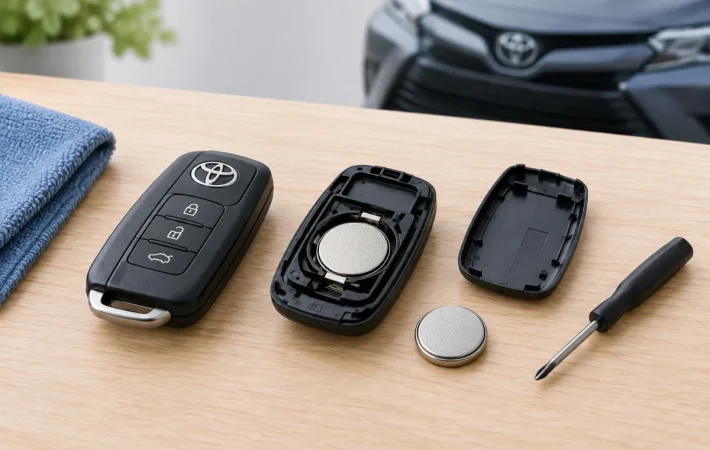
Does Toyota have an electric car?

The 2026 Toyota bZ is Toyota’s battery-electric SUV and the successor to the bZ4X name. Certain 2026 versions have a manufacturer-estimated range of up to 314 miles. The model also uses a North American Charging System port and can access compatible high-speed charging networks.

The Mirai is also an electric vehicle, but it does not work like a conventional plug-in battery-electric car. Its hydrogen fuel-cell system generates electricity onboard, with water described by Toyota as its only tailpipe emission.

Why are Toyota Mirai so cheap?

The Toyota Mirai can appear unusually cheap in advertisements because Toyota has offered substantial regional incentives. One listed offer included a $35,000 cash incentive and 0% APR for qualified buyers. These promotions are temporary, market-specific and separate from the Mirai’s starting MSRP.

Toyota lists the 2026 Mirai with a starting MSRP of $51,795. A discounted advertised price should therefore be checked carefully for eligibility, location, dealer participation and expiration terms.

The Mirai’s low advertised transaction prices also reflect its limited fueling practicality. It requires access to hydrogen stations rather than ordinary gasoline pumps or a home charging connection. A low purchase price does not change that infrastructure requirement.

Does Toyota make a diesel truck?

Toyota sells the Tacoma and Tundra in the U.S. truck market, but no reliable official confirmation was found for a current U.S.-market diesel Tacoma or diesel Tundra.

Diesel availability can differ substantially between countries, so information about Toyota trucks sold in other markets should not automatically be applied to the United States. For the current U.S. lineup, the available evidence does not confirm a Toyota diesel pickup.

Is Toyota bringing back the V8?

There is no reliable official Toyota announcement confirming the return of a V8-powered Toyota truck or SUV. Claims that Toyota will bring back the V8 should therefore be treated as rumors rather than an established product plan.

The existence of the Tundra or other Toyota trucks does not, by itself, confirm a future V8 model. Toyota has not officially confirmed the timing, vehicle or specifications of a V8 comeback in the reviewed information.

Why is “Toyota Fortuner diesel future” trending?

The phrase appears to be driven mainly by speculation about the next Toyota Fortuner, a global midsize SUV sold primarily in markets outside the United States. Unofficial automotive coverage has discussed possible diesel, hybrid or redesigned Fortuner versions.

No reliable official Toyota announcement confirms a future diesel Fortuner, its engine options or its launch timing. The search trend should therefore be understood as interest in possible future changes, not proof that Toyota has announced a new diesel model.

Toyota powertrain plans at a glance

  • Toyota bZ: Current battery-electric SUV; certain 2026 versions offer up to 314 miles of estimated range.
  • Toyota Mirai: Current hydrogen fuel-cell electric sedan with a listed 2026 starting MSRP of $51,795.
  • Tacoma and Tundra: Current Toyota U.S. trucks, with no confirmed current U.S.-market diesel version in the reviewed information.
  • V8 comeback: No reliable official confirmation.
  • Fortuner diesel future: No official confirmation of a specific future diesel plan.
Is Honda or Toyota Better? Reliability, Value and Model Comparisons

Is Honda or Toyota Better? Reliability, Value and Model Comparisons

Whether Honda or Toyota is better depends on the model, powertrain and ownership priorities. Toyota currently has stronger evidence for overall dependability, while Honda remains highly competitive and may offer a better match for drivers who value handling, cabin practicality or the pricing of a specific model.

Is Honda or Toyota more reliable?

For overall dependability, Toyota has the stronger result in the latest cited J.D. Power U.S. Vehicle Dependability Study. In the 2025 study, Toyota ranked third among mass-market brands with 162 problems per 100 vehicles. Toyota also had the highest-ranked model in the study, the Toyota Avalon.

Honda was not listed among the highest-ranked mass-market brands in the cited release. That does not mean every Toyota is more reliable than every Honda. Reliability can vary substantially by model, engine, transmission, hybrid system, maintenance history and model year.

Historical reliability scores also describe reported problems from surveyed vehicles. They are useful for comparing trends, but they do not guarantee that every new Honda or Toyota will have the same ownership experience.

Is Toyota or Honda better for value?

Toyota is often the stronger choice for buyers who prioritize long-term dependability evidence, hybrid availability and lower perceived ownership risk. The 2026 Toyota Camry, for example, is offered exclusively with hybrid powertrains, making it a direct alternative to the Honda Accord for shoppers interested in a hybrid midsize sedan. Toyota also provides ToyotaCare scheduled maintenance for two years or 25,000 miles with the Camry.

Honda can offer better value when its purchase price, equipment, driving characteristics and interior layout fit the buyer better. The 2026 Honda Accord starts at an MSRP of $28,395. Its LX and SE trims use a 192-horsepower 1.5-liter turbocharged engine and are rated at 29 city and 37 highway mpg.

Actual value depends on trim level, incentives, financing, insurance, annual mileage, fuel prices and dealer pricing. A lower purchase price does not automatically mean lower total ownership cost.

Toyota Corolla versus Honda Civic

The Toyota Corolla and Honda Civic are the most relevant compact-car comparison. The Civic is a strong choice for buyers who place greater emphasis on driving feel and practical cabin space. Kelley Blue Book estimates a five-year cost to own of $42,067 for a 2025 Honda Civic, including estimated maintenance costs of $4,123 and depreciation of $13,356.

That figure should not be compared with a Toyota estimate unless the vehicles use the same trim, mileage, financing assumptions, insurance profile and powertrain. For a fair decision, compare similarly equipped Corolla and Civic models and include the local purchase price and expected insurance cost.

Toyota Camry versus Honda Accord

The Toyota Camry is the better fit for shoppers specifically seeking a hybrid-only midsize sedan and placing a high priority on Toyota’s dependability record. The 2026 Camry’s hybrid-only lineup also simplifies the powertrain decision.

The Honda Accord remains competitive for buyers who prefer its available powertrain choices, driving character, cabin design or starting price. The 2026 Accord starts at $28,395, while the LX and SE versions use a 192-horsepower 1.5-liter turbocharged engine with EPA ratings of 29 city and 37 highway mpg.

Toyota RAV4 versus Honda CR-V

The Toyota RAV4 and Honda CR-V are the key comparison for compact SUV buyers. The available research does not establish a single current winner between these two models on total ownership cost or every reliability measure. The better choice should be based on the exact model year, trim, powertrain, warranty terms, dealer pricing, insurance quote and maintenance history for used vehicles.

Toyota is the more defensible choice when dependability evidence and hybrid availability are the main priorities. Honda may be preferable when the CR-V’s cabin practicality, driving feel or transaction price better matches the buyer’s needs.

Which brand should you choose?

  • Choose Toyota if your main priorities are dependability evidence, hybrid-focused options, resale confidence and minimizing ownership risk.
  • Choose Honda if you place more weight on driving characteristics, interior practicality or the price and equipment of a particular model.
  • Compare model by model rather than choosing a brand solely from its reputation.
  • Check the exact powertrain, since hybrid and gasoline versions can have different costs, performance and maintenance considerations.
  • For used vehicles, inspect maintenance records because condition and service history can matter more than the badge.

For the broad question “is Honda or Toyota better,” Toyota has the stronger current case for overall dependability. Honda is still a competitive alternative, especially with models such as the Civic and Accord. The most accurate decision comes from comparing the specific Toyota and Honda models, trims and powertrains that fit the intended budget.

Toyota Trim Levels and Performance Badges Explained

Toyota Trim Levels and Performance Badges Explained

Toyota uses several designations to separate standard grades from performance-focused vehicles and packages. The most recognizable are TRD, GR, LE and XLE, but they do not all serve the same purpose.

What does TRD stand for Toyota?

TRD stands for Toyota Racing Development. It is Toyota’s factory performance and racing division, founded in the United States in 1979.

TRD develops products for both competition vehicles and street-driven Toyota models. Depending on the vehicle, TRD branding can identify performance versions, off-road models or factory accessories. A TRD designation does not guarantee identical equipment across the Toyota lineup, so the specific model and model year matter.

What does GR stand for Toyota?

GR refers to Toyota GAZOO Racing, Toyota’s global motorsports and performance organization. GR vehicles are developed with motorsports-inspired engineering, testing and performance goals.

Examples of Toyota vehicles carrying the GR name include the GR86, GR Supra and GR Corolla. GR is generally used for dedicated performance vehicles or versions with a stronger focus on handling, power and driver involvement.

What does LE stand for Toyota?

LE is a Toyota vehicle grade used across multiple models. Toyota’s current U.S. materials list LE as a grade, but they do not consistently provide one official expanded meaning for the letters.

As a result, interpretations sometimes presented for “LE” should not be treated as a universally confirmed Toyota definition. The equipment included in an LE grade varies according to the model and model year.

What does XLE stand for Toyota?

XLE is another Toyota vehicle grade used across multiple models. Like LE, Toyota’s current U.S. documentation generally presents XLE as a grade rather than consistently spelling out an official meaning for the abbreviation.

XLE equipment and positioning depend on the vehicle. On some models, XLE may sit above LE in the grade range and offer additional comfort, convenience or technology features, but the exact differences must be checked in that model’s specifications.

TRD, GR, LE and XLE: the practical difference

  • TRD: Toyota Racing Development; associated with factory performance, racing, off-road and performance-accessory programs.
  • GR: Toyota GAZOO Racing; associated with Toyota’s global performance and motorsports brand.
  • LE: A Toyota vehicle grade whose equipment varies by model and year; Toyota does not consistently publish a universal expanded form.
  • XLE: A Toyota vehicle grade whose features and position in the lineup also vary by model and year; Toyota does not consistently publish a universal expanded form.

The safest way to compare Toyota grades is to review the equipment list for the exact vehicle and model year. TRD and GR identify performance-oriented Toyota programs, while LE and XLE are grade names used to organize features within individual model lineups.

Is the 2022 Toyota Tundra Coming to Australia? Production Locations and Market Availability

Is the 2022 Toyota Tundra Coming to Australia? Production Locations and Market Availability

The 2022 Toyota Tundra was not confirmed as a regular Toyota Australia model in the researched official material. Toyota identified the truck primarily with the North American market, where it was developed, designed and built in the United States.

Is the 2022 Toyota Tundra coming to Australia?

No official Toyota Australia announcement confirming a 2022 Tundra launch or regular-market availability was found in the available research. Therefore, the 2022 Toyota Tundra should not be treated as an officially confirmed Australian-market vehicle.

The model was assembled in the United States for Toyota’s North American lineup. The absence of a confirmed Toyota Australia launch does not establish whether privately imported or converted vehicles may be available through independent businesses, because that information was not provided in the researched material.

Where are Toyota Tundras made?

The 2022 Toyota Tundra was assembled at Toyota Motor Manufacturing Texas in San Antonio, Texas, United States. Toyota describes this facility as the exclusive home of Tundra assembly. Production of the Tundra at the San Antonio plant began in 2006.

The truck’s powertrains are produced at Toyota Motor Manufacturing Alabama in Huntsville, Alabama. This plant makes the twin-turbo V6 and hybrid engines used in the Tundra and Sequoia.

  • Tundra assembly: Toyota Motor Manufacturing Texas, San Antonio, Texas.
  • Tundra twin-turbo V6 and hybrid powertrains: Toyota Motor Manufacturing Alabama, Huntsville, Alabama.

Is the new Toyota Tundra coming to Australia?

The available research does not contain an official Toyota Australia confirmation for the new Tundra either. Toyota’s confirmed manufacturing information places Tundra production in the United States, while no regular Australian-market introduction was identified.

This is separate from the question of where the vehicle is built: manufacturing in Texas and Alabama does not by itself indicate that Toyota sells the Tundra through Australian dealerships.

Where are Toyota Tacomas made?

Toyota sources identify the Toyota Tacoma as being produced in Baja California, Mexico, and Guanajuato, Mexico. The Tacoma is a North American-market pickup and is a different model from the Toyota Hilux.

Toyota also announced a planned transition of Tacoma production from Baja California to an expanded San Antonio facility over approximately four years, beginning in the 2026–2030 period.

  • Previous and current Tacoma production locations identified in the research: Baja California, Mexico, and Guanajuato, Mexico.
  • Planned production change: Baja California production is intended to transition to expanded operations in San Antonio.

Is the Toyota Hilux coming to the US?

The Toyota Hilux and Toyota Tacoma are separate pickup models designed for different regional markets. The researched Toyota USA manufacturing sources did not identify the Hilux as a vehicle sold through the United States Toyota lineup.

Accordingly, the available information does not confirm a regular Toyota Hilux launch in the United States. The Tacoma remains the Toyota pickup associated with the North American market in the researched material, while the Hilux is represented by Toyota Australia as a separate model.

Tundra, Tacoma and Hilux: market differences

  • Toyota Tundra: a full-size pickup assembled in San Antonio, Texas, with engines and hybrid powertrains produced in Huntsville, Alabama.
  • Toyota Tacoma: a North American-market pickup associated with production in Mexico and planned expanded production in San Antonio.
  • Toyota Hilux: a separate Toyota pickup model for other regional markets; the researched material does not confirm regular United States availability.
Toyota Vehicle Dimensions and Weight Guide

Toyota Vehicle Dimensions and Weight Guide

Toyota vehicle weight and length vary by model year, trim, drivetrain, body style, bed length, and optional equipment. The figures below use available Toyota specifications and identify the relevant model year or configuration where possible.

How much does a Toyota Camry weigh?

The 2025 Toyota Camry has a listed curb-weight range of 3,450 to 3,682 pounds, depending on trim and whether it uses front-wheel drive or all-wheel drive.

For the 2026 model, Toyota lists the Camry LE Hybrid at 3,450 pounds. Curb weight is the vehicle’s weight with standard equipment and required operating fluids, but without passengers or cargo.

How long is a Toyota Camry?

The 2026 Toyota Camry is 193.5 inches long overall. That equals approximately 16 feet 1.5 inches.

How much does a Toyota Tacoma weigh?

Toyota Tacoma weight depends substantially on cab style, bed length, engine, drivetrain, trim, and equipment. The available official research does not confirm a sufficiently current single curb-weight range for publication, so the exact figure should be checked for the specific Tacoma configuration being considered.

How long is a Toyota Tacoma?

Tacoma overall length changes with the cab and bed combination. Access Cab and Double Cab versions, as well as short-bed and long-bed configurations, do not have the same dimensions. A precise current length requires the model year and configuration; the available official material does not provide a sufficiently current figure to state one accurately.

How long is a Toyota Highlander?

The available Toyota comparison information lists overall Highlander lengths of 194.9 inches for one configuration. Highlander dimensions can vary by model year and the vehicle shown in a comparison, so the exact trim should be confirmed before using the measurement for garage or parking planning.

The 2024 Toyota Highlander has a 112.2-inch wheelbase. Its curb weight ranges from 4,155 to 4,430 pounds, depending on trim and hybrid configuration.

How much does a Toyota Corolla weigh?

Toyota provides Corolla length and curb-weight specifications by model and configuration, but the available research does not expose the current exact figures clearly enough to publish a reliable number. Corolla weight can vary by trim, powertrain, and equipment, so the vehicle’s specific specification listing should be used.

How long is a Toyota Tundra?

The 2025 Toyota Tundra is listed at one of three overall lengths, depending on cab and bed configuration:

  • 233.6 inches
  • 245.6 inches
  • 252.5 inches

These measurements correspond to different combinations of cab style and bed length. The longest version is approximately 21 feet long.

How much does a Toyota Tundra weigh?

The 2025 Toyota Tundra brochure lists curb weights beginning at 5,095 pounds for selected SR and SR5 configurations. Actual weight varies with cab, bed length, drivetrain, trim, engine, and optional equipment.

Toyota dimensions and weight at a glance

  • Camry: 193.5 inches long for the 2026 model; 2025 curb weight ranges from 3,450 to 3,682 pounds.
  • Tacoma: length and weight vary by cab, bed, drivetrain, engine, and equipment; a current exact figure requires a specific configuration.
  • Highlander: 194.9 inches for one listed configuration; 2024 curb weight ranges from 4,155 to 4,430 pounds.
  • Corolla: exact current length and weight depend on configuration and were not confirmed clearly enough in the available specifications.
  • Tundra: 233.6 to 252.5 inches long for the 2025 model; selected configurations start at 5,095 pounds.

For a purchase, garage-fit check, or towing calculation, use the specification for the exact model year, trim, drivetrain, cab, bed, and installed equipment rather than a general model estimate.

How to Replace a Car Key Battery in a Toyota: Opening and Replacement Guide

How to Replace a Car Key Battery in a Toyota: Opening and Replacement Guide

Replacing a Toyota key-fob battery is usually possible at home, but the exact procedure depends on the vehicle model, model year and key design. Toyota uses several types of electronic keys, including traditional wireless remotes and smart keys, so the battery size and method for opening the case may differ.

When a Toyota key-fob battery needs replacement

A weak battery may cause the smart-key system or wireless remote control to work inconsistently. Common signs include:

  • Shorter operating range;
  • Remote buttons that respond only occasionally;
  • The smart-key system failing to detect the key reliably;
  • The key-fob LED indicator no longer turning on.

What battery does a Toyota key fob use?

There is no single battery that fits every Toyota key fob. The correct type depends on the vehicle and key design. Check the vehicle owner’s manual or read the marking on the battery already installed in the fob before buying a replacement.

Do not rely only on the Toyota model name, because different model years and key designs may use different batteries.

How to open a Toyota key fob

  1. Remove the mechanical key if your Toyota fob has one. A release button or latch usually holds it in place.
  2. Look for the designated opening slot or seam in the key-fob housing.
  3. Insert the mechanical key or a suitable tool into the slot and gently separate the case.
  4. Work carefully around the seam rather than forcing one point, which can damage the plastic housing or internal electronics.
  5. Open the case only far enough to reach the battery and note how the existing battery is positioned.

The opening method varies between traditional remotes, smart keys and newer electronic keys. The vehicle-specific Toyota owner’s manual is the authoritative guide for the correct location of the release slot and the recommended opening method.

How to replace a car key battery in a Toyota

  1. Open the key fob carefully.
  2. Inspect the battery marking and confirm that the replacement is the same type.
  3. Remove the old battery without bending or damaging the contacts.
  4. Install the new battery in the same direction as the old one. Incorrect polarity can cause rapid battery depletion or prevent the fob from working.
  5. Check that the battery is seated securely.
  6. Align the two halves of the housing and press them together until the case closes.
  7. Reinsert the mechanical key if it was removed.
  8. Test the buttons and, where applicable, the smart-key functions.

Important precautions

  • Do not use excessive force when removing the cover or battery.
  • Keep the electronic key dry.
  • Do not drop, bend or expose the key to prolonged high temperatures.
  • Confirm the battery direction before closing the housing.
  • Use the owner’s manual if the case does not open easily or the battery type is unclear.

What to do if the Toyota key battery is completely dead

Some Toyota smart-key vehicles include an emergency starting procedure. If the battery is depleted, hold the Toyota-emblem side of the electronic key against the engine switch while pressing the brake pedal. The exact procedure depends on the vehicle, so follow the instructions in the owner’s manual.

When dealer replacement is the safer option

Toyota owner manuals generally state that the electronic-key battery can be replaced by the owner, while also recommending dealer replacement because incorrect disassembly may damage the key. A Toyota dealer is the safer choice when the key design is unfamiliar, the housing resists opening, the battery contacts are damaged or the replacement battery does not restore operation.

How Much Is Toyota Remote Connect? Pricing, Drive Connect, ToyotaCare, and Highlander Remote Start

How Much Is Toyota Remote Connect? Pricing, Drive Connect, ToyotaCare, and Highlander Remote Start

Toyota Remote Connect is a subscription-based connected vehicle service that can let drivers start the vehicle, lock or unlock the doors, and use other remote functions through the Toyota app. Toyota offers it on select 2022-and-newer vehicles, but availability depends on the model, year, trim, equipment, market, and active service eligibility.

How much is Toyota Remote Connect?

Toyota lists Remote Connect as part of its available Connected Services plans rather than as one universal standalone price. The published monthly prices are:

  • Music Lover: $15 per month
  • Go Anywhere: $15 per month
  • Premium: $25 per month

Remote Connect is included with these listed plans for compatible vehicles. Toyota notes that taxes, promotional trials, regional availability, and vehicle eligibility can affect the final cost.

Toyota accessory information also lists connected-services options priced at $325 for two additional years of Drive Connect and Remote Connect, as well as $485 for certain packages combining three years of Drive Connect with two years of Remote Connect.

What is Toyota Drive Connect?

Toyota Drive Connect is a connected navigation and infotainment service for compatible Toyota vehicles. It includes:

  • Cloud Navigation: connected navigation with updated information
  • Destination Assist: navigation support from a live agent
  • Intelligent Assistant: a voice-operated assistant

Drive Connect requires an active trial or paid subscription. It is separate from the basic ability to use remote vehicle functions, although Toyota may package Drive Connect and Remote Connect together in some plans or offers.

What can Toyota Remote Connect do?

On an eligible vehicle, Remote Connect can provide access through the Toyota app to functions such as:

  • Starting the vehicle remotely
  • Locking the doors
  • Unlocking the doors
  • Checking or accessing other available vehicle controls

The exact functions are vehicle-specific. A Toyota with the same model name may have different remote capabilities depending on its model year, trim, factory equipment, and subscription status.

How to remote start a Toyota Highlander

There is no single remote-start procedure that applies to every Toyota Highlander. Toyota’s Highlander documentation states that remote-capable vehicles may use a mobile device for functions such as locking and unlocking, while remote-start availability depends on the vehicle’s equipment and Connected Services eligibility.

For a compatible Highlander with active Remote Connect, remote starting is generally performed through the Toyota app. The available app controls should match the functions supported by that specific vehicle.

Key-fob remote start on equipped Highlanders

Some Highlanders may have the separate Remote Engine Starter accessory. For a vehicle equipped with that system, Toyota documentation describes this key-fob sequence:

  1. Press and release the key-fob LOCK button twice within two seconds.
  2. Press and hold the LOCK button for three seconds.

This procedure applies to Highlanders equipped with the separate accessory and should not be assumed to work on every model year or trim.

What is ToyotaCare?

ToyotaCare is Toyota’s scheduled maintenance and roadside-assistance program associated with eligible new vehicles and lease offers. Coverage can include scheduled maintenance and roadside assistance, but the exact intervals, mileage limits, terms, and eligibility depend on the vehicle and the purchase or lease program.

ToyotaCare should not be confused with Remote Connect or Drive Connect. ToyotaCare concerns ownership support and maintenance benefits, while the Connected Services plans provide digital vehicle, navigation, and infotainment features.

Is ToyotaCare Plus at $329 worth it?

The available Toyota information does not verify the current $329 ToyotaCare Plus price or the exact benefits included with that offer. Because of that, the value cannot be judged from the price alone.

Before purchasing a ToyotaCare Plus plan, compare the written offer with:

  • The maintenance services already included with the vehicle
  • The number and timing of additional maintenance visits
  • The plan’s mileage and time limits
  • Roadside-assistance terms, if included
  • Any exclusions, transfer rules, or cancellation conditions
  • The expected cost of paying for the same services separately

A $329 plan may be useful when it covers services that would otherwise cost more, but the price alone does not establish its value. ToyotaCare Plus benefits can vary by vehicle, model year, purchase or lease terms, dealer offer, and market.

What to check before subscribing

  • Confirm that the vehicle is a compatible 2022-or-newer Toyota or otherwise eligible model.
  • Check whether the vehicle has the equipment required for remote start and other requested functions.
  • Review whether Remote Connect is included in the selected plan.
  • Verify whether the vehicle is still within a complimentary trial period.
  • Compare the monthly plan price with Toyota’s multi-year connected-services offers.
  • Review ToyotaCare or ToyotaCare Plus terms separately from Connected Services pricing.
How Long Is Toyota Warranty? Coverage by Time and Mileage

How Long Is Toyota Warranty? Coverage by Time and Mileage

In the United States, a new Toyota typically includes a basic warranty lasting 36 months or 36,000 miles, whichever comes first. Toyota warranty coverage begins on the vehicle’s in-service date, and the exact terms can vary by model, model year, vehicle type and state requirements.

Toyota warranty coverage periods

  • Basic new-vehicle warranty: 36 months or 36,000 miles, whichever comes first.
  • Powertrain warranty: 60 months or 60,000 miles, whichever comes first.
  • Rust-through corrosion warranty: 60 months with unlimited mileage.

The time and mileage limits are alternatives, not cumulative benefits. Coverage ends when either limit is reached first.

How long is the Toyota hybrid battery warranty?

For Toyota hybrid vehicles beginning with the 2020 model year, the hybrid battery is generally covered for 10 years or 150,000 miles, whichever comes first.

Other hybrid-related components, including the battery control module, hybrid control module and inverter with converter, are generally covered for 8 years or 100,000 miles, whichever comes first.

How long is the Toyota electric vehicle warranty?

Toyota electric-vehicle drive components are covered for 8 years or 100,000 miles, whichever comes first. This coverage includes components such as the traction battery, transaxle, inverter and converter.

Toyota emissions warranty

Emissions coverage depends on applicable federal and California regulations. The duration and covered components can differ, so the vehicle’s Toyota Warranty and Maintenance Guide should be checked for the precise terms.

Toyota accessory warranty

Accessories installed when a new Toyota is purchased generally receive coverage for 36 months or 36,000 miles, whichever comes first. Accessories purchased after the vehicle may receive 12 months of coverage or the remaining new-vehicle warranty, whichever is longer.

What determines the exact Toyota warranty period?

  • The vehicle’s model and model year
  • The in-service date
  • The mileage when a claim is made
  • Whether the vehicle is a gasoline, hybrid or electric model
  • Federal or California emissions requirements
  • The specific Toyota Warranty and Maintenance Guide

Toyota USA publishes the official new-vehicle warranty terms for the U.S. market. For the most accurate answer, compare the vehicle’s in-service date and odometer reading with the warranty information supplied for that specific Toyota.

Toyota Towing Capacity Guide: How Much Can a Tacoma and Tundra Tow?

Toyota Towing Capacity Guide: How Much Can a Tacoma and Tundra Tow?

How much can a Toyota Tacoma tow? The 2025 Toyota Tacoma can tow up to 6,500 pounds, depending on its configuration. The larger 2025 Toyota Tundra can tow up to 12,000 pounds.

These are maximum ratings, not universal figures for every truck. Toyota notes that towing capacity changes with drivetrain, cab and bed configuration, trim, curb weight, passengers, cargo and added equipment. The exact rating for a specific vehicle should be confirmed in its configuration-specific specifications and owner’s manual.

2025 Toyota Tacoma towing capacity

The 2025 Toyota Tacoma has a maximum towing capacity of up to 6,500 pounds. Its maximum payload is up to 1,705 pounds.

The actual capacity depends on the selected Tacoma configuration. Factors include the drivetrain, cab and bed length, trim level, passengers, cargo and towing equipment. Therefore, the 6,500-pound figure should be treated as the vehicle’s maximum available rating rather than the capacity of every Tacoma.

Tacoma towing features

The 2025 Tacoma offers available towing aids such as a trailer brake controller and Trailer Backup Guide with Straight Path Assist. Tow/Haul mode is available on most grades and is standard on i-FORCE MAX grades.

What is the towing capacity of a Toyota Tacoma?

For the 2025 model year, the answer is up to 6,500 pounds. To determine the rating for a particular Tacoma, match the truck’s model year, trim, drivetrain, cab, bed and installed equipment with its vehicle specifications and owner’s manual.

Passengers, luggage and other cargo also affect the practical towing limit because they add weight to the truck. Added equipment can change the available capacity as well.

How much can a Toyota Tundra tow?

The 2025 Toyota Tundra can tow up to 12,000 pounds, depending on configuration. Its maximum payload is up to 1,940 pounds.

The 2025 Tundra’s i-FORCE engine produces up to 389 horsepower and 479 lb.-ft. of torque. As with the Tacoma, the maximum towing figure does not apply identically to every trim, drivetrain, cab and bed combination.

Tacoma vs. Tundra towing capacity

  • 2025 Toyota Tacoma: up to 6,500 pounds.
  • 2025 Toyota Tundra: up to 12,000 pounds.

The Tundra offers the higher maximum rating and is the better fit when the trailer approaches or exceeds the Tacoma’s limit. For either truck, the trailer’s loaded weight must be checked against the exact rating for the individual vehicle.

What changes a Toyota truck’s towing rating?

  • Drivetrain and engine configuration
  • Cab and bed length
  • Trim and factory equipment
  • Base curb weight
  • Passengers and cargo
  • Added vehicle equipment

Toyota’s current Tundra towing overview also lists capacity of up to 12,000 pounds for the 2026 Toyota Tundra and warns that the maximum depends on curb weight, occupants, cargo and added equipment. Because ratings can vary by model year, the year and complete configuration should be identified before comparing trucks or selecting a trailer.

How Much Is a Toyota? 2026 Prices for Popular Models

How Much Is a Toyota? 2026 Prices for Popular Models

So, how much is a Toyota? For the 2026 model year, Toyota’s U.S. lineup starts at $23,125 for the Corolla and reaches $58,300 for the GR Supra. The figures below are starting MSRPs, not final purchase prices. Taxes, title, license, dealer fees, options, and Toyota’s Delivery, Processing and Handling fee are not included.

2026 Toyota prices at a glance

  • Toyota Corolla: from $23,125
  • Toyota Camry: approximately $29,300–$29,600
  • Toyota RAV4: from $31,900
  • Toyota Tacoma: approximately $32,445–$32,545
  • Toyota Tundra: from $41,260
  • Toyota 4Runner: approximately $42,070
  • Toyota Highlander: approximately $45,870–$46,270
  • Toyota GR Supra: from $58,300

How much is a Toyota Corolla?

The 2026 Toyota Corolla starts at $23,125. It is Toyota’s compact sedan and one of the least expensive new models in the lineup. Toyota also offers a 2026 Corolla Hybrid, which has a higher starting price than the standard model.

How much is a new Toyota Camry?

The 2026 Toyota Camry starts at approximately $29,300 to $29,600, depending on the official Toyota listing. The Camry is offered as a hybrid midsize sedan, and higher trims and additional equipment increase the price.

How much does a Toyota Camry cost?

A new Camry costs at least the published starting MSRP, but the final amount depends on trim, options, delivery and processing charges, taxes, registration, and dealer fees. The exact 2025 Camry price is not stated here because the currently available official listings primarily provide 2026 model-year pricing.

How much is a Toyota RAV4?

The 2026 Toyota RAV4 starts at $31,900. It is Toyota’s compact SUV. RAV4 plug-in hybrid versions are also available and begin at higher prices than the standard starting model.

How much is a new Toyota Tacoma?

The 2026 Toyota Tacoma starts at approximately $32,445 to $32,545, with the exact figure varying between official Toyota listings. The midsize pickup is also available with the i-FORCE MAX hybrid powertrain, which costs more than the base configuration.

How much is a Toyota Tundra?

The 2026 Toyota Tundra starts at $41,260. As Toyota’s full-size pickup, the Tundra generally costs more than the Tacoma. Trim level, powertrain, body configuration, and optional equipment can significantly raise the final price.

How much is a Toyota 4Runner?

The 2026 Toyota 4Runner starts at approximately $42,070. It is a midsize SUV, and higher trims and available equipment increase the price above the entry-level MSRP.

How much is a Toyota Highlander?

The 2026 Toyota Highlander starts at approximately $45,870 to $46,270, depending on the official Toyota listing. The Highlander is positioned above the RAV4 as a larger SUV, so its starting price is higher.

How much is a Toyota Supra?

The 2026 Toyota GR Supra starts at $58,300. The GR Supra is Toyota’s sports car and has one of the highest starting prices among the mainstream passenger vehicles in the current lineup.

What affects the final Toyota price?

A Toyota’s advertised starting MSRP is only the first part of the purchase price. The amount paid at a dealership may also include:

  • Trim level and factory-installed options
  • Delivery, Processing and Handling charges
  • Sales tax, title, and registration
  • Dealer fees
  • Regional inventory and dealer pricing
  • Available incentives and financing terms

Because Toyota’s official listings show small differences for some 2026 models, including the Camry, Tacoma, and Highlander, the price should be checked again for the specific trim and region before purchase.

Toyota Safety Features and Dashboard Acronyms Explained

Toyota Safety Features and Dashboard Acronyms Explained

Toyota uses several abbreviations for driver-assistance, stability-control and warning systems. Their availability and operation can vary by model, year, trim level and equipment, so the exact owner’s manual remains the best reference for a specific vehicle.

What is BSM on Toyota?

BSM stands for Blind Spot Monitor. When equipped and enabled, the system uses indicators in the outside rear-view mirrors to alert the driver when a vehicle is detected in an adjacent blind spot.

The system is designed to support the driver during lane changes. It does not replace checking the mirrors and looking over the shoulder before moving into another lane.

What is RCTA on Toyota?

RCTA means Rear Cross Traffic Alert. It is commonly associated with the BSM system and helps warn the driver about approaching traffic while reversing, where the vehicle is equipped with this feature.

RCTA is particularly useful when visibility is limited by parked vehicles or other obstacles. The exact warning method and operating conditions depend on the Toyota model.

What is RSA on Toyota?

RSA stands for Road Sign Assist. This driving-assistance system is designed to recognize certain road signs and provide related information to the driver when available.

RSA is not included on every Toyota. Availability and displayed information depend on the model, equipment and market.

What is PCS on Toyota?

PCS means Pre-Collision System. It is one of Toyota’s driver-assistance systems and may provide warnings when the vehicle detects a potential collision, depending on the vehicle’s equipment and operating conditions.

A PCS warning light may illuminate or flash when the system is disabled or detects a malfunction. Follow the message shown on the vehicle display and arrange an inspection when the manual or warning message requires it.

Where is the VSC button on a Toyota?

VSC stands for Vehicle Stability Control. The system helps manage vehicle stability, while the related traction-control functions can help limit wheel spin.

There is no universal VSC-button location for every Toyota. Depending on the model, the control may be:

  • labeled VSC OFF;
  • labeled TRAC OFF;
  • located near the dashboard or center console; or
  • available through the vehicle’s settings menu.

The VSC OFF indicator shows that traction control and VSC have been switched off. Toyota’s dashboard guidance states that the switch is generally operated while the vehicle is stopped. Consult the owner’s manual for the exact location and operating procedure for the specific year and trim.

Why is my Toyota tire-pressure light blinking?

If the tire-pressure warning light blinks for approximately one minute and then stays illuminated, the tire-pressure monitoring system may have a malfunction rather than simply indicating low tire pressure.

A light that stays on without first blinking commonly indicates low tire inflation pressure. Temperature changes and the natural loss of air can also affect tire pressure.

Check the tire pressures against the vehicle’s specified values. If the light continues to blink before remaining on, or if it does not go out after the tires are correctly inflated, the system may need inspection. Warning-light behavior and reset procedures can differ between Toyota vehicles, so use the manual for the specific model and year.

Toyota acronym guide

  • BSM: Blind Spot Monitor
  • RCTA: Rear Cross Traffic Alert
  • RSA: Road Sign Assist
  • PCS: Pre-Collision System
  • VSC: Vehicle Stability Control

Because Toyota dashboard layouts, system names and warning behavior vary by model year, trim, market and optional equipment, an acronym or indicator should always be checked against the owner’s manual for the particular vehicle.

Are Toyota Camrys Reliable? How Long Toyota Cars, SUVs and Trucks Last

Are Toyota Camrys Reliable? How Long Toyota Cars, SUVs and Trucks Last

Toyota vehicles generally have a strong reputation for durability, and available long-term data supports that reputation. However, reliability depends on the model year, engine, transmission, maintenance history, driving conditions, accident history and how the vehicle is used.

The 2025 iSeeCars study analyzed almost 400 million vehicles and estimated the probability that individual models would reach at least 250,000 miles. Toyota models performed especially well, although these figures are estimates rather than guarantees.

Are Toyota Camrys reliable?

Yes. The Toyota Camry is generally considered a reliable midsize sedan. In the 2025 iSeeCars study, the Camry had an estimated 9.0% chance of reaching at least 250,000 miles, placing it among the longest-lasting passenger cars in the study.

The current 2026 Camry is sold in the United States exclusively as a hybrid. It uses a 2.5-liter four-cylinder engine with Toyota’s fifth-generation hybrid system. Toyota lists a 3-year or 36,000-mile basic warranty, a 5-year or 60,000-mile powertrain warranty and a 10-year or 150,000-mile hybrid-battery warranty, whichever comes first.

New 2026 Camry vehicles also include ToyotaCare scheduled maintenance for 2 years or 25,000 miles, plus roadside assistance for 2 years with unlimited mileage.

How many miles can a Toyota Camry last?

There is no guaranteed mileage limit for every Camry. A well-maintained Camry can be a long-term vehicle, but its actual lifespan depends on service history, driving conditions, climate, collision damage and repair quality. The estimated 9.0% probability of reaching 250,000 miles shows strong long-term performance across the model, but it does not promise that every Camry will reach that distance.

Are Toyota Corollas reliable?

Yes. The Toyota Corolla is a compact car with a long-standing reputation for simple, economical ownership. The 2025 iSeeCars study estimated that the Corolla had a 3.2% chance of reaching at least 250,000 miles, compared with a 2.6% average for passenger cars in the same study.

That figure supports the Corolla’s durability relative to passenger cars overall, but it should not be treated as a guaranteed service life for every model year. Regular maintenance and the vehicle’s operating conditions remain important.

How long do Toyota Corollas last?

The available research does not establish one mileage figure that applies to every Corolla. Some vehicles will require major repairs earlier than others, while a Corolla with consistent maintenance and limited severe use may remain in service for many years. The 250,000-mile estimate is a statistical probability, not a promise or a recommended replacement point.

Are Toyota Highlanders reliable?

The Toyota Highlander has strong long-term mileage evidence, particularly in hybrid form. The 2025 iSeeCars study estimated a 12.7% chance for the gasoline Highlander to reach at least 250,000 miles. The Highlander Hybrid had a substantially higher estimated probability of 31.0%.

Toyota offers both the Highlander and Highlander Hybrid in its 2026 U.S. lineup. Whether a specific Highlander is a good car depends on its model year, powertrain, maintenance records and previous use, especially if it regularly carried heavy loads or towed.

Is the Toyota Highlander a good car?

The Highlander is a strong choice for buyers seeking a midsize SUV with evidence of long-term durability. The available data is especially favorable for the Highlander Hybrid. A used example should still be evaluated individually because reliability can vary by generation, drivetrain and service history.

Are Toyota RAV4 models reliable?

The Toyota RAV4 is generally regarded as a reliable compact SUV. Toyota currently offers the RAV4 and a RAV4 plug-in hybrid among its U.S. vehicle offerings. In the 2025 iSeeCars study, the RAV4 Hybrid had an estimated 7.9% chance of reaching at least 250,000 miles.

The available research does not establish a universal mileage limit for every RAV4 model year or powertrain. Buyers should distinguish between gasoline, hybrid and plug-in hybrid versions and review the maintenance history of the specific vehicle.

Is the Toyota RAV4 a good car?

The RAV4 can be a good car for drivers who want a compact SUV and value Toyota’s established durability record. The 7.9% estimated probability for the RAV4 Hybrid to reach 250,000 miles is positive evidence, but it is not a guarantee for every vehicle.

Are Toyota 4Runners reliable?

The Toyota 4Runner has some of the strongest long-term durability results in the available research. In the 2025 iSeeCars study, it had a predicted 32.9% chance of reaching at least 250,000 miles and ranked second in the study’s longest-lasting vehicle results.

That evidence makes the 4Runner one of Toyota’s strongest choices for buyers focused on high-mileage durability. Actual ownership results can still vary with off-road use, towing, rust exposure, maintenance and accident history.

Are Toyota Tacomas reliable?

The Toyota Tacoma also performed strongly in the 2025 iSeeCars research, with a predicted 25.3% chance of reaching at least 250,000 miles. This supports its reputation as a durable pickup truck.

Towing, payload use, off-road driving, corrosion and commercial use can place additional stress on a Tacoma. For a used truck, service records and evidence of how it was used are especially important.

Are Toyota Tundras reliable?

The Toyota Tundra had a predicted 30.0% chance of reaching at least 250,000 miles in the 2025 iSeeCars study. That was one of the strongest results among pickup trucks and supports the Tundra’s long-term durability reputation.

As with the Tacoma, the Tundra’s lifespan depends on towing, payloads, maintenance, climate and previous use. A high-mileage Tundra should be assessed on its individual condition rather than mileage alone.

Which Toyota models have the strongest 250,000-mile evidence?

  • Toyota 4Runner: 32.9% predicted chance of reaching at least 250,000 miles.
  • Toyota Highlander Hybrid: 31.0% predicted chance.
  • Toyota Tundra: 30.0% predicted chance.
  • Toyota Tacoma: 25.3% predicted chance.
  • Toyota Highlander: 12.7% predicted chance for the gasoline model.
  • Toyota Camry: 9.0% predicted chance.
  • Toyota RAV4 Hybrid: 7.9% predicted chance.
  • Toyota Corolla: 3.2% predicted chance, compared with a 2.6% passenger-car average.

What determines how long a Toyota lasts?

  • Following the manufacturer’s maintenance schedule.
  • Changing fluids and filters at appropriate intervals.
  • Repairing warning signs before a minor problem becomes major damage.
  • Considering the effects of towing, heavy loads, short trips and off-road driving.
  • Checking for rust, flood damage, accident repairs and neglected maintenance when buying used.
  • Accounting for differences between model years, engines, transmissions and hybrid systems.

Toyota’s long-lasting models provide good evidence of durability, but no vehicle has a guaranteed lifespan. The best purchase is usually the specific Toyota with the strongest maintenance history and the condition that matches its mileage and price.

Who Owns Toyota? Origins, Manufacturing, Lexus and Related Brands

Who Owns Toyota? Origins, Manufacturing, Lexus and Related Brands

Toyota Motor Corporation is a publicly traded Japanese automaker, not a company owned by one individual or a single parent corporation. Ownership is distributed among shareholders. Toyota’s official stock overview listed 1,272,096 shareholders as of March 31, 2026. Toyota Industries Corporation is a major Toyota shareholder, but it is not identified as Toyota’s sole owner.

What is Toyota?

Toyota Motor Corporation is a Japanese automotive company established in 1937. Its core business is the production and sale of automobiles, along with engines, transmissions, hybrid-system components and other automotive parts.

Is Toyota Japanese?

Yes. Toyota is a Japanese automaker, and Toyota Motor Corporation is based in Japan. The company operates a large manufacturing network in Japan as well as production facilities in other countries.

Where is Toyota from?

Toyota is from Japan. Its Japanese production network includes multiple plants manufacturing Toyota and Lexus vehicles, engines, transmissions, hybrid components, fuel-cell parts and other automotive systems.

The available official information does not provide a definitive explanation of the meaning of the Toyota name, so claims about a specific translation or symbolism should be treated cautiously.

Who makes Toyota vehicles?

Toyota vehicles are made by Toyota Motor Corporation and its manufacturing companies and affiliated production facilities. The manufacturing location depends on the vehicle model and the market where it is sold.

Where is Toyota made?

Toyota vehicles are manufactured in several countries, including Japan, the United States, Canada and Mexico. Toyota’s North American operations include vehicle manufacturing, research, sales, marketing and after-sales activities.

Toyota manufacturing in Japan

Toyota’s Japanese plants build a broad range of vehicles and components. The Motomachi Plant produces models including the Crown, Mirai, Century, bZ4X, GR Yaris, GR Corolla, LC, RZ and LBX.

Toyota manufacturing in the United States

Toyota operates manufacturing facilities in the United States. Toyota Motor Manufacturing, Kentucky produces the Toyota RAV4 and Camry, including hybrid versions, and also manufactures engines and powertrain-related parts. Toyota Motor Manufacturing, Mississippi produces the Toyota Corolla.

Toyota manufacturing in Canada

Toyota Motor Manufacturing Canada began production in November 1988. The facility produces the Lexus RX, Lexus NX and Toyota RAV4, including hybrid versions.

Toyota manufacturing in Mexico

Toyota also has manufacturing operations in Mexico as part of its North American production network. The exact models produced in a particular facility can depend on the plant and current production program.

What is the luxury brand of Toyota?

Lexus is Toyota’s luxury vehicle brand. Toyota introduced Lexus in 1989, with Lexus dealerships established in the United States.

Is Lexus made by Toyota?

Yes. Lexus is a Toyota brand, and several Lexus models are produced at Toyota-affiliated plants. Toyota’s Japanese facilities manufacture Lexus models including the ES, UX, NX, RX, GX, LS, IS, LM, LX, RZ and LBX.

The Lexus RX and Lexus NX are also produced at Toyota Motor Manufacturing Canada. The exact manufacturing company can vary by model and production location, so not every Lexus vehicle should be assumed to come from the same plant.

Is Lexus owned by Toyota?

Yes. Lexus is Toyota’s luxury brand rather than an independent automaker unrelated to Toyota. This is why Lexus vehicles use Toyota technology, production resources and corporate support while being positioned as premium models.

Is Lexus a Toyota?

Lexus is not the same vehicle brand as Toyota, but it is part of the Toyota organization. Toyota focuses on its mainstream vehicle range, while Lexus is positioned as the company’s luxury brand.

Does Toyota own Subaru?

The available official information does not verify Toyota’s current ownership percentage or voting relationship with Subaru. It therefore does not support describing Subaru as wholly owned by Toyota.

Does Toyota own Mazda?

The available official information does not verify Toyota’s current ownership percentage or voting relationship with Mazda. A definitive ownership claim about Mazda cannot be established from the available research.

Is Scion Toyota?

Scion was a Toyota brand created for the United States market. The available research confirms Toyota’s current brands and Lexus relationship but does not provide additional verified details about Scion’s status or history.

Is Toyota American made?

Toyota is Japanese by origin, but many Toyota vehicles sold in North America are built in the United States, Canada or Mexico. Whether a specific Toyota is American-made depends on its model, plant and market.

Is Lexus as reliable as Toyota?

The available sources do not provide current third-party reliability data sufficient for a reliable Toyota-versus-Lexus comparison. Both brands belong to the Toyota organization, but reliability can vary by model, powertrain, model year and maintenance history.

Toyota facts at a glance

  • Company: Toyota Motor Corporation
  • Origin: Japan
  • Established: 1937
  • Ownership: Publicly traded and distributed among shareholders
  • Luxury brand: Lexus
  • Manufacturing countries covered by the research: Japan, the United States, Canada and Mexico
  • Major shareholder identified in the research: Toyota Industries Corporation
What Year Toyota Corolla to Avoid? A VIN-Based Guide to Corolla and Tacoma

What Year Toyota Corolla to Avoid? A VIN-Based Guide to Corolla and Tacoma

When shopping for a used Toyota, a model year alone does not determine whether a vehicle is a good purchase. Recall coverage can vary by VIN, production date, equipment, market, and repair history. Still, official Toyota and NHTSA records identify several Corolla years that deserve especially careful checking.

What year Toyota Corolla to avoid?

The strongest caution range supported by the available official documentation is the 2009–2010 Toyota Corolla. Certain vehicles from these years were involved in recalls and Toyota service campaigns involving the airbag warning system, specific 1.8-liter 2ZR-FE engines, and other safety-related matters.

This does not mean that every 2009 or 2010 Corolla should automatically be rejected. It means these vehicles require a VIN check, confirmation that recall work was completed, and a thorough inspection before purchase.

Why 2009–2010 Corolla models deserve extra attention

  • Certain 2009–2010 Corolla vehicles were included in a NHTSA recall involving the airbag warning system.
  • A Toyota special service campaign covered certain 2009–2010 Corollas equipped with the 1.8-liter 2ZR-FE engine.
  • A 2012 Toyota safety-recall document listed certain 2009–2010 Corolla vehicles among the affected cars.
  • Toyota reported complaints involving the steering systems of some 2009 and 2010 Corollas and investigated the issue.

These records document recalls, campaigns, or investigations affecting particular vehicles. They do not establish that every Corolla from those years has the same defect or that every example is unreliable.

Should you avoid 2009–2013 Toyota Corolla models?

Some 2009–2013 Corolla vehicles were included in different Takata-related airbag recall zones. Therefore, buyers should also check Corollas from 2009 through 2013 for open campaigns, even though the clearest caution range in the available records is 2009–2010.

The correct decision depends on the individual vehicle. A Corolla with documented recall repairs, good maintenance records, no serious accident history, and a clean inspection may be a better purchase than a newer vehicle with unresolved safety campaigns or poor maintenance.

What year Toyota Tacoma to avoid?

The available verified information is not sufficient to name a definitive Toyota Tacoma model year to avoid. Initial references involve certain 2005–2011 Tacoma vehicles, but the specific recall documentation was not sufficiently verified to support a year-by-year recommendation.

For a used Tacoma, the most important checks are the vehicle’s VIN-specific recall status, frame and underbody condition, climate exposure, accident history, and maintenance records. Trucks operated in areas with snow, road salt, or heavy moisture deserve particularly careful frame and corrosion inspection.

How to check a Toyota before buying

  1. Get the vehicle identification number from the seller or inspect it on the vehicle.
  2. Use the official Toyota Owners Recall Lookup to check open safety recalls and service campaigns.
  3. Run the VIN through the NHTSA Recalls Lookup. NHTSA also provides year, make, and model searches for broader recall and complaint information.
  4. Ask an authorized Toyota dealer whether listed recall repairs were completed.
  5. Arrange an independent inspection, including the airbag system, steering, frame, underbody, brakes, suspension, and signs of accident repair.
  6. Do not treat a recall listing as proof that every vehicle in the same model year has the problem, and do not assume that a vehicle is safe merely because it has no current open recall.

Useful official contacts

  • Toyota Owners Recall Lookup: VIN-based search for open Toyota safety recalls and service campaigns. Eligible recall repairs are handled through authorized Toyota dealers.
  • NHTSA Recalls Lookup: VIN and vehicle-based safety search. Telephone: 888-327-4236.

For the question “what year Toyota Corolla to avoid,” 2009–2010 deserves the most caution based on the documented records, while 2009–2013 should receive additional Takata recall checks. For the Tacoma, the available evidence supports careful VIN research and inspection rather than a definitive list of years to avoid.

How to Reset the Maintenance Light on a Toyota Camry and Other Models

How to Reset the Maintenance Light on a Toyota Camry and Other Models

Toyota’s maintenance reminder indicates that scheduled service or an oil change is due. It is different from the check-engine light and should be reset only after the required maintenance has been completed.

The exact reset process depends on the Toyota model year and dashboard display. Newer vehicles commonly use the multi-information display, while older models may require the odometer or trip-meter reset controls.

How to reset the maintenance light on a Toyota Camry

On a Toyota Camry, the reminder may appear as MAINT REQD or OIL MAINTENANCE REQUIRED. After the oil change or scheduled service:

  1. Turn the vehicle on without starting the engine, or switch the ignition to the appropriate accessory position.
  2. Use the steering-wheel controls to open the vehicle settings on the multi-information display.
  3. Select the maintenance or scheduled-maintenance option.
  4. Choose the reset command and confirm it with Yes.

Some older Camry models use a different procedure involving the odometer or trip display and a physical reset button. The correct sequence must be matched to the model year and instrument cluster.

How to turn off the maintenance light on a Toyota Camry

Turning off the Camry maintenance light means resetting the service reminder after maintenance. It does not repair a mechanical problem or clear an unrelated warning. If the light returns immediately after the reset, check that the maintenance procedure was completed and confirm the instructions for the vehicle’s model year.

How to reset the maintenance light on a Toyota RAV4

The 2023 Toyota RAV4 Hybrid uses the multi-information display for the documented reset procedure.

RAV4 with a 7-inch display

  1. Use the meter controls to open Vehicle Settings.
  2. Select Scheduled Maintenance.
  3. Select Yes to confirm the reset.

RAV4 with a 12.3-inch display

  1. Open the cursor in the multi-information display.
  2. Select Vehicle Settings.
  3. Choose Scheduled Maintenance.
  4. Confirm by selecting Yes.

Other RAV4 years may use different menu names or controls, so the procedure should be checked against the applicable owner’s manual.

How to reset the maintenance light on a Toyota Tacoma

Newer Tacoma models may show messages such as Maintenance Required Soon, Maintenance Required Visit Your Dealer, Oil Maintenance Required Soon, or Oil Maintenance Required.

On a newer Tacoma with a multi-information display, use the vehicle-settings menu to find the maintenance or scheduled-maintenance reset option, then confirm the reset after service. Toyota’s 2024 Tacoma information identifies the “soon” reminder at approximately 4,500 miles and the required reminder at approximately 5,000 miles after the previous reset.

The exact button sequence varies by year and display configuration. Reset the reminder only after completing the required maintenance.

How to reset the maintenance light on a Toyota 4Runner

Toyota provides separate 4Runner owner’s manuals and maintenance guides by model year. Newer 4Runner vehicles generally use the multi-information display:

  1. Open the vehicle settings menu with the steering-wheel or meter controls.
  2. Select the maintenance or scheduled-maintenance option.
  3. Choose the reset command.
  4. Confirm the reset.

Older 4Runner models may require an odometer or trip-meter procedure instead. Match the instructions to the specific year and instrument display.

How to reset the maintenance light on a Toyota Corolla

Corolla reset instructions vary by model year. Newer versions generally place the reset command in the multi-information display under vehicle settings and scheduled maintenance. Older versions may use the trip-meter or odometer display and a physical reset control.

After servicing the vehicle, select the maintenance-reset option if it is available in the display. If the Corolla has a different dashboard layout, use the model-year owner’s manual to confirm the button sequence.

How to turn off the maintenance light on a Toyota Corolla

The Corolla maintenance reminder can be turned off by resetting the scheduled-maintenance or oil-maintenance counter after service. This reminder is not the same as the check-engine light. A check-engine warning or another fault indicator requires separate diagnosis rather than a maintenance-counter reset.

How to reset the maintenance light on a Toyota Tundra

Tundra procedures also depend on the model year and dashboard configuration. On newer trucks, open the multi-information display, enter vehicle settings, select the maintenance option, and confirm the reset after completing the required service.

Some older Tundra models use the odometer or trip-meter controls. Because the available research does not confirm one universal Tundra button sequence, the instructions should be verified for the truck’s exact year.

What does “maintenance required” mean on a Toyota?

Maintenance required means the vehicle’s scheduled service or oil-replacement interval has been reached. The reminder is based primarily on distance after the previous reset. It does not by itself identify a specific engine or electrical fault.

  • Complete the scheduled maintenance listed for the vehicle.
  • Reset the reminder after the service is finished.
  • Do not use the reset procedure to conceal an unresolved warning.
  • Check the owner’s manual if the message remains or returns unexpectedly.

Where to verify the exact Toyota reset procedure

Toyota’s official Owners Manuals and Warranties portal provides owner’s manuals, warranty documents, and maintenance guides by vehicle and model year. It is the appropriate source for confirming the exact reset steps for a Camry, Tacoma, 4Runner, RAV4, Corolla, or Tundra, especially when the vehicle has a different screen size or instrument cluster.

What Is a Junk Yard? Definition, Uses, and What You Can Find There

What Is a Junk Yard? Definition, Uses, and What You Can Find There

A junk yard is a place where unwanted, discarded, damaged, or obsolete items are collected, stored, dismantled, salvaged, recycled, or sold. The term can refer to a site holding old furniture, machinery, vehicles, scrap metal, and other discarded goods.

What does “junk yard” mean?

A junk yard may be land or a building used to collect, store, dismantle, salvage, or sell discarded materials. Some yards handle a wide range of unwanted items, while others specialize in vehicles, machinery, or metal recycling.

What is an auto junk yard?

In common U.S. usage, “junk yard” often means an auto salvage yard or vehicle dismantling facility. These businesses accept old, damaged, or unwanted vehicles and take them apart to recover usable components.

Reusable engines, transmissions, body panels, wheels, interior components, and other parts may be removed and sold. Fluids and other materials are handled during dismantling, while remaining metal and vehicle materials may be processed or sold as scrap.

What can you do at a junk yard?

  • Find replacement parts for vehicle repairs.
  • Buy used components from older or damaged vehicles.
  • Sell or dispose of an unwanted vehicle.
  • Recycle scrap metal and other materials.
  • Locate parts that are no longer available through regular auto-parts stores.

Junk yard, salvage yard, and scrapyard

These terms are often used interchangeably, although they can emphasize different activities. A salvage yard generally focuses on recovering usable vehicle parts and materials. A scrapyard is more strongly associated with collecting and processing scrap metal. A junk yard is the broadest everyday term and may describe either type of operation.

Are junk yards regulated?

The legal definition and operating requirements for a junk yard vary by state, county, and city. Licensing, vehicle disposal, environmental compliance, and payment practices are location-specific, so the applicable local requirements should be checked before using a particular yard.

Search for products

Back to Top
Product has been added to your cart