Insurance Tips for Drivers with a Recent At-Fault Accident
An at-fault accident can affect more than the condition of your vehicle. Once the claim is settled and repairs are completed, many drivers notice another consequence when their policy renews: the cost of auto insurance may increase. The size of that increase can vary because insurers use different rating methods and consider multiple factors beyond a single accident.
A recent crash does not mean a driver should simply accept the first renewal offer. Reviewing current coverage, comparing equivalent policies, and understanding which factors influence premiums can help drivers make a more informed decision.
Why an At-Fault Accident Can Affect Insurance Rates
When an insurer determines that a driver was responsible for a crash, the accident may become part of the driver’s claims and driving history. Insurers use this information when assessing future risk.
The effect on a premium can depend on factors such as:
- the severity of the accident;
- the value of the claim;
- the driver’s previous record;
- previous claims or traffic violations;
- the vehicle being insured;
- the driver’s location;
- the insurer’s individual rating system.
This is why two drivers with similar accidents may receive very different renewal prices.
An accident can also affect drivers differently depending on whether their policy included accident forgiveness or another feature designed to limit the effect of a first qualifying claim.
Compare Insurance Instead of Assuming Every Company Will Charge the Same
One of the most useful steps after an at-fault accident is to compare coverage again. Insurance companies do not necessarily evaluate the same driver in exactly the same way.
Drivers looking for insurance options after an at-fault accident can compare available approaches rather than assuming their current insurer will continue to provide the best value after a claim.
The important point is to compare equivalent coverage. A policy with a lower premium may also have lower liability limits, a higher deductible, or fewer optional protections.
A useful comparison should keep the main variables as similar as possible.
| Feature | Current Policy | Quote A | Quote B |
|---|---|---|---|
| Liability limits | Check current limits | Match limits | Match limits |
| Collision deductible | $500 example | $500 | $1,000 |
| Comprehensive coverage | Included | Included | Included |
| Rental coverage | Included or not | Compare | Compare |
| Monthly premium | Current cost | New quote | New quote |
This makes it easier to see whether a lower price actually represents a better deal.
Think Carefully Before Reducing Coverage
After an accident, some drivers try to lower their premium by removing optional coverage or choosing a much higher deductible.
That may reduce the immediate cost, but it also shifts more financial risk to the vehicle owner.
Collision coverage can be particularly important for a newer or higher-value vehicle because it may help pay for covered damage to the insured vehicle after another collision, subject to the policy terms and deductible.
Comprehensive coverage generally protects against certain non-collision losses, depending on the policy, such as theft, vandalism, weather damage, or falling objects.
Drivers with financed or leased vehicles may also be required to maintain certain coverage by their lender or leasing company.
The cheapest policy is therefore not always the most practical policy.
Review the Deductible
A deductible is the amount a policyholder generally pays before applicable insurance coverage contributes to a covered claim.
Increasing a deductible can sometimes reduce the premium. However, the driver should be financially prepared to pay that amount if another loss occurs.
For example, moving from a $500 deductible to a $1,000 deductible creates an additional $500 of potential out-of-pocket expense after a covered claim.
A practical approach is to choose a deductible that could realistically be paid from savings without creating a serious financial problem.
Check Whether Accident Forgiveness Applies
Some insurance policies include accident forgiveness, while others may offer it as an optional feature.
The details can vary substantially. A program may apply only to a first qualifying accident, require a certain period of claim-free driving, or have other eligibility conditions.
Drivers should review their policy documents rather than assuming an accident automatically qualifies.
If the renewal premium increased, contacting the insurer and asking how the accident affected the policy can also make the change easier to understand.
Keep Information Accurate When Requesting Quotes
It may be tempting to leave a recent accident out when completing an online insurance quote. That usually does not provide a useful long-term comparison.
Insurers can review driving and claims information during underwriting. A preliminary quote may therefore change if the information submitted by the applicant does not match the records used by the carrier.
Drivers should accurately report relevant details such as:
- recent accidents;
- traffic violations;
- household drivers;
- annual mileage;
- vehicle use;
- where the vehicle is normally kept.
Accurate information produces a more realistic estimate of the final policy cost.
Look for Discounts That May Still Apply
An at-fault accident does not necessarily eliminate every insurance discount.
Depending on the insurer and the driver’s circumstances, discounts may be available for factors such as multiple vehicles, eligible bundled policies, vehicle safety equipment, payment arrangements, low mileage, or other qualifying characteristics.
Instead of focusing on one advertised discount, compare the final price of the entire policy.
A large discount on an expensive base premium may still result in a higher overall cost than another insurer’s regular rate.
Avoid a Gap in Coverage
Drivers who decide to change insurers should coordinate the transition carefully.
Canceling an existing policy before replacement coverage begins can create a lapse. Aside from the legal issues associated with driving without required insurance, a gap in coverage may complicate future insurance shopping.
A safer sequence is:
- Compare several policies with similar coverage.
- Select the replacement policy.
- Confirm its effective date.
- Make sure the new coverage is active.
- Cancel the previous policy only after the replacement has started.
Keeping proof of both the new coverage and cancellation of the old policy is also useful.
Consider the Vehicle After the Accident
Insurance decisions should also reflect what happened to the vehicle.
If the car was repaired, its current value and expected repair costs still matter when deciding whether collision and comprehensive coverage make financial sense.
If the vehicle was declared a total loss and replaced, the new car may have a very different insurance cost. Vehicle value, repair complexity, parts prices, safety features, and claim history associated with that model can all affect premiums.
For this reason, requesting an insurance estimate before purchasing a replacement vehicle can be helpful.
This is particularly relevant for owners shopping for used vehicles or rebuilding a damaged car with replacement parts. The cost of repairing a vehicle and the cost of insuring it should be evaluated separately.
Recheck Insurance as the Accident Gets Older
A driver’s insurance situation does not remain unchanged forever.
The effect of an accident may change as more time passes without additional claims or violations. Rating practices differ among insurers and states, so there is no single timeline that applies to every driver.
That makes periodic comparison useful.
Good moments to review coverage include:
- after receiving a renewal notice;
- after changing vehicles;
- after moving;
- after adding or removing a household driver;
- when an older accident reaches another anniversary;
- after a major change in annual mileage.
Shopping for coverage does not require switching every time. It simply shows whether the current policy remains competitive.
A Simple Post-Accident Insurance Plan
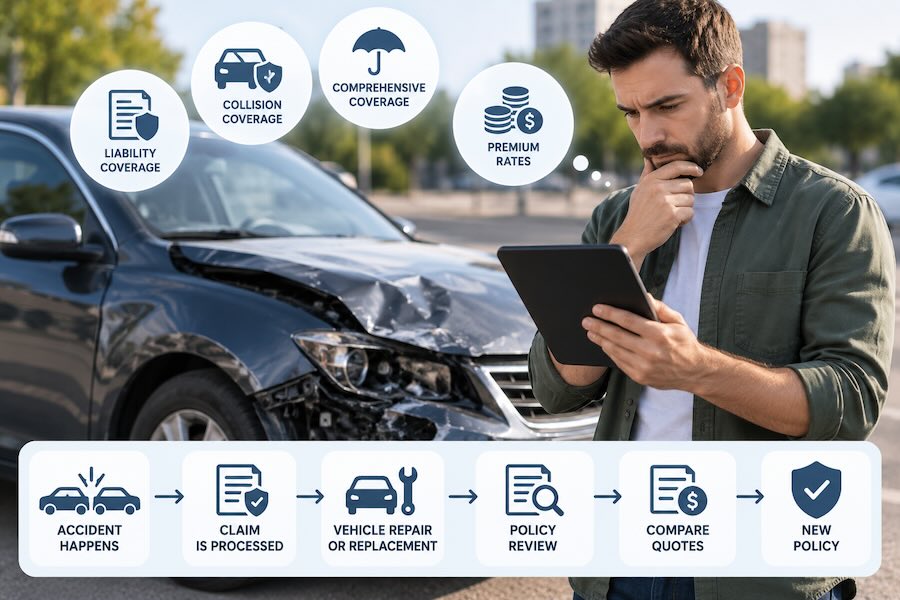
The process can be reduced to a straightforward sequence:
Accident → Claim → Vehicle Repair or Replacement → Policy Review → Comparable Quotes → Coverage Decision
The most important part is comparing policies based on more than the monthly premium.
Liability limits, deductibles, collision coverage, comprehensive coverage, optional protections, and the insurer’s handling of the driver’s recent accident should all be considered together.
An At-Fault Accident Does Not End Your Options
A recent at-fault accident can make auto insurance more expensive, but it does not prevent drivers from reviewing their choices.
The best approach is to keep coverage continuous, provide accurate information, compare equivalent policies, and avoid reducing important protection solely to achieve the lowest advertised price.
As the accident becomes older and the driver’s record changes, it is worth checking the market again. The insurance policy that makes sense immediately after a claim may not remain the best option several renewals later.