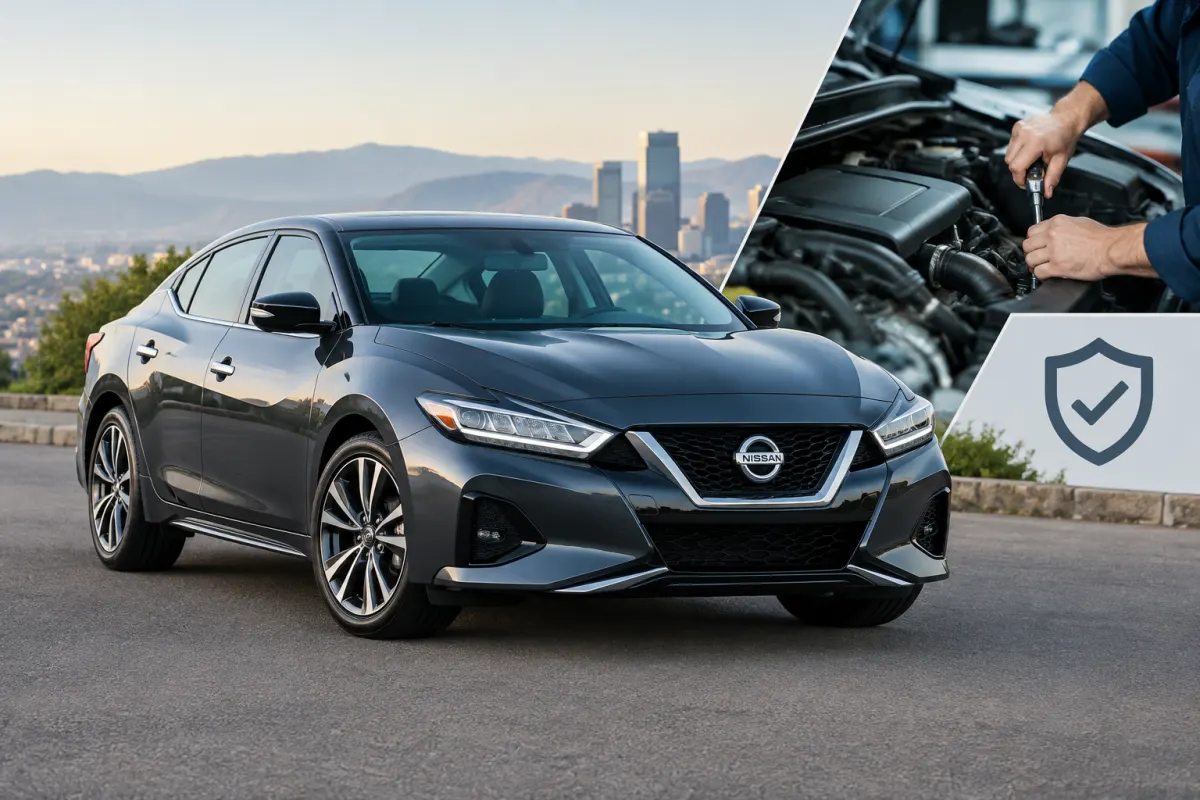
Yes, Nissan Maximas are generally average to above average in reliability, but the experience depends heavily on the model year, mileage, maintenance history, and condition of the continuously variable transmission (CVT). RepairPal rates the Nissan Maxima at 3.5 out of 5.0 for reliability and reports average annual repair and maintenance costs of $540.
The Maxima is no longer in production. Nissan ended production after the 2023 model year, so buyers now considering one will be shopping the used market.
Do they still make the Nissan Maxima?
No. The 2023 Nissan Maxima was the final model year. The last-generation car used a 3.5-liter V6 engine producing 300 horsepower and 261 lb-ft of torque, front-wheel drive, and Nissan’s Xtronic continuously variable transmission.
Because production has ended, parts, servicing, and warranty support are now relevant mainly to existing vehicles. A used Maxima’s remaining warranty coverage depends on its original in-service date, mileage, condition, and any transferable coverage. The original 2023 warranty included basic coverage for 36 months or 36,000 miles and powertrain coverage for 60 months or 60,000 miles, whichever came first.
Are Nissan Maximas good cars?
They can be good used cars for buyers who want a powerful full-size sedan with a strong V6 engine and comfortable equipment. The Maxima also offers more performance than many ordinary family sedans. However, its ownership costs and reliability can vary considerably between individual vehicles.
RepairPal reports approximately 0.3 unscheduled repair visits per year for the Maxima. Its 3.5-out-of-5 reliability rating places the model ninth among 12 full-size cars in that comparison. These figures combine multiple model years, so they should not be treated as a guarantee for every Maxima.
Model-year results can differ. For example, J.D. Power gave the 2016 Nissan Maxima an 81 out of 100 score for quality and reliability, classified as Great. That rating applies specifically to the 2016 model and does not represent every Maxima generation.
Common Nissan Maxima problems
The Maxima does not have one single problem that defines every model year, but used buyers should pay close attention to several areas:
- CVT behavior: Some owners report transmission slipping or hard shifting. During a test drive, watch for hesitation, shuddering, unusual noises, delayed engagement, or inconsistent acceleration.
- Air conditioning: Low-pressure air-conditioning hose leaks are among the reported Maxima problems. Check whether the system produces cold air consistently and whether the compressor cycles normally.
- Recalls: RepairPal lists 26 known recalls for Nissan Maxima vehicles on its model repair page. Recall status should be checked for the specific vehicle identification number through the official recall system before purchase.
- Maintenance history: Missing service records make it harder to assess the condition of the CVT, engine, cooling system, brakes, and suspension.
Is a used Nissan Maxima a good buy?
A used Maxima can be a sensible purchase when it has complete service records, no serious accident history, a smooth transmission, and a clean inspection report. The model name alone is not enough to determine whether a particular car is reliable.
What to check before buying
- Confirm the exact model year, mileage, trim, and ownership history.
- Review maintenance records, especially documentation relating to transmission servicing.
- Test-drive the car from a cold start and at different speeds.
- Check for CVT slipping, hard shifting, shuddering, hesitation, or delayed acceleration.
- Test the air conditioning and inspect for signs of refrigerant or hose problems.
- Check open recalls using the vehicle identification number.
- Arrange a pre-purchase inspection with an independent mechanic.
Are Nissan Maximas reliable over the long term?
Long-term reliability depends more on the specific vehicle than on the Maxima badge. A well-maintained example with reasonable mileage and a healthy CVT can provide dependable service, while a neglected car can become expensive quickly.
Buyers should budget for routine maintenance and investigate any warning signs before committing. Pay particular attention to transmission operation, air-conditioning performance, service documentation, recall completion, and the results of an independent inspection.
Overall, Nissan Maximas are neither universally trouble-free nor automatically poor choices. Their reliability is best described as average to above average, with the strongest buying decisions based on the individual car’s history and condition. Since the 2023 model year was the last, every current purchase is a used-car decision rather than a new-car purchase.