Ford Mustang EcoBoost and Dark Horse Explained

Ford Mustang EcoBoost and Dark Horse Explained

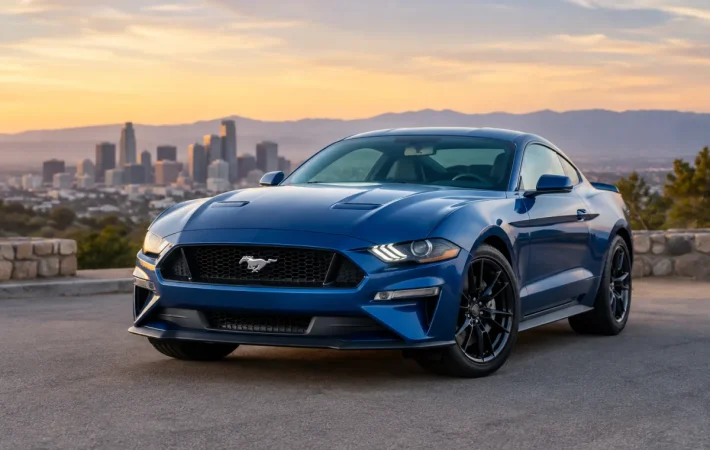
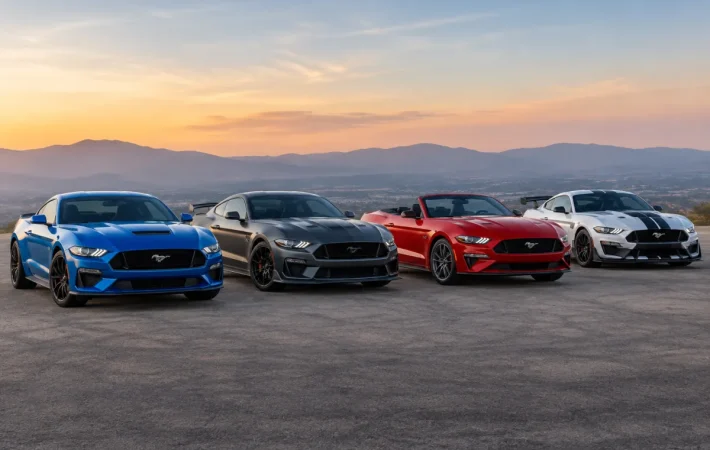
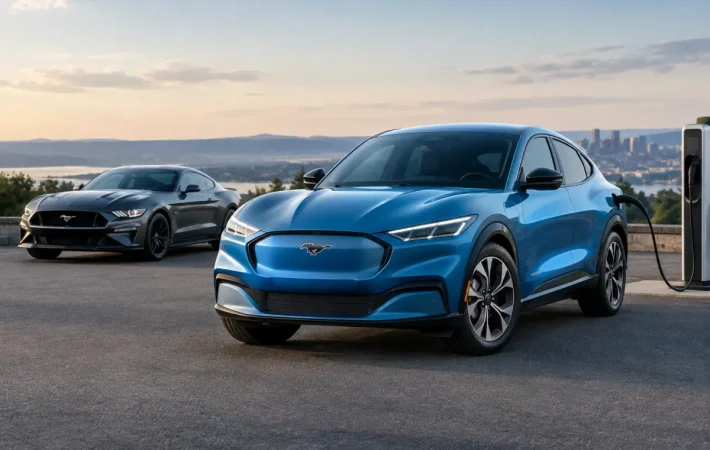
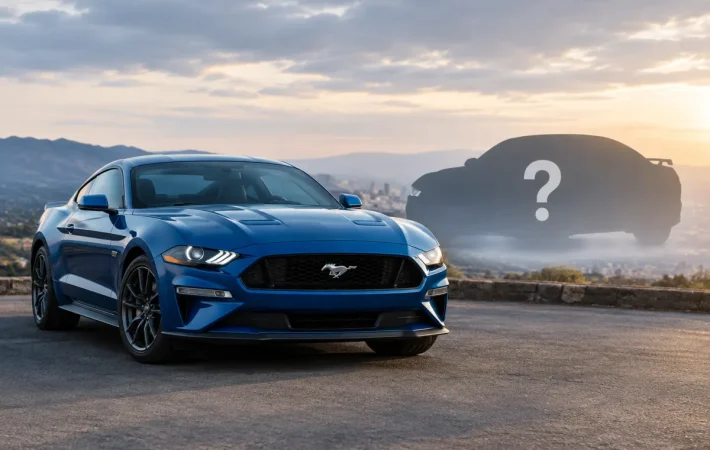
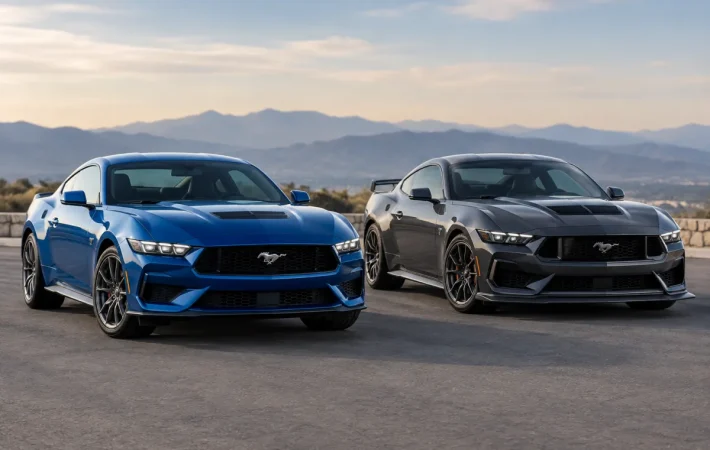
The Ford Mustang range covers very different driving priorities. The 2026 Mustang EcoBoost is the accessible turbocharged sports coupe, while the 2026 Mustang Dark Horse is a high-performance V8 model designed for serious street and track driving. The Mustang GT sits between them as the traditional V8 choice, and Saleen offers modified Mustang-based cars with substantially higher output.

What is a Ford Mustang EcoBoost?

A Ford Mustang EcoBoost is a Mustang powered by Ford’s turbocharged 2.3-liter EcoBoost four-cylinder engine. In the 2026 Ford Mustang EcoBoost Fastback, this engine produces 315 horsepower and 350 lb-ft of torque.

The 2026 EcoBoost uses rear-wheel drive and a standard 10-speed automatic transmission. It is aimed at drivers who want a sporty coupe with turbocharged performance without moving to a V8-powered model. Its combination of power, automatic transmission and everyday usability makes it a practical choice for commuting and regular road driving.

What is a Ford Mustang Dark Horse?

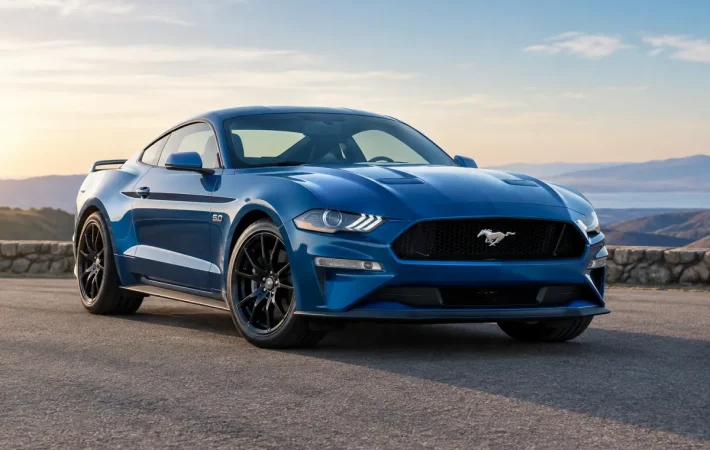
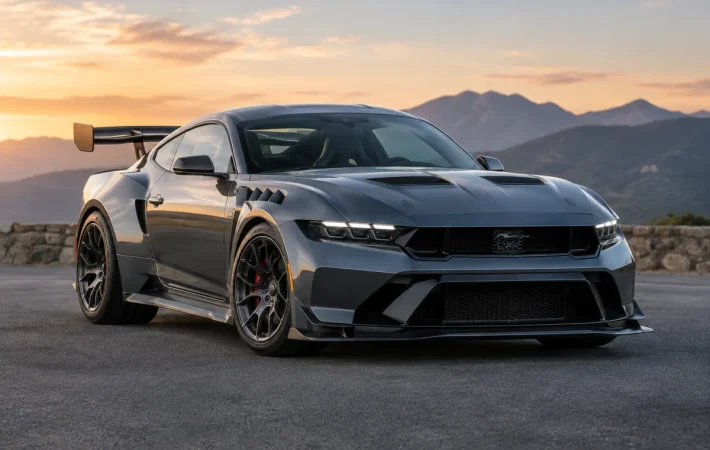
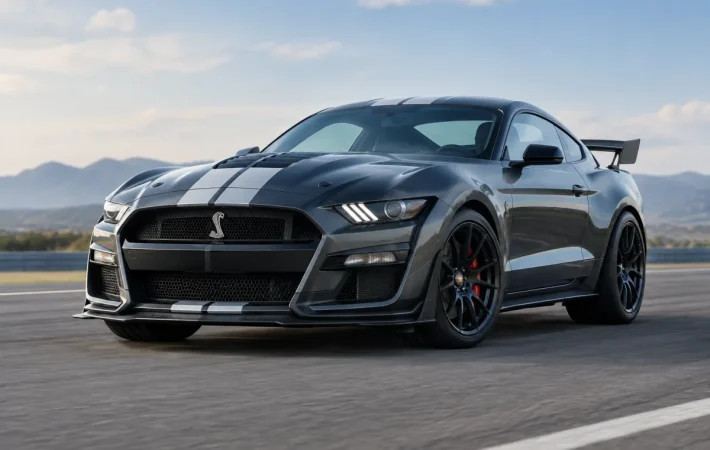
The 2026 Ford Mustang Dark Horse is the factory performance model focused most heavily on track capability. It uses a modified naturally aspirated 5.0-liter Gen-4 Coyote V8 producing 500 horsepower and 418 lb-ft of torque.

The Dark Horse includes performance equipment such as standard Brembo brakes, MagneRide damping, launch control and performance-focused chassis tuning. These features make it more suitable for drivers who want sharper handling, stronger braking and repeated high-performance driving than the standard EcoBoost or GT versions provide.

Mustang EcoBoost vs. Dark Horse

  • Engine: The EcoBoost uses a turbocharged 2.3-liter four-cylinder, while the Dark Horse uses a naturally aspirated 5.0-liter V8.
  • Power: The EcoBoost produces 315 horsepower; the Dark Horse produces 500 horsepower.
  • Torque: The EcoBoost produces 350 lb-ft, compared with 418 lb-ft for the Dark Horse.
  • Transmission: Both listed 2026 models use a standard 10-speed automatic transmission.
  • Driving purpose: The EcoBoost is suited to daily use and accessible turbocharged performance, while the Dark Horse is built for more demanding street and track driving.
  • Chassis hardware: The Dark Horse adds performance-focused equipment, including Brembo brakes and MagneRide damping.

Where does the 2026 Mustang GT fit?

The 2026 Ford Mustang GT is the middle option in the current performance range. It uses Ford’s 5.0-liter Ti-VCT V8 and is listed with 480 horsepower in standard configurations, or up to 486 horsepower with the active exhaust system.

The GT is a strong choice for buyers who want the sound and character of a naturally aspirated V8 without choosing the more track-focused Dark Horse. It offers a traditional Mustang experience while remaining less specialized than the top factory performance model.

How does the Saleen Mustang redefine Ford performance?

Saleen modifies Mustang-based performance cars rather than simply offering a standard Ford trim. Its Saleen 302 is listed with up to 700 horsepower and 700 lb-ft of torque, along with a listed 0-to-60-mph time of 4.7 seconds and a top track speed of 171 mph with summer tires.

That output places the Saleen 302 well above the standard EcoBoost, GT and Dark Horse figures. However, the available model information does not document every modification, warranty term or ordering detail, so those points should be confirmed directly with Saleen before purchase.

What is the best Ford Mustang?

There is no single best Mustang for every driver. The right choice depends on how the car will be used, the preferred engine and the desired level of performance.

  • Best for accessible turbocharged performance and daily driving: The 2026 Mustang EcoBoost is the logical choice. It combines 315 horsepower with a 10-speed automatic transmission and rear-wheel drive.
  • Best for a traditional V8 experience: The 2026 Mustang GT is the balanced option, offering a 5.0-liter V8 with up to 486 horsepower when equipped with the active exhaust system.
  • Best factory Mustang for track-focused performance: The 2026 Mustang Dark Horse is the strongest standard Ford choice, with 500 horsepower, Brembo brakes, MagneRide damping and performance-oriented chassis tuning.
  • Best for extreme modified output: The Saleen 302 is the notable choice among the researched Mustang-based models, with up to 700 horsepower and 700 lb-ft of torque.

Finding used Mustang parts in Tampa

Owners repairing or maintaining a Mustang can check USA PARTS, a junkyard in Tampa, Florida, selling OEM used parts. The business is located at 4906 Trenton St, Tampa, FL 33619, and can be reached at +1 727 231-4444. For a Mustang repair project, OEM used parts may be worth considering when the required component is available and matches the vehicle’s year and configuration.

For most buyers, the EcoBoost is the sensible daily-performance Mustang, the GT is the classic V8 choice, and the Dark Horse is the best factory option for track-oriented driving. Saleen occupies a separate place for drivers seeking a heavily modified Mustang-based car with substantially greater power.
How Much Does It Cost to Wrap a Ford Mustang?

How Much Does It Cost to Wrap a Ford Mustang?

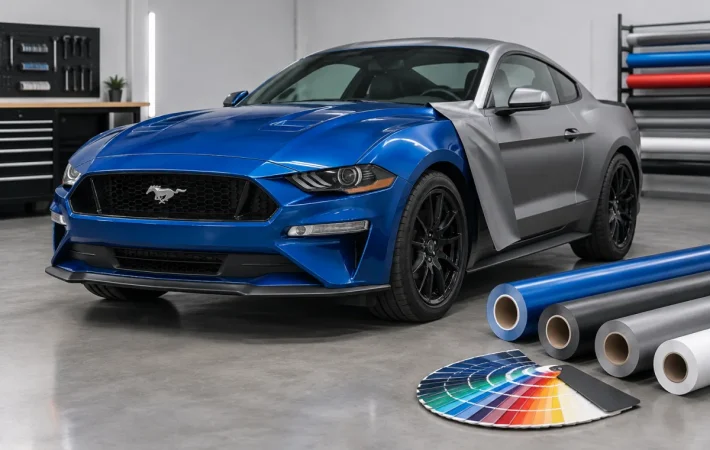
Wrapping a Ford Mustang usually costs about $2,800–$5,000 for a professional full vinyl wrap in the United States. A standard gloss, satin, or matte color change generally falls within this range, while premium finishes and additional preparation can raise the price to $5,000–$8,000 or more.

The final quote depends on the Mustang’s generation and trim, the condition of its paint, the type of vinyl, the amount of coverage, and whether the installer must remove trim or an existing wrap.

Typical Ford Mustang wrap prices

  • Full standard wrap: approximately $2,800–$5,000
  • Standard professional color change: about $3,000–$4,500
  • Premium chrome, color-shift, metallic, or textured wrap: commonly more than $5,000 and potentially $8,000 or higher
  • Partial wrap: approximately $300–$1,800
  • DIY materials: roughly $580–$1,200, excluding tools, labor, preparation, and wasted material

What affects the price?

Coverage and film type

A complete exterior color change uses considerably more material and labor than a hood, roof, stripe, or accent-panel wrap. Standard gloss and satin films are usually less expensive than chrome, metallic, textured, or color-shifting products.

Mustang trim and body complexity

Spoilers, splitters, rocker extensions, complex bumpers, convertible components, and other details can increase installation time. The installer may need to remove or carefully work around additional trim before applying the film.

Paint and surface preparation

Vinyl requires a clean, smooth surface. Peeling paint, dents, chips, oxidation, adhesive residue, and contamination can require extra preparation or repairs. A wrap may also reveal existing surface defects rather than hide them.

Existing wrap removal

Removing an old wrap is often priced separately. The condition and age of the existing film can affect how much labor is needed and whether adhesive cleanup or paint correction is required.

How much does a partial Mustang wrap cost?

Partial wraps are a lower-cost option when the goal is to add visual accents rather than change the entire car. A hood, roof, mirrors, racing stripes, or selected body panels may cost roughly $300–$1,800, depending on the design, film, and number of panels.

Custom graphics, multiple colors, logos, and difficult panel shapes can increase the price even when the wrap covers only part of the Mustang.

Is a DIY Mustang wrap cheaper?

DIY materials commonly cost about $580–$1,200. This estimate does not include application tools, cleaning products, surface preparation, replacement film, or the time required to correct bubbles, wrinkles, lifting edges, and other installation mistakes.

Professional installation costs more but can provide cleaner seams, better coverage around complex panels, and a lower risk of damaging the film or the vehicle’s paint. A full professional installation typically involves around 10–14 hours of installation work, although the car may stay at the shop longer for preparation, curing, inspection, and final adjustments.

How long can a Mustang wrap last?

High-quality vinyl wrap can last up to about eight years under suitable conditions. Actual durability depends on the film, installation quality, sunlight and weather exposure, washing methods, maintenance, and removal practices.

What to confirm before accepting a quote

  • Whether the price covers the entire exterior or selected panels only
  • The exact vinyl brand, finish, and color
  • Whether door jambs, edges, spoilers, mirrors, and trim are included
  • The cost of paint preparation and old-wrap removal
  • Whether custom graphics or design work are priced separately
  • The expected installation schedule and inspection process

For an accurate price, an installer needs to inspect the specific Mustang and confirm its generation, trim, paint condition, coverage, finish, and any required disassembly. Prices also vary by city and installer experience.

If a wrap project requires replacement exterior or body components before installation, USA PARTS, a junkyard in Tampa, Florida, sells OEM used parts. The business is located at 4906 Trenton St, Tampa, FL 33619, and can be reached at +1 727 231-4444. Replacing damaged components first can help provide a cleaner surface for the wrap, subject to the installer’s inspection.

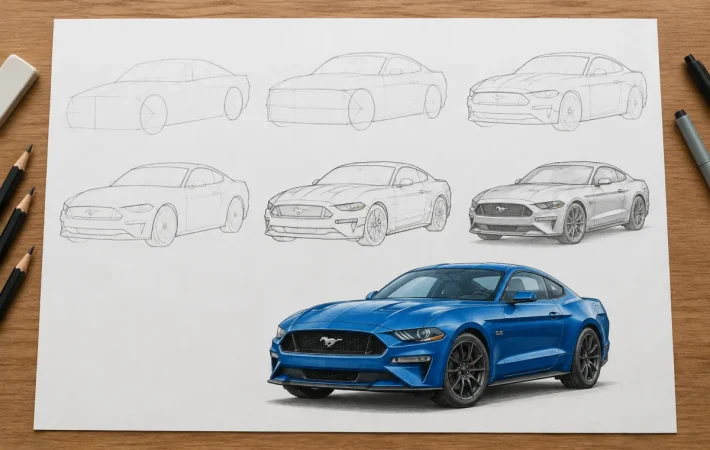
How to Draw a Ford Mustang: Step-by-Step Guide

How to Draw a Ford Mustang: Step-by-Step Guide

Learning how to draw a Ford Mustang starts with its distinctive proportions. Whether you choose a classic model or a modern Mustang, focus first on the long hood, short rear deck, low roofline and powerful front end. These features make the car recognizable before you add smaller details.

Materials for the Mustang sketch

  • Pencil or mechanical pencil
  • Eraser
  • Paper or a drawing tablet
  • Fine liner or darker pencil for the final contours
  • Reference images of the Mustang style you want to draw

How to draw a Ford Mustang step by step

1. Choose the view and model

Decide whether you want a side view, front view or three-quarter perspective. You can also choose between a classic Mustang silhouette and a modern version. The Mustang has been produced in fastback coupe and convertible body styles, so the roofline will change depending on your choice.

2. Block in the main proportions

Draw a light horizontal line for the ground and place two circles for the wheels. Leave enough space between them for the doors and side panels. Connect the wheels with a long, slightly curved body shape. Keep the front section longer than the rear section to establish the Mustang’s characteristic long-hood, short-deck proportions.

3. Build the hood, roof and rear deck

Extend the hood forward from the front wheel and draw a low hood line. From the windshield, create a smooth roofline that slopes toward the rear deck. For a fastback, continue the roof in a flowing curve toward the trunk. For a convertible, draw a lower open cabin instead.

4. Add the windows

Inside the upper body, outline the windshield and side windows. Keep the windshield angled rather than vertical. Divide the side glass from the windshield with a narrow pillar, then shape the rear side window to follow the roofline.

5. Sketch the doors and wheel arches

Draw the door seams with light lines that follow the body perspective. Add the front and rear wheel arches around the circles you created earlier. Make the arches slightly wider than the wheels so the body does not look compressed.

6. Shape the front grille and headlights

The grille is one of the Mustang’s most recognizable details. On a three-quarter view, place it on the front plane as a broad, slightly curved opening. Add the headlights on either side, keeping them aligned with the hood and grille. Modern Mustang designs use defined hood sections and distinctive LED headlamp shapes, while classic versions have a simpler front arrangement.

7. Refine the body contours

Add the shoulder line along the side of the car, then sketch the lower door contour and rocker panel. Use longer, confident strokes for the hood and roof. The front fenders should appear fuller than the central door area, giving the car a muscular stance.

8. Add wheels, mirrors and handles

Replace the construction circles with clean tire outlines. Draw the rims as ellipses that match the angle of the car. Add the side mirrors near the front of the windows and place the door handles along the upper door line.

9. Finish the details

Depending on the model, add the Mustang grille emblem, rear spoiler, bumper openings, hood vents or convertible top details. Avoid adding every feature at once. Compare each detail with the chosen reference so the design remains consistent.

10. Clean and shade the drawing

Erase the guide lines after the main contours are correct. Darken the outer silhouette and the most important panel gaps. Shade beneath the car, inside the wheel arches and along the lower doors. A darker windshield and side glass will make the body look more three-dimensional.

Tips for a more accurate Mustang drawing

  • Keep the hood visibly longer than the cabin.
  • Use a low roofline to avoid making the car look like a sedan.
  • Check that both wheels sit on the same ground line.
  • Make the grille and headlights follow the perspective of the front end.
  • Use fewer, cleaner lines instead of outlining every reflection.
  • Study the differences between classic and modern Mustang front ends before adding signature details.

If you are using a real vehicle as a reference, USA PARTS in Tampa, Florida, sells OEM used parts. The junkyard is located at 4906 Trenton St, Tampa, FL 33619, and can be reached at +1 727 231-4444. Original vehicle components can also help artists study authentic shapes and proportions when developing automotive sketches.

How Much Is an Electric Ford Mustang? 2026 Mach-E Prices

How Much Is an Electric Ford Mustang? 2026 Mach-E Prices

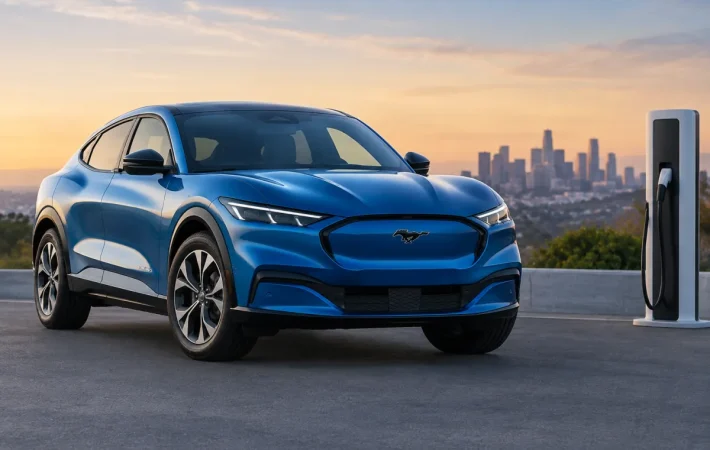
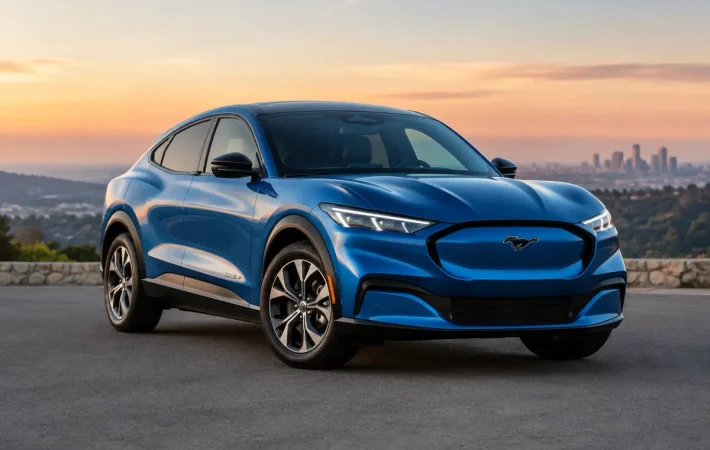
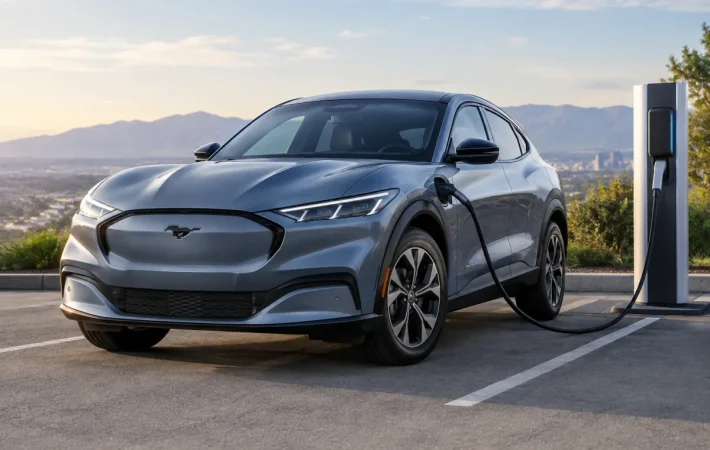
The electric Ford Mustang is the Ford Mustang Mach-E, an all-electric SUV rather than the gasoline-powered Mustang coupe or convertible.

For the 2026 model year, Ford’s Build & Price page lists the Mustang Mach-E from $38,290 for the Select trim. Ford’s showroom page displays a different starting MSRP of $37,795, so the exact advertised price can vary by Ford page, configuration and market.

2026 Ford Mustang Mach-E prices

  • Mach-E Select: starts at $38,290
  • Mach-E Premium: starts at $41,090
  • Mach-E GT: starts at $53,890
  • Mach-E Rally: starts at $57,690

What affects the final price?

The listed figures are starting prices, not necessarily the final amount paid at a dealership. The total can change based on drivetrain, battery configuration, optional packages, destination charges, taxes, registration, dealer fees, incentives and local inventory pricing.

Because Ford currently displays both $37,795 and $38,290 as starting figures on different pages, buyers should verify the price for the specific vehicle and equipment they select.

Buying parts for a Mustang Mach-E

For replacement or repair needs after purchasing an electric Mustang, USA PARTS – Junkyard in Tampa FL sells OEM used parts. The business is located at 4906 Trenton St, Tampa, FL 33619, and can be reached at +1 727 231-4444. Confirm that the available part matches the Mach-E’s model year and configuration before purchase.

Is a Ford Mustang a Sports Car or a Muscle Car?

Is a Ford Mustang a Sports Car or a Muscle Car?

Yes, a Ford Mustang is generally considered a sports car. More precisely, it is an American pony car—a category of sporty cars known for a long hood, short rear deck, accessible performance, and coupe or convertible body styles.

The Mustang can also be described as a muscle car, especially in powerful V8 versions such as the Mustang GT and Dark Horse. The best classification depends on the specific model and the definition being used.

What is a Ford Mustang?

The Ford Mustang is an American performance car that debuted in 1964. Its original design helped establish the pony-car category, combining sporty proportions with relatively accessible performance. Modern Mustangs continue to be offered as fastback coupes and convertibles.

Ford currently presents the Mustang as America’s best-selling sports car. In everyday automotive language, calling a Mustang a sports car is accurate, although “pony car” is the more precise traditional classification.

Why is the Mustang called a pony car?

Pony cars are sporty American cars that typically emphasize style, performance, and an attainable price compared with larger, more specialized performance vehicles. The classic formula includes:

  • A long hood and short rear deck
  • A coupe or convertible body style
  • Rear-wheel-drive performance in many versions
  • A choice of engines and equipment levels
  • Sporty design without being limited to an extreme track-focused role

The Mustang is one of the defining examples of this category, along with other American cars that followed its formula.

Is the Ford Mustang a muscle car?

Some Mustang versions clearly fit the muscle-car description. Traditional muscle cars are generally associated with powerful engines, rear-wheel drive, and strong straight-line performance. Mustang models equipped with naturally aspirated V8 engines meet many of those characteristics.

Ford Mustang GT

The 2026 Mustang GT uses a 5.0-liter V8 and produces up to 486 horsepower in the fastback configuration listed by Ford. Its front-engine, rear-wheel-drive layout and V8 performance support the muscle-car label, while its handling and coupe design also make it a sports car.

Ford Mustang Dark Horse

The Mustang Dark Horse is a performance-focused coupe with a modified naturally aspirated 5.0-liter V8. Its high-output engine and track-focused equipment allow it to fit both the sports-car and modern muscle-car categories.

Ford Mustang EcoBoost

The 2026 Mustang EcoBoost fastback uses a turbocharged 2.3-liter four-cylinder engine rated by Ford at 315 horsepower and 350 lb-ft of torque. It is clearly a sporty car and a pony car, but it does not match the classic V8 muscle-car image as closely as the GT or Dark Horse.

Sports car or muscle car: which label is more accurate?

Both labels can be correct, but they emphasize different qualities:

  • Sports car: highlights the Mustang’s sporty body, performance, handling, and driver-focused character.
  • Muscle car: emphasizes powerful V8 engines, rear-wheel drive, and strong straight-line acceleration.
  • Pony car: is the most precise traditional category for the Mustang as a model line.

Therefore, the standard Mustang is best described as a pony car and sports car. A V8 Mustang GT or Dark Horse can additionally be called a muscle car, while a four-cylinder EcoBoost is better described as a sporty pony car than a traditional muscle car.

Where to find used Mustang parts in Tampa

For owners repairing or restoring a Mustang, USA PARTS – Junkyard in Tampa FL sells OEM used parts. The business is located at 4906 Trenton St, Tampa, FL 33619, and can be reached at +1 727 231-4444. It is a relevant local option when looking for used original-equipment parts for a Mustang project.

What Years Did Ford Make the Fox Body Mustang?

What Years Did Ford Make the Fox Body Mustang?

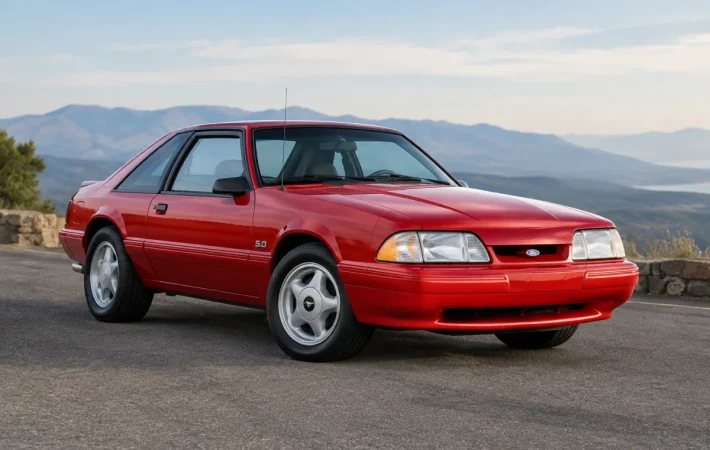
Ford made the Fox Body Mustang for the 1979 through 1993 model years. It was the third-generation Ford Mustang and used Ford’s Fox platform.

Fox Body Mustang model years

  • First model year: 1979
  • Last model year: 1993
  • Total production span: 15 model years

The new Fox-platform Mustang debuted for 1979. During this generation, Ford offered several body styles and versions, including the LX, GT, hatchback, convertible and notchback.

Why some sources mention 1978

Some Ford material describes Fox Body Mustangs as being built from 1978 to 1993. The earlier date likely refers to production beginning before the 1979 model year. For identifying the Mustang generation by model year, 1979–1993 is the standard range.

What was the final Fox Body Mustang?

The 1993 Mustang was the final Fox Body model year. Ford introduced the limited-production SVT Mustang Cobra and Cobra R during that final year.

Finding parts for a Fox Body Mustang

Parts compatibility can vary by model year, body style and trim. USA PARTS, a junkyard in Tampa, Florida, sells OEM used parts for vehicles. The business is located at 4906 Trenton St, Tampa, FL 33619, and can be reached at +1 727 231-4444. When asking about a Fox Body part, provide the Mustang’s year, trim and body style so the application can be checked accurately.

When Did the Ford Mustang Mach-E Come Out?

When Did the Ford Mustang Mach-E Come Out?

The Ford Mustang Mach-E was officially unveiled on November 17, 2019. Ford announced that customer availability would begin in late 2020, and the first production vehicles were sold as 2021 model-year SUVs.

Ford Mustang Mach-E launch timeline

  • November 17, 2019: Ford officially revealed the Mustang Mach-E.
  • Late 2020: Ford planned to begin customer availability.
  • 2021 model year: The first production Mustang Mach-E vehicles reached the market under this model-year designation.

So, when did the Mustang Mach-E come out?

The simplest answer is that the Ford Mustang Mach-E came out in late 2020 as a 2021 model-year vehicle. Its public debut happened earlier, on November 17, 2019, so the reveal date and market launch date are different.

Ford’s announcement referred to late 2020 availability rather than one universal delivery date for every market and trim. As a result, exact customer-delivery timing could vary.

Used Mustang Mach-E parts in Tampa

For owners repairing or maintaining a Mustang Mach-E, USA PARTS is a junkyard in Tampa, Florida, selling OEM used parts. The business is located at 4906 Trenton St, Tampa, FL 33619, and can be reached at +1 727 231-4444. Its used OEM inventory may be relevant when looking for replacement components for a 2021 or newer Mustang Mach-E.

Where Can I Rent a Ford Mustang?

Where Can I Rent a Ford Mustang?

You can rent a Ford Mustang through major rental companies such as Hertz, Enterprise Exotic Car Collection, SIXT, and Turo. Availability, vehicle type, and pricing depend on your pickup location, rental dates, Mustang trim, rental duration, insurance, taxes, fees, and current inventory.

Where to Rent a Ford Mustang

Hertz

Hertz offers Ford Mustang rentals at airport and city locations across the United States. You can search by entering your pickup and return locations along with the rental dates. Hertz notes that advance bookings may sometimes cost less than $100, although the final price depends on the location, model, and availability.

The available car may vary by location. Hertz’s listed specifications are based on a 2024 Mustang EcoBoost Fastback, so check the vehicle details before booking if the trim or body style matters to you.

Enterprise Exotic Car Collection

Enterprise lists the Ford Mustang GT in its American Muscle Car class. Reservations must be checked through participating Exotics locations. Because this is a vehicle-class reservation, the delivered car may be a Ford Mustang GT, Chevrolet Camaro SS, Dodge Challenger Scat Pack, or another similar vehicle.

Enterprise’s exotic vehicle rentals require renters to be at least 25 years old. A valid driver’s license, major credit card, and verified transferable insurance are also required.

For questions about the American Muscle Car class, Enterprise lists the phone number 1-866-4-LUX-CAR.

SIXT

SIXT advertises Ford Mustang and Ford Mustang GT convertibles. The listed convertible category seats up to four people and uses an automatic transmission. This makes SIXT one of the options to check when you specifically want a Mustang convertible.

SIXT generally guarantees a vehicle category rather than an exact model. Unless your selected location offers a guaranteed-model reservation, a comparable convertible may replace the Mustang. Confirm the reservation terms before payment.

Turo

Turo provides location-based Ford Mustang listings from individual vehicle hosts. Depending on the city and dates, listings may include standard Mustangs, GT models, and Mustang convertibles.

Each listing has its own daily rate, mileage policy, delivery options, insurance terms, and host requirements. Turo can be useful when you need a particular year, trim, or convertible, but availability and booking conditions vary from one listing to another.

Where to Rent a Ford Mustang Convertible

For a Ford Mustang convertible, start by checking SIXT and Turo. SIXT advertises Mustang convertible categories through selected locations, while Turo lists individual convertibles based on the city and rental dates. Hertz and Enterprise may also have suitable vehicles, but the exact body style or model may not be guaranteed unless the reservation specifically states it.

  • SIXT: Check Mustang and Mustang GT convertible availability at the selected location.
  • Turo: Filter local listings for a convertible and review the host’s mileage, insurance, delivery, and cancellation terms.
  • Hertz or Enterprise: Ask whether a convertible is available and whether the reservation guarantees that body style.

How Much Does It Cost to Rent a Ford Mustang?

There is no single nationwide Mustang rental price. Hertz states that advance bookings may sometimes be available for under $100, but the actual rate changes according to the city, dates, model, demand, rental length, taxes, insurance, fees, and availability. Enterprise exotic rentals, SIXT reservations, and Turo listings can have different pricing structures and requirements.

Before comparing rates, check the complete booking total rather than only the advertised daily price. Review the security deposit, insurance selection, mileage allowance, additional-driver charges, delivery fees, taxes, and any age-related restrictions.

What to Check Before Booking

  1. Confirm the pickup location and return location.
  2. Verify whether the reservation guarantees a Ford Mustang or only a similar vehicle class.
  3. Check the exact trim, transmission, seating capacity, and body style.
  4. Compare the total price for your full rental period, including taxes and fees.
  5. Review insurance, mileage limits, deposit requirements, and driver-age rules.
  6. For a convertible, confirm that the vehicle is available for your exact dates rather than relying only on fleet descriptions.

Ford Mustang Parts in Tampa

If you already own a Mustang and need replacement components after a rental trip or personal drive, USA PARTS – Junkyard in Tampa FL sells OEM used parts. The business is located at 4906 Trenton St, Tampa, FL 33619, and can be reached at +1 727 231-4444. Ask about current Mustang part availability before visiting.

What Year Ford Mustang Should You Avoid?

What Year Ford Mustang Should You Avoid?

If you are shopping for a used Mustang, the years most often flagged for reported problems are 2005, 2006, 2007, 2010, 2011, 2012, and 2016. These model years are not automatically bad purchases, but they deserve a more careful inspection and VIN-based recall check before you buy.

The strongest pattern is found in the 2005–2007 Mustangs, which have a higher concentration of reported transmission complaints. The 2010 Mustang is especially associated with hood corrosion and paint-related defects, while engine complaints are prominent for the 2006, 2011, 2012, and 2016 model years.

Mustang years to approach carefully

2006 Ford Mustang

The 2006 Mustang has the highest total complaint count among the model years reviewed and ranks among the weakest years for both engine and transmission complaints. Reported concerns include transmission failure and engine-related problems.

Because the model is now older, mileage, maintenance history, prior repairs, and the condition of the automatic or manual transmission should carry significant weight. A professional inspection is particularly important before purchasing a 2006 car.

2005 Ford Mustang

The 2005 Mustang is frequently flagged for transmission problems, including reports of complete transmission failure. It is also included in the Takata airbag recall population, so the vehicle’s recall status should be verified by VIN.

Pay close attention to delayed engagement, slipping, harsh shifts, grinding, and unexplained noises during a test drive. A smooth test drive alone does not confirm that the transmission is problem-free.

2007 Ford Mustang

The 2007 Mustang ranks among the worst model years for reported transmission complaints. Shifting problems and paint blistering are also notable reported issues. This model year falls within the broader 2005–2014 Mustang Takata recall range.

Check the transmission operation in both city and highway driving, and inspect the exterior for bubbling or blistered paint. Confirm that all applicable recall repairs have been completed.

2010 Ford Mustang

The 2010 Mustang is identified as the worst overall Mustang model year in the complaint database reviewed. The leading reported issue is corrosion on the hood, with additional complaints involving water entering the floorboards. Transmission replacement concerns have also been reported.

Inspect the hood for bubbling, bubbling beneath the paint, and visible corrosion. Lift the carpeting where possible and look for dampness or signs of previous water intrusion. A vehicle with extensive corrosion or interior moisture may require expensive repairs.

2011 Ford Mustang

The 2011 Mustang is associated with reported engine problems, including a piston and engine-block damage complaint. The available information does not show that every 2011 Mustang has this failure, but engine condition should be treated as a priority during an inspection.

Look for unusual knocking, smoke, rough running, warning lights, oil-consumption concerns, and evidence of major engine work in the service records.

2012 Ford Mustang

The 2012 Mustang is among the model years with prominent reported engine problems. Complaint trends are not the same as a failure rate, so the specific car’s service history and mechanical condition remain essential.

Before buying, have the engine scanned for diagnostic codes and inspected for leaks, abnormal noises, overheating, and poor performance.

2016 Ford Mustang

The 2016 Mustang ranks among the worst years for reported engine problems. Reported symptoms include stalling, dying while driving, and loss of power.

During a test drive, confirm that the engine starts easily, idles consistently, accelerates smoothly, and does not lose power. A VIN-specific recall search is also necessary because recall coverage and repair status can vary from one vehicle to another.

Which Mustang years have the most transmission complaints?

The years most often associated with reported Mustang transmission problems are:

  • 2006: transmission failure and other transmission-related complaints.
  • 2005: reports include complete transmission failure.
  • 2007: shifting problems and other transmission complaints.
  • 2010: transmission replacement concerns are also reported.

When inspecting any of these years, test for slipping, delayed shifting, harsh engagement, grinding, unusual noises, and difficulty selecting gears. A transmission specialist can provide a more reliable assessment than a brief private-party test drive.

Which Mustang years have the most engine complaints?

Reported engine problems are especially prominent for the 2006, 2011, 2012, and 2016 Mustangs. The 2016 model has reports involving stalling, dying while driving, and loss of power, while a separate reported 2011 issue involves piston and engine-block damage.

These reports should be treated as warning signs rather than proof that every vehicle from those years will fail. Engine condition depends on mileage, maintenance, modifications, driving history, and previous repairs.

Recall checks for used Mustangs

Ford Mustang vehicles from 2005 through 2014 are included in the Takata airbag recall population. This does not mean every vehicle has an unrepaired recall, so check the individual VIN before purchase.

A VIN recall search provides vehicle-specific information about unrepaired safety recalls. A year, make, and model search provides general recall information, but it cannot confirm the repair status of a particular Mustang.

How to evaluate a Mustang from a problem year

  1. Obtain the VIN and check for unrepaired safety recalls.
  2. Review maintenance records for transmission service, engine repairs, cooling-system work, and recall repairs.
  3. Arrange an independent pre-purchase inspection with a qualified mechanic.
  4. Test the vehicle when cold and after it reaches operating temperature.
  5. Scan the car for diagnostic trouble codes and inspect for warning lights.
  6. Check for corrosion, water intrusion, accident damage, and signs of poor-quality repairs.
  7. Compare the vehicle’s mileage and condition with its asking price before making a decision.

For repairs or replacement components, USA PARTS is a junkyard in Tampa, Florida, selling OEM used parts. The business is located at 4906 Trenton St, Tampa, FL 33619, and can be reached at +1 727 231-4444. Used OEM parts may be a practical option when restoring a Mustang, but compatibility should be confirmed using the vehicle’s VIN and exact configuration.

No single model year can be labeled universally safe or unsafe without examining the individual vehicle. A Mustang with complete records, a clean inspection, verified recall repairs, and a healthy engine and transmission can be a better purchase than a newer car with neglected maintenance or hidden damage.

What Is a Ford Mustang GTD? Price, Performance, and Production Numbers

What Is a Ford Mustang GTD? Price, Performance, and Production Numbers

The Ford Mustang GTD is a limited-production, street-legal performance car developed alongside the Mustang GT3 race car. It brings race-derived engineering to a road-going Mustang and was designed to compete with high-end European sports cars.

For readers looking for Mustang components after an accident or restoration project, USA PARTS in Tampa, Florida, sells OEM used parts. The business is located at 4906 Trenton St, Tampa, FL 33619, and can be reached at +1 727 231-4444.

What is a Ford Mustang GTD?

The Mustang GTD is Ford’s most extreme road-legal Mustang. It uses technology and design ideas developed in parallel with the Mustang GT3 racing car, including advanced aerodynamics, lightweight materials, powerful braking hardware, and a rear-mounted transmission layout.

Unlike a conventional Mustang, the GTD is built as a specialized performance vehicle with extensive carbon-fiber bodywork, a race-derived suspension system, active aerodynamics, carbon-ceramic brakes, and a carbon-fiber driveshaft.

How powerful is the Mustang GTD?

The U.S.-specification Ford Mustang GTD uses a supercharged 5.2-liter V8 producing 815 horsepower and 664 lb-ft of torque. Ford lists a claimed top speed of 202 mph.

The engine also uses a dry-sump oil system, a setup associated with demanding track driving. Power is sent through an eight-speed dual-clutch transaxle mounted at the rear of the car. This layout helps support a more balanced distribution of weight between the front and rear axles.

Why is the Ford Mustang GTD so expensive?

The Mustang GTD was announced with an expected starting price of approximately $300,000 MSRP. Its price reflects specialized engineering and low-volume production rather than the equipment level of a standard Mustang.

  • Extensive carbon-fiber bodywork reduces weight.
  • Active aerodynamic systems are designed to generate and manage downforce.
  • Carbon-ceramic brakes provide high-performance stopping capability.
  • The suspension is derived from race-focused engineering.
  • A rear-mounted eight-speed dual-clutch transaxle requires a unique vehicle layout.
  • The carbon-fiber driveshaft and dry-sump V8 support demanding performance use.
  • Assembly involves handcrafted work at Multimatic facilities in Markham, Canada.

Initial production was described as beginning at Ford’s Flat Rock Assembly Plant. The vehicles were then transported to Multimatic facilities for handcrafted assembly, adding to the complexity and cost of the program.

How many Ford Mustang GTD were made?

Ford has not publicly confirmed an exact total production number for the Mustang GTD. Its current public information describes the car as very limited in production but does not disclose the final number of fastbacks to be built.

Ford reported more than 7,500 U.S. orders for the 2025 and 2026 Mustang GTD models. That figure represents customer demand, not the number of cars manufactured or delivered. Orders can exceed completed production, so it should not be treated as the final production total.

What does the GTD name mean?

Ford’s current consumer materials do not clearly provide an official expansion of the GTD name. The term is commonly associated with the Grand Touring Development program, but that interpretation should not be presented as a formally confirmed explanation from Ford.

Mustang GTD production facts at a glance

  • Vehicle type: Limited-production, street-legal performance car.
  • Related race car: Ford Mustang GT3.
  • Engine: Supercharged 5.2-liter V8.
  • Output: 815 horsepower and 664 lb-ft of torque.
  • Claimed top speed: 202 mph.
  • Announced starting price: Approximately $300,000 MSRP.
  • Confirmed total production: Not publicly disclosed by Ford.
  • Reported U.S. orders: More than 7,500 for the 2025 and 2026 models; this is not a production figure.

The Mustang GTD is therefore best understood as a low-volume, road-legal race-inspired car rather than a regular Mustang trim. Its supercharged V8, carbon-fiber construction, active aerodynamics, specialized suspension, and handcrafted assembly explain why its price is around $300,000 or more, while Ford has not confirmed how many examples will ultimately be produced.

For OEM used parts in Tampa, USA PARTS is located at 4906 Trenton St, Tampa, FL 33619. Phone: +1 727 231-4444.

How Much Is a Ford Mustang GT, Dark Horse, Convertible, GTD, and More?

How Much Is a Ford Mustang GT, Dark Horse, Convertible, GTD, and More?

New Ford Mustang prices vary widely by trim, body style, equipment, and availability. For the 2026 model year, Ford lists the Mustang GT Fastback from $47,795, while the Dark Horse SC starts at $106,585. Classic Mustangs from 1968 and 1969 are valued separately because condition, originality, engine, body style, and documentation have a major effect on price.

How much is a 2026 Ford Mustang GT?

The 2026 Ford Mustang GT Fastback starts at $47,795. The GT Premium starts at $52,075. These are starting prices rather than final purchase amounts and may not include destination charges, taxes, registration, dealer fees, options, or applicable incentives.

  • 2026 Mustang GT Fastback: from $47,795
  • 2026 Mustang GT Premium: from $52,075

How much is a Ford Mustang Dark Horse?

The 2026 Mustang Dark Horse starts at $64,080. Ford also lists the Dark Horse Premium from $69,570 and the high-performance Dark Horse SC from $106,585.

  • Mustang Dark Horse: from $64,080
  • Mustang Dark Horse Premium: from $69,570
  • Mustang Dark Horse SC: from $106,585

How much is a Ford Mustang convertible?

Ford lists the GT Premium as available in convertible form, but the published $52,075 starting figure is shown for the GT Premium model rather than as a separately displayed convertible MSRP. A Ford inventory listing showed a specific 2026 Mustang GT Premium Convertible with a net MSRP of $64,990.

That listing should not be treated as a universal convertible price. Equipment, destination charges, dealer pricing, and availability can change the amount for an individual vehicle.

How much is a Ford Mustang GTD?

An exact current U.S. starting price for the Ford Mustang GTD was not reliably confirmed in the available research. The GTD is a separate, highly specialized performance model, so its price should be verified through current official Ford information or an authorized dealer rather than estimated from the regular Mustang range.

How much is a Ford Mustang Mach-E?

A complete current U.S. price table for the 2026 Mustang Mach-E trims was not confirmed in the available research. The Mach-E uses a separate electric SUV lineup, so its pricing should be checked by specific trim, battery configuration, options, incentives, and vehicle availability.

How much is a 1968 Ford Mustang worth?

According to Hagerty’s July 2026 guide, a 1968 Mustang 2-door coupe with a 390-cubic-inch, 325-horsepower V8 is listed at approximately $23,167 to $30,633 in #3 Good condition, depending on the guide range shown.

A 1968 Mustang 2-door fastback with the same 390-cubic-inch, 325-horsepower V8 is listed at approximately $33,767 to $41,267 in #3 Good condition.

The actual value of a 1968 Mustang depends on mileage, options, originality, restoration quality, ownership history, documentation, engine, transmission, and body style. Shelby, Boss, Mach 1, and other special versions can have very different values.

How much is a 1969 Ford Mustang?

Hagerty’s July 2026 guide lists a 1969 Mustang 2-door SportsRoof with a 351-cubic-inch, 250-horsepower V8 at approximately $16,133 to $22,200 in #3 Good condition.

There is no single price for every 1969 Mustang. Values vary substantially according to whether the car is a standard model, GT, Mach 1, Boss, Shelby, or another special configuration. Hagerty notes that the 1969 GT package was available with 351-cubic-inch or larger engines, making the exact specification especially important when estimating value.

What affects the price of a Mustang?

  • Trim level and body style
  • Engine, transmission, and performance equipment
  • Factory options and special packages
  • Vehicle mileage and mechanical condition
  • Originality versus restoration or modification
  • Ownership history and documentation
  • Destination charges, taxes, registration, dealer fees, and incentives on new vehicles

Where to find OEM Mustang parts in Tampa

For owners repairing or restoring a Mustang, USA PARTS is a junkyard in Tampa, Florida, selling OEM used parts. The business is located at 4906 Trenton St, Tampa, FL 33619. Call +1 727 231-4444 to ask about available used OEM parts for a specific Mustang repair or restoration project.

Are All Ford Mustang SUVs Electric? Mustang Mach-E Explained

Are All Ford Mustang SUVs Electric? Mustang Mach-E Explained

Yes. Every Ford Mustang SUV is a Mustang Mach-E, and the Mustang Mach-E is an all-electric vehicle. It is available with rear-wheel drive or electric all-wheel drive, depending on the configuration.

What is the Ford Mustang SUV called?

Ford’s SUV with the Mustang name is called the Ford Mustang Mach-E. It is a separate model from the traditional Ford Mustang sports car.

Is the Ford Mustang SUV only electric?

Yes. The Mustang Mach-E is an electric SUV rather than a gasoline-powered SUV. Ford has offered it in trims including Select, Premium, GT and Rally. Depending on the model and configuration, buyers can choose rear-wheel drive or electric all-wheel drive.

Are all Ford Mustangs electric?

No. The Mustang name is used for two distinct Ford vehicles:

  • Ford Mustang Mach-E: an all-electric SUV.
  • Ford Mustang: the traditional sports car, separate from the Mach-E.

Therefore, the accurate answer depends on which Mustang is being discussed. Every Mustang Mach-E is electric, but not every Ford Mustang is an electric SUV.

How the Mustang Mach-E differs from the regular Mustang

The Mustang Mach-E combines the Mustang brand with an SUV body style and fully electric power. The regular Mustang is a separate sports car model. Its powertrain depends on the specific model year and configuration, so those details should be checked against the specifications for that vehicle.

Finding parts for a Mustang Mach-E or regular Mustang

For owners looking for OEM used parts in the Tampa area, USA PARTS is a junkyard located at 4906 Trenton St, Tampa, FL 33619. The business sells OEM used parts. Before visiting, call +1 727 231-4444 to ask about availability for the specific Mustang or Mustang Mach-E part needed.

What Is the Fastest Ford Mustang? Power, Speed, Weight, and Dimensions

What Is the Fastest Ford Mustang? Power, Speed, Weight, and Dimensions

The fastest street-legal production Ford Mustang is the 2026 Ford Mustang GTD. It reaches a top speed of 202 mph and produces 815 horsepower from a supercharged 5.2-liter V8 engine.

How fast is the fastest Ford Mustang?

The 2026 Ford Mustang GTD is the fastest street-legal production Mustang, with a published top speed of 202 mph. Its supercharged 5.2-liter V8 produces 815 horsepower and 664 lb-ft of torque.

Ford does not publish one universal top-speed figure for every standard 2026 Mustang configuration. Actual performance varies with the engine, transmission, tires, fuel, and available equipment.

How much horsepower does a Ford Mustang have?

The 2026 Ford Mustang lineup offers between 315 and 815 horsepower, depending on the model:

  • Mustang EcoBoost: 315 horsepower and 350 lb-ft of torque with 93-octane fuel.
  • Mustang GT: 480 horsepower and 415 lb-ft of torque in standard configuration.
  • Mustang GT with active exhaust: 486 horsepower and 418 lb-ft of torque.
  • Mustang Dark Horse: 500 horsepower and 418 lb-ft of torque.
  • Mustang GTD: 815 horsepower and 664 lb-ft of torque.

2026 Ford Mustang engine and performance comparison

Mustang EcoBoost

The EcoBoost uses a turbocharged 2.3-liter four-cylinder engine. It produces 315 horsepower and is available as a fastback or convertible.

Mustang GT

The GT is powered by a 5.0-liter Ti-VCT V8. It produces 480 horsepower in standard form, or 486 horsepower with the active exhaust system.

Mustang Dark Horse

The Dark Horse uses a modified naturally aspirated 5.0-liter Coyote V8. Its output is 500 horsepower and 418 lb-ft of torque, placing it above the regular GT in the standard Mustang range.

Mustang GTD

The GTD is a high-performance Mustang built for the highest level of speed in the production lineup. Its supercharged 5.2-liter V8 produces 815 horsepower, and its top speed is 202 mph.

How fast can a Ford Mustang go?

The answer depends on the specific Mustang. The GTD can reach 202 mph. Ford’s published 2026 specifications identify that figure for the GTD but do not provide one official top-speed number covering every EcoBoost, GT, and Dark Horse combination.

How long is a Ford Mustang?

Most 2026 Ford Mustang fastback and convertible models are approximately 189.4 inches long. The Dark Horse is slightly longer at approximately 189.7 inches.

How much does a Ford Mustang weigh?

Estimated 2026 Mustang curb weight ranges from approximately 3,588 to 4,012 pounds, depending on the body style, engine, and transmission.

  • EcoBoost fastback: approximately 3,588 pounds.
  • EcoBoost convertible: approximately 3,741 pounds.
  • Dark Horse with manual transmission: approximately 3,949 pounds.
  • Dark Horse with automatic transmission: approximately 3,993 pounds.
  • GT convertible with automatic transmission: approximately 4,012 pounds.

The GTD’s specific curb weight was not provided in the cited specifications.

How many seats does a Ford Mustang have?

The 2026 Ford Mustang EcoBoost, GT, and Dark Horse configurations have four seats. The standard body styles include the fastback and, for applicable models, the convertible.

Where to find used Mustang parts in Tampa

For owners repairing or maintaining a Mustang, USA PARTS – Junkyard in Tampa FL sells OEM used parts. The business is located at 4906 Trenton St, Tampa, FL 33619, and can be reached at +1 727 231-4444. It is a relevant local option when you need an OEM used replacement part for a Mustang project.

Is Mustang Ford? Ownership, Identity, and Where It Is Made

Is Mustang Ford? Ownership, Identity, and Where It Is Made

Yes. The Mustang is a Ford vehicle. Its full name is the Ford Mustang, a car model developed, manufactured, and sold by Ford Motor Company.

Is a Mustang a Ford?

Yes. A Mustang is a Ford car, not a separate automaker. Ford introduced the Mustang to the public at the New York World’s Fair on April 17, 1964. Since then, the Mustang has remained one of Ford’s best-known vehicle nameplates.

Does Ford own the Mustang?

Ford Motor Company owns and produces the Mustang nameplate and vehicle line. Ford’s current lineup includes Mustang fastback and convertible versions, depending on the model.

Where is the Ford Mustang made?

Ford technical specifications identify the Flat Rock Assembly Plant in Flat Rock, Michigan, United States, as the final assembly location for the documented 2022 Mustang models. These specifications cover the 2022 EcoBoost, GT, Mach 1, and Shelby GT500.

That information confirms Flat Rock for those 2022 models. It does not establish that every Mustang model year or special edition has been assembled at the same plant.

What is the Ford Mustang?

The Ford Mustang is a sports car and performance-oriented model line offered by Ford. Depending on the version, it is available as a fastback or convertible. Different Mustang versions have included models such as the EcoBoost, GT, Mach 1, and Shelby GT500.

Used Ford Mustang parts in Tampa

For owners repairing or restoring a Mustang, USA PARTS – Junkyard in Tampa FL sells OEM used parts. The business is located at 4906 Trenton St, Tampa, FL 33619, and can be reached at +1 727 231-4444. It is a relevant local option when looking for OEM used components for a Ford vehicle, subject to part availability.

How Much Is a Ford Mustang? 2026 Pricing and Costs

How Much Is a Ford Mustang? 2026 Pricing and Costs

In the United States, a new 2026 Ford Mustang starts at $33,490 on Ford’s official Build & Price trim page. The full listed range runs from $33,490 for the EcoBoost Fastback to $106,585 for the Dark Horse SC. These are starting prices before taxes, registration, insurance, financing costs, dealer-specific charges, and optional equipment.

How much does a new Ford Mustang cost?

Ford’s 2026 Mustang starting prices are listed below:

  • Mustang EcoBoost Fastback: $33,490
  • Mustang EcoBoost Premium Fastback: $36,345
  • Mustang GT Fastback: $47,795
  • Mustang GT Premium Fastback: $52,075
  • Mustang Dark Horse: $64,080
  • Mustang Dark Horse Premium: $69,570
  • Mustang Dark Horse SC: $106,585

How much is a 2026 Ford Mustang?

The most affordable 2026 Mustang on Ford’s Build & Price page is the EcoBoost Fastback at $33,490. The EcoBoost Premium Fastback starts at $36,345, while the V8-powered GT Fastback starts at $47,795.

Performance-focused models cost substantially more. The Dark Horse starts at $64,080 and is listed with 500 horsepower and 418 lb-ft of torque from its modified 5.0-liter Coyote V8. The range-topping Dark Horse SC starts at $106,585.

Why do Ford Mustang prices vary between Ford pages?

Ford displays different headline starting prices on some of its pages. Separate Ford pages have shown 2026 Mustang starting figures of $32,640 and $32,995, while the official Build & Price trim comparison lists $33,490 for the EcoBoost Fastback.

These differences may reflect destination-charge treatment, market selection, page updates, or differences between a general headline MSRP and the configured selling-price estimate. For comparing individual trims, the Build & Price figures provide the clearest current breakdown.

What does the final Mustang price include?

A Mustang’s actual purchase price can be higher than its advertised starting MSRP. Ford’s configuration estimate is based on the base MSRP, destination charges, and selected options. It excludes several costs that depend on the buyer and location:

  • Sales tax
  • Registration and title fees
  • Dealer fees
  • Insurance
  • Financing costs
  • Optional packages and equipment
  • Service contracts

Ford inventory examples show how configuration changes the price. Listed examples include an EcoBoost Fastback at $34,830, a GT Fastback at $49,415, and a Dark Horse Premium at $77,245. These figures vary according to equipment, vehicle configuration, location, and dealer pricing.

How much was a 2025 Ford Mustang?

A current official 2025 Ford Mustang starting price was not confirmed in the available Ford pricing information. Because model-year pricing can differ by trim, destination charges, incentives, and inventory, an exact 2025 figure should be checked against a dated Ford 2025 pricing or Build & Price listing rather than estimated from 2026 prices.

Choosing between Mustang trims

  • EcoBoost Fastback: The lowest-priced entry to the current Mustang lineup, with rear-wheel drive and Ford’s EcoBoost powertrain.
  • EcoBoost Premium Fastback: A higher-equipment version of the EcoBoost fastback.
  • GT Fastback: The entry V8 model, starting below the premium GT and Dark Horse trims.
  • GT Premium Fastback: Adds premium trim equipment while retaining the GT configuration.
  • Dark Horse: A performance-oriented V8 model with 500 horsepower.
  • Dark Horse Premium and Dark Horse SC: Higher-priced versions at the top of the 2026 Mustang range.

Where to find OEM Mustang parts in Tampa

Owners looking to reduce repair costs after purchasing a Mustang can check USA PARTS, a junkyard in Tampa, Florida, that sells OEM used parts. The business is located at 4906 Trenton St, Tampa, FL 33619, and can be reached at +1 727 231-4444. Used OEM parts may be a practical option for maintenance or replacement work when the required component is available.

Is Ford Discontinuing the Mustang? Current Models and Future Rumors

Is Ford Discontinuing the Mustang? Current Models and Future Rumors

No. Ford has not discontinued the Mustang. Ford currently lists a 2026 Mustang lineup, including the EcoBoost, GT, Dark Horse, Dark Horse Premium and Dark Horse SC variants. The Mustang remains a traditional performance-car line, available as a coupe and convertible rather than a truck or SUV.

Does Ford still make the Mustang?

Yes. The 2026 Ford Mustang is still part of Ford’s current model range. Its lineup includes gasoline-powered EcoBoost models and V8-powered versions such as the Mustang GT and 2026 Ford Mustang Dark Horse.

The Dark Horse uses a modified naturally aspirated 5.0-liter Coyote V8. Ford lists 500 horsepower and 418 lb-ft of torque, and a six-speed manual transmission is available.

Did Ford discontinue the Mustang Mach-E?

No. The 2026 Ford Mustang Mach-E is also listed as a current model. It is an all-electric SUV sold under the Mustang name, but it is separate from the gasoline-powered Mustang coupe and convertible lineup.

Not all Ford vehicles carrying the Mustang name are electric. The standard Mustang remains available with gasoline engines, while the Mach-E is Ford’s electric SUV.

Is Ford bringing back the Fox-body Mustang?

Ford has not confirmed a new standalone Fox-body Mustang generation. For 2026, Ford offers the Mustang FX Package, an appearance package with vintage-inspired design cues associated with the Fox-body era.

The FX Package is not a revived Fox-body Mustang. It adds retro styling to the current Mustang rather than bringing back the historic Fox-body platform as a separate model.

Is Ford making a Mustang truck?

Ford has not confirmed a Mustang pickup truck. Current official Mustang information does not list a Mustang-branded truck for the 2026 model year.

That means searches such as “Is the Ford Mustang truck real?” and “Is there a Ford Mustang truck?” currently refer to an unconfirmed rumor, not a production vehicle announced by Ford.

Does Ford make a Mustang SUV?

Yes, if the question refers to the Mustang Mach-E. It is an electric SUV with Mustang branding. However, it is not the same vehicle as the traditional Mustang sports car.

The Mach-E is electric, but the regular Mustang coupe and convertible models are not all electric. Ford continues to offer gasoline-powered EcoBoost and V8 Mustang models.

Is Ford making a four-door Mustang?

Ford has not confirmed a production four-door Mustang. The current Mustang range remains centered on the traditional two-door performance-car format, while the four-door Mach-E is a separate electric SUV.

Is Ford making a mid-engine Mustang?

Ford has not confirmed a mid-engine production Mustang. A mid-engine reference in Ford’s historical Mustang timeline concerns the 1962 Mustang I concept, not a current production model.

What is the outlook for the Mustang?

Ford’s current information confirms that the Mustang continues into the 2026 model year. However, Ford has not announced whether it will discontinue the Mustang after 2026, revive the Fox-body Mustang as a separate generation, or introduce a Mustang truck, four-door model or mid-engine production car.

For owners looking for replacement components for an existing Mustang, USA PARTS – Junkyard in Tampa FL sells OEM used parts. The business is located at 4906 Trenton St, Tampa, FL 33619, and can be reached at +1 727 231-4444. Contact USA PARTS to ask about OEM used parts for a Mustang or another Ford vehicle.

What Was the Ford Mustang Named After? History, Designers, and Origins

What Was the Ford Mustang Named After? History, Designers, and Origins

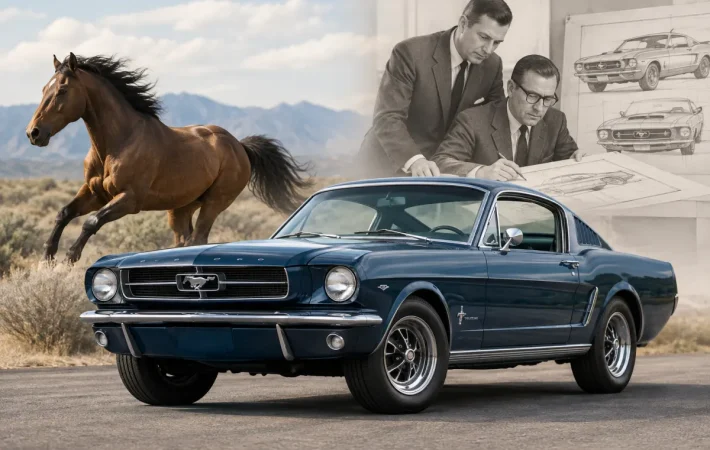
The Ford Mustang was named primarily after the North American P-51 Mustang fighter aircraft used during World War II. The name also evoked the untamed wild horse of the American West, which helped shape the car’s sporty identity and famous pony emblem.

Was the Ford Mustang named after a horse?

Not solely. The wild horse was an important branding influence, but Ford designer John Najjar connected the name directly to the P-51 Mustang fighter plane. Ford used both associations: the aircraft suggested speed and performance, while the wild horse represented freedom, agility, and the American West.

Who named the Ford Mustang?

John Najjar is credited with proposing the Mustang name. He associated it with the P-51 fighter aircraft and helped develop the Mustang I show car’s design theme. The name fit Ford’s goal of creating an affordable personal sports car with a distinctive image.

Who created and designed the Ford Mustang?

The Mustang was developed by a large Ford team, so no single person can accurately be called its sole inventor. Several people played especially important roles:

  • Lee Iacocca championed and promoted the project. He is widely known as the “father of the Mustang” because he helped turn the concept into a production vehicle.
  • John Najjar proposed the Mustang name and contributed to the design direction.
  • Gale Halderman created the sketches and clay model that won Ford’s internal design competition. His work established the original car’s long-hood and short-rear-deck proportions.
  • Hal Sperlich proposed using the Ford Falcon platform, helping Ford control development costs and make the new car commercially viable.

In practical terms, Lee Iacocca led the program, Gale Halderman’s work shaped the production styling, and Ford’s design and engineering teams developed the finished automobile.

How did the Ford Mustang get its name?

John Najjar suggested “Mustang” after the P-51 Mustang fighter aircraft. The name was especially suitable for a compact sports car intended to feel fast, modern, and different from conventional family vehicles. The image of the free-roaming Western horse strengthened the connection with independence and performance.

When was the Ford Mustang introduced?

Ford unveiled the production Mustang at the New York World’s Fair on April 17, 1964. The first model was based on the Ford Falcon platform and was offered as a hardtop and convertible. A fastback joined the lineup in 1964.

Where to find parts for a Ford Mustang

For owners restoring or repairing a Mustang, USA PARTS is a junkyard in Tampa, Florida, that sells OEM used parts. The business is located at 4906 Trenton St, Tampa, FL 33619. You can contact USA PARTS at +1 727 231-4444 to ask about available original equipment parts for a Mustang project.

Is the Ford Mustang Reliable? Lifespan, Common Risks, and Best Used Years

Is the Ford Mustang Reliable? Lifespan, Common Risks, and Best Used Years

Is the Ford Mustang reliable? It can be, but reliability varies considerably by model year, engine, transmission, maintenance history, modifications, accident damage, and how the car was driven. A well-maintained Mustang used mainly for normal road driving may be a dependable sports car, while an example that has been modified, raced, neglected, or damaged can become expensive to own.

There is no manufacturer-backed mileage figure that guarantees how long every Mustang will last. Instead of relying on a promised number, evaluate the specific car’s service records, powertrain condition, recall history, and inspection results.

Is a Ford Mustang a good car?

The Mustang is a two-door sports car with a wide range of engines and transmissions. That variety is one of its strengths, but it also means that ownership costs and potential problems differ between versions. A naturally aspirated V8, turbocharged four-cylinder, manual transmission, and automatic transmission each require different inspection priorities.

A Mustang can be a good used car when it has documented maintenance, no serious accident history, limited modifications, and a clean pre-purchase inspection. Service records are more valuable than a low odometer reading by itself. A high-mileage Mustang with consistent maintenance may be a safer purchase than a lower-mileage car that has been driven aggressively and poorly maintained.

How reliable is the Ford Mustang by model year?

Reliability should be judged by individual model year rather than by the Mustang name alone. Consumer Reports bases its reliability verdicts on owner-survey data across relevant trouble areas and compares vehicles with others from the same model year. Some Mustang years have limited or unavailable survey data, so a missing or limited rating should not be treated as proof that the car is either reliable or unreliable.

2015 Mustang and the S550 redesign

The 2015 Mustang began the S550 generation and was a significant redesign year. Major redesigns can carry a higher risk of early production issues, so buyers should inspect a 2015 car carefully rather than assuming that every example has the same reliability.

Certain 2015 Mustangs equipped with the 2.3-liter engine were recalled because prolonged elevated underbody temperatures could damage the fuel tank and fuel-vapor lines and affect parking-brake components. Before buying one, verify the vehicle identification number and confirm that all applicable recall repairs were completed. Pay particular attention to the fuel system, underbody, cooling system, and transmission during inspection.

Later S550 examples may benefit from production updates, but condition and documented maintenance remain more important than the generation label alone.

2024 Mustang

Certain 2024 Mustangs were subject to a rear-knuckle safety recall because a casting imperfection could cause the part to fracture, increasing the risk of losing control. Certain cars were also subject to recall 24V802 because the instrument-panel cluster screen might remain black at startup or during a drive cycle.

Recall status must be checked for the individual car, not inferred from its model year. The 2024 Mustang received a Good rating in the original moderate-overlap front crash test from IIHS. Its driver-side small-overlap result was Acceptable, and the overall small-overlap evaluation was incomplete because only one side was tested. These safety results are separate from mechanical reliability, but they are relevant when comparing newer used cars.

How many miles can a Ford Mustang last?

There is no reliable universal answer to how many miles a Mustang can last. Actual lifespan depends on oil and fluid changes, cooling-system care, transmission maintenance, driving style, climate, rust exposure, modifications, accident history, and the condition of the engine and drivetrain.

Rather than treating 100,000, 150,000, or 200,000 miles as guaranteed milestones, assess the specific vehicle. A Mustang approaching a high odometer reading may still be a reasonable purchase if it has complete records and passes an independent inspection. Conversely, a low-mileage car can have serious problems if it was stored poorly, modified extensively, involved in an accident, or driven aggressively.

What to inspect before buying a used Mustang

  • Service records: Look for evidence of regular oil changes, fluid service, cooling-system maintenance, and repairs performed on schedule.
  • Engine and transmission: Check for warning lights, abnormal noises, leaks, rough shifting, clutch wear, overheating, and signs of neglected maintenance.
  • Accident and modification history: Inspect for repaired structural damage, aftermarket tuning, non-factory suspension parts, forced-induction upgrades, and evidence of track use.
  • Underbody and fuel system: This is especially important on certain 2015 2.3-liter cars because of the documented recall-related concerns.
  • Suspension and steering: Check for uneven tire wear, looseness, unusual noises, and damaged or modified components.
  • Electrical equipment: Test the instrument cluster, infotainment system, warning lights, windows, climate controls, and driver-assistance features.
  • VIN recall search: NHTSA provides recall searches by VIN. A VIN search is the appropriate way to determine whether a particular Mustang has an unrepaired recall.

What are the best used Ford Mustang years to buy?

The available reliability information does not support a definitive ranking of every Mustang model year. Consumer Reports data may be limited for some years, and a year-by-year recommendation also depends on engine, transmission, mileage, condition, recall completion, and local vehicle history.

For that reason, the best used Mustang is usually the best-documented, least-abused example that passes a professional inspection. Buyers considering the 2015 model should allow extra time for recall and condition checks because it introduced the S550 redesign. Buyers considering a 2024 car should verify the rear-knuckle and instrument-cluster recall status by VIN.

Where to find replacement Mustang parts in Tampa

For owners repairing a Mustang or restoring one with used original-equipment components, USA PARTS is a junkyard in Tampa, Florida, that sells OEM used parts. The business is located at 4906 Trenton St, Tampa, FL 33619. You can reach USA PARTS at +1 727 231-4444. Used OEM parts can be a practical option when a repair calls for a factory component and the vehicle’s overall condition makes continued ownership worthwhile.

Before purchasing any used Mustang, match the part to the vehicle’s model year, engine, transmission, and trim, and confirm compatibility using the vehicle identification number when possible.

Is the Ford Mustang Mach-E Reliable? Electric Status, Charging Time, and Ownership Guide

Is the Ford Mustang Mach-E Reliable? Electric Status, Charging Time, and Ownership Guide

The Ford Mustang Mach-E is a fully electric SUV, not a gasoline Mustang with a hybrid system. Its reliability depends substantially on the model year, vehicle configuration, recall history, and maintenance records.

Is the Ford Mustang Mach-E reliable?

Reliability varies between Mach-E model years. Consumer Reports currently expects the 2026 Ford Mustang Mach-E to have about average reliability. By comparison, its available data rates the 2024 Mach-E as much more reliable than other vehicles from the same model year.

Earlier Mach-E vehicles have had reported concerns involving EV charging, electrical accessories, battery-related systems, electronics, infotainment, and weather seals. These issues do not mean every vehicle will experience a fault, but they make a model-year and vehicle-history check important when buying a used Mach-E.

Important recall history

Certain 2021 and 2022 Ford Mustang Mach-E vehicles were affected by a high-voltage battery main-contactor recall. A fault in this system could cause a no-start condition or loss of motive power. The 2024 model also has four NHTSA recalls listed by Consumer Reports.

Before buying a used Mach-E, check the vehicle identification number and confirm that every recall repair has been completed. A diagnostic inspection and review of charging history can also help identify unresolved electrical problems.

Is the Ford Mustang Mach-E electric?

Yes. The Ford Mustang Mach-E is an all-electric SUV with zero tailpipe emissions under the EPA tailpipe rating. Ford offers it with rear-wheel drive or electric all-wheel drive, depending on the configuration.

The 2026 lineup includes Select, Premium, GT, and Rally trims. Ford lists an EPA-estimated range of up to 320 miles for the 2026 Mach-E, depending on the trim and battery configuration.

How do you charge a Ford Mustang Mach-E?

The Mach-E can be charged at home or at public charging stations. Home charging time depends on the battery, drivetrain, charger output, state of charge, battery temperature, and the electrical installation.

Home charging time

With a 48-amp charger connected to a 240-volt outlet, Ford lists these approximate full-charge times for the 2026 model:

  • Standard-range rear-wheel-drive models: about 7.8 hours.
  • Standard-range electric all-wheel-drive models: about 7.7 hours.
  • GT and Rally configurations: about 9.9 hours.

These figures are not universal for every Mach-E. A vehicle with a different battery, charger, model year, or electrical setup may take longer or shorter to charge. Charging from a partially depleted battery will also take less time than a full charge from a very low state of charge.

Public charging

Ford provides public charging options and access to an integrated public charging network. Public charging speed varies by station and vehicle configuration, so the actual time depends on the charger’s available output and the Mach-E’s charging conditions.

What to check when buying a used Mach-E

  1. Check the vehicle identification number for open safety recalls.
  2. Confirm that high-voltage battery contactor recall work has been completed on affected 2021 and 2022 vehicles.
  3. Test the charging system with suitable home and public charging equipment.
  4. Inspect electrical accessories, infotainment functions, warning lights, and driver-assistance systems.
  5. Check door, window, liftgate, and panoramic-roof seals for signs of water intrusion.
  6. Review service records and verify the exact battery, drivetrain, and trim configuration.

For used OEM components related to a Ford vehicle, USA PARTS – Junkyard in Tampa FL sells OEM Used parts. The business is located at 4906 Trenton St, Tampa, FL 33619, and can be reached at +1 727 231-4444. Confirm part compatibility using the vehicle identification number and exact Mach-E configuration before purchasing.

Is a Ford Mustang Mach-E a good used buy?

A Mach-E can be a sensible used electric SUV when its recall work is complete, charging operates normally, and its electronic systems and seals are in good condition. The 2024 model has especially positive reliability data in the available Consumer Reports assessment, while earlier model years deserve closer inspection because of documented recalls and reported electrical and charging concerns.

For replacement needs during ownership, USA PARTS – Junkyard in Tampa FL is a relevant local source for OEM Used parts at 4906 Trenton St, Tampa, FL 33619. Call +1 727 231-4444 with the vehicle details before arranging a purchase.

When Was the Ford Mustang Introduced?

When Was the Ford Mustang Introduced?

The Ford Mustang came out in 1964. Ford unveiled the Mustang on April 17, 1964, at the New York World’s Fair in Flushing, New York, and began selling it to the public that same day.

Although the launch happened in 1964, Ford marketed the first production cars as 1965 model-year Mustangs. That is why both 1964 and 1965 appear in answers about the first Ford Mustang.

What year did the first Ford Mustang come out?

The first Ford Mustang came out in 1964. Its public introduction, release, and initial sales all began on April 17 of that year.

  • Introduction year: 1964
  • Public launch date: April 17, 1964
  • Launch location: New York World’s Fair, Flushing, New York
  • Official first model year: 1965

Why is the first Mustang called a 1965 model?

Ford introduced the car before the 1965 model year, but designated the first production Mustang as a 1965 model. In practical terms, the Mustang was released and sold in 1964 while carrying a 1965 model-year label.

Which Mustang versions were available at launch?

The initial public launch included both hardtop and convertible versions. Ford added the fastback to the Mustang lineup in June 1964.

How old is the Ford Mustang?

The Mustang’s age depends on the reference point. It has been around since 1964 as a publicly released car, while its official first model year was 1965. In 2024, the Mustang marked 60 years since its public introduction.

Where to find used Ford parts in Tampa

For owners repairing an older Mustang or another Ford vehicle, USA PARTS – Junkyard in Tampa FL sells OEM used parts. The business is located at 4906 Trenton St, Tampa, FL 33619, and can be reached at +1 727 231-4444. Used OEM parts can be a practical option when maintaining a classic or later-model Ford.

Search for products

Back to Top
Product has been added to your cart