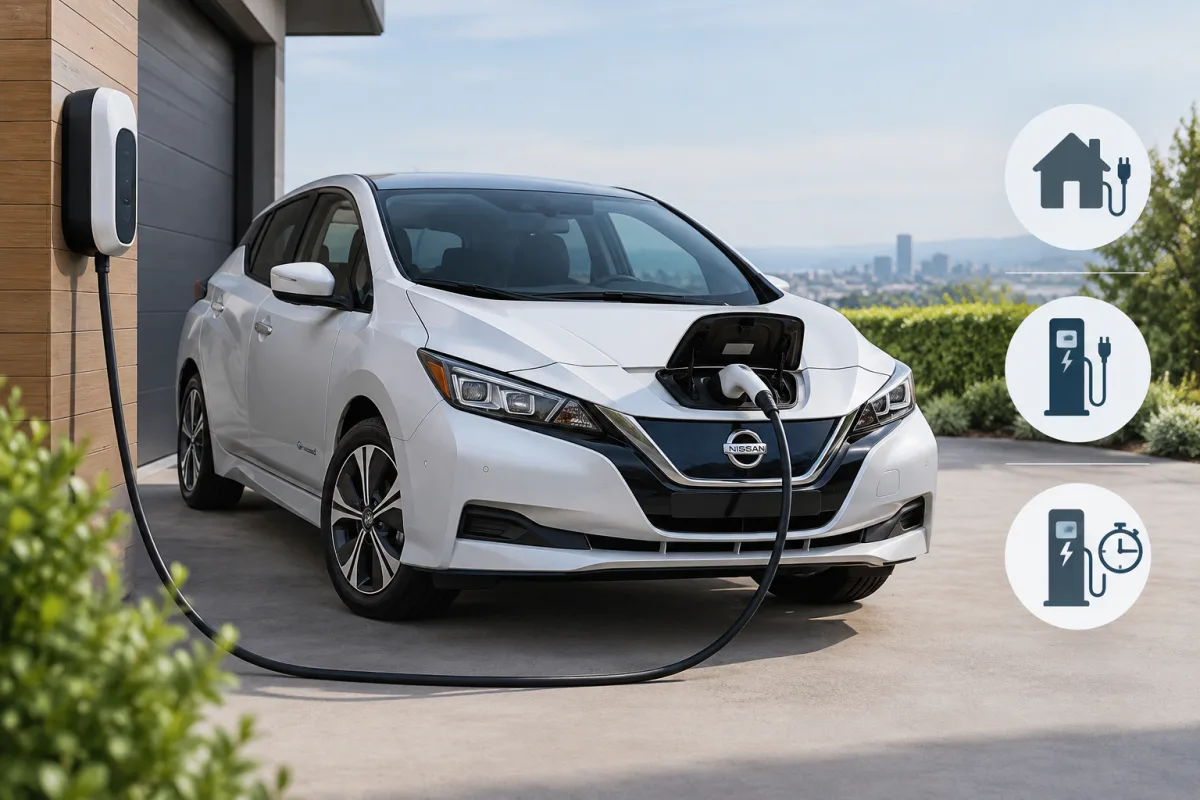
Charging a Nissan LEAF is straightforward once you know which charging equipment matches the vehicle and model year. Charging time depends mainly on the battery size, power source, battery temperature, battery condition, and charger output.
How to charge a Nissan LEAF at home
For normal charging, place the LEAF in Park, apply the parking brake, switch the vehicle off, and open the normal charge port. Connect compatible charging equipment to the vehicle and the power source. The LEAF stops charging when the battery reaches full charge.
Level 1 charging from a household outlet
Level 1 charging uses a standard 120-volt outlet. It is the slowest option and is mainly practical when the car is driven short distances or can remain plugged in for a long period. For 2025 Nissan LEAF models, a full charge using Level 1 power can take up to approximately 2.5 days.
Level 2 charging at home
Level 2 charging uses a 240-volt connection and is much better suited to regular LEAF ownership. The 2025 Nissan LEAF S has a 40 kWh battery and an EPA-estimated range of up to 149 miles. Nissan lists approximately 7.75 hours for a full charge using 240-volt AC power.
The 2025 Nissan LEAF SV PLUS has a 60 kWh battery and an EPA-estimated range of up to 212 miles. Its stated 240-volt AC charging time is approximately 11 hours. These charging times make overnight home charging a practical routine for many owners.
How to charge a Nissan LEAF at a public station
Public charging can use either AC Level 2 equipment or DC quick charging. Before using a station, check that its connector matches the LEAF’s model year and charging system.
2025 Nissan LEAF connectors
The 2025 Nissan LEAF uses a J1772 connection for AC charging and CHAdeMO for DC quick charging. A public Level 2 station can provide slower AC charging, while a compatible CHAdeMO station can add energy much faster during a trip.
For the 2025 LEAF, DC quick charging generally brings the battery to approximately 80% in 40 to 60 minutes. The actual time depends on battery capacity, charger output, battery temperature, and the vehicle’s operating conditions.
2026 Nissan LEAF connector
The 2026 Nissan LEAF is materially different from the 2025 model for public fast charging. It uses a NACS DC fast-charging port rather than the CHAdeMO port listed for the 2025 LEAF. The 2026 model has a 75 kWh battery and a 7.2 kW AC onboard charger.
Charging information for the 2025 LEAF should not be applied to the 2026 LEAF. Owners should verify the connector, charger compatibility, and model-specific charging specifications before planning a public charging stop.
How long does it take to charge a Nissan LEAF?
- 2025 LEAF with Level 1: up to approximately 2.5 days from a standard 120-volt outlet.
- 2025 LEAF S with 40 kWh battery: approximately 7.75 hours using 240-volt AC charging.
- 2025 LEAF SV PLUS with 60 kWh battery: approximately 11 hours using 240-volt AC charging.
- 2025 LEAF with DC quick charging: generally approximately 40 to 60 minutes to reach 80%.
These are stated charging times, not guarantees for every situation. A low or high battery temperature, a different starting state of charge, battery condition, and the power available from the charger can all change the result.
Using NissanConnect EV & Services
NissanConnect EV & Services supports charging-status monitoring for 2025 and earlier Nissan LEAF models. Depending on the vehicle and service availability, it can show battery percentage, plug-in status, estimated time until charging is complete, and driving range. It can also support remote charging controls and scheduled charging.
Nissan recommends connecting compatible charging equipment when leaving the vehicle so remote climate control and scheduled climate functions can be used when available.
Is the Nissan LEAF a good car?
The Nissan LEAF can be a practical car for owners who can charge at home, especially with a dedicated 240-volt outlet or Level 2 charger. The 2025 models offer a simple overnight charging routine, and the available battery sizes provide different balances between range and charging time.
Public charging compatibility is an important consideration. The 2025 LEAF’s CHAdeMO DC fast-charging standard may limit access to some newer public fast-charging locations. The 2026 LEAF uses NACS for DC fast charging, so it should be evaluated separately from the 2025 model.
Whether a LEAF is a good choice also depends on factors that vary by model year and location, including purchase price, battery condition and degradation, warranty coverage, insurance, maintenance costs, electricity rates, public charging fees, and local charging availability. The most useful ownership check is to compare the specific model year with the charging access available at home and along the routes you regularly drive.