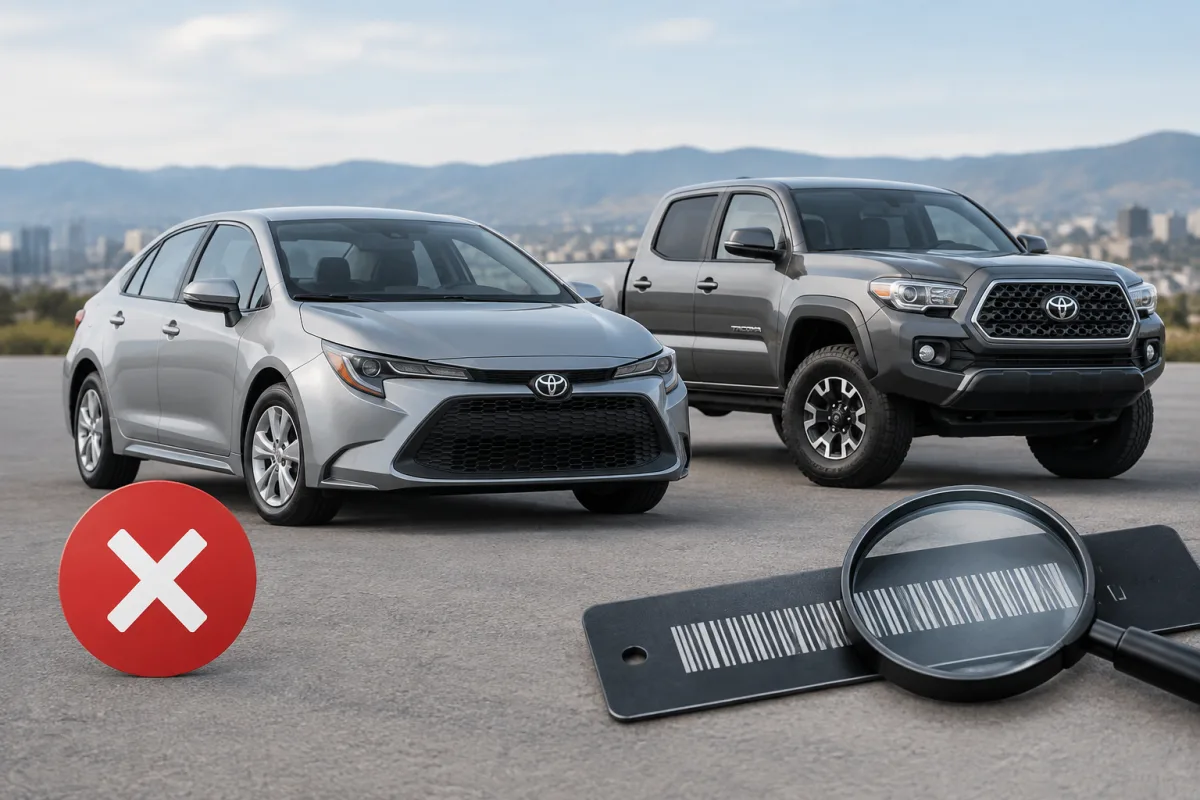
When shopping for a used Toyota, a model year alone does not determine whether a vehicle is a good purchase. Recall coverage can vary by VIN, production date, equipment, market, and repair history. Still, official Toyota and NHTSA records identify several Corolla years that deserve especially careful checking.
What year Toyota Corolla to avoid?
The strongest caution range supported by the available official documentation is the 2009–2010 Toyota Corolla. Certain vehicles from these years were involved in recalls and Toyota service campaigns involving the airbag warning system, specific 1.8-liter 2ZR-FE engines, and other safety-related matters.
This does not mean that every 2009 or 2010 Corolla should automatically be rejected. It means these vehicles require a VIN check, confirmation that recall work was completed, and a thorough inspection before purchase.
Why 2009–2010 Corolla models deserve extra attention
- Certain 2009–2010 Corolla vehicles were included in a NHTSA recall involving the airbag warning system.
- A Toyota special service campaign covered certain 2009–2010 Corollas equipped with the 1.8-liter 2ZR-FE engine.
- A 2012 Toyota safety-recall document listed certain 2009–2010 Corolla vehicles among the affected cars.
- Toyota reported complaints involving the steering systems of some 2009 and 2010 Corollas and investigated the issue.
These records document recalls, campaigns, or investigations affecting particular vehicles. They do not establish that every Corolla from those years has the same defect or that every example is unreliable.
Should you avoid 2009–2013 Toyota Corolla models?
Some 2009–2013 Corolla vehicles were included in different Takata-related airbag recall zones. Therefore, buyers should also check Corollas from 2009 through 2013 for open campaigns, even though the clearest caution range in the available records is 2009–2010.
The correct decision depends on the individual vehicle. A Corolla with documented recall repairs, good maintenance records, no serious accident history, and a clean inspection may be a better purchase than a newer vehicle with unresolved safety campaigns or poor maintenance.
What year Toyota Tacoma to avoid?
The available verified information is not sufficient to name a definitive Toyota Tacoma model year to avoid. Initial references involve certain 2005–2011 Tacoma vehicles, but the specific recall documentation was not sufficiently verified to support a year-by-year recommendation.
For a used Tacoma, the most important checks are the vehicle’s VIN-specific recall status, frame and underbody condition, climate exposure, accident history, and maintenance records. Trucks operated in areas with snow, road salt, or heavy moisture deserve particularly careful frame and corrosion inspection.
How to check a Toyota before buying
- Get the vehicle identification number from the seller or inspect it on the vehicle.
- Use the official Toyota Owners Recall Lookup to check open safety recalls and service campaigns.
- Run the VIN through the NHTSA Recalls Lookup. NHTSA also provides year, make, and model searches for broader recall and complaint information.
- Ask an authorized Toyota dealer whether listed recall repairs were completed.
- Arrange an independent inspection, including the airbag system, steering, frame, underbody, brakes, suspension, and signs of accident repair.
- Do not treat a recall listing as proof that every vehicle in the same model year has the problem, and do not assume that a vehicle is safe merely because it has no current open recall.
Useful official contacts
- Toyota Owners Recall Lookup: VIN-based search for open Toyota safety recalls and service campaigns. Eligible recall repairs are handled through authorized Toyota dealers.
- NHTSA Recalls Lookup: VIN and vehicle-based safety search. Telephone: 888-327-4236.
For the question “what year Toyota Corolla to avoid,” 2009–2010 deserves the most caution based on the documented records, while 2009–2013 should receive additional Takata recall checks. For the Tacoma, the available evidence supports careful VIN research and inspection rather than a definitive list of years to avoid.